(WorldFrontNews Editorial):- Wenzhou, Zhejiang Apr 21, 2026 (Issuewire.com) – Is your production line struggling to maintain freshness and structural integrity across diverse food products?
In the competitive landscape of modern food processing, a “one-size-fits-all” approach to packaging often leads to inefficiencies, increased waste, and compromised quality. As global supply chains demand longer shelf lives and more sustainable practices, the role of a Custom Vacuum Sealing Machine has shifted from a luxury to a technical necessity. Wenzhou Dajiang Vacuum Packaging Machinery Co., Ltd. (DJPACK) addresses these challenges by integrating decades of engineering expertise with a flexible manufacturing model designed to solve the unique biological and logistical hurdles of food preservation.
Navigating the Complexity of Modern Food Packaging Requirements
The transition from standard packaging to precision-engineered solutions is driven by the multifaceted nature of today’s food products. Manufacturers no longer deal with uniform items; instead, they face a spectrum of variables that dictate how a product must be sealed to remain viable and appealing to consumers.
One of the primary drivers for customization is the disparity in production scales and batch sizes. A high-volume meat processing facility requires a fully automated, high-speed belt-type vacuum sealer to maintain output, whereas a specialty cheese producer or a boutique deli may require a double-chamber system that allows for manual precision and diverse cycle settings. DJPACK addresses this by scaling machine architecture–such as chamber depth, seal bar length, and pump capacity–to match the specific spatial constraints and throughput targets of the client.
Precision Selection: The Technical Divergence of Vacuum vs. Skin Packaging
Understanding the physical properties of food is essential for selecting the correct atmospheric extraction method. While both technologies share the fundamental goal of removing oxygen to inhibit aerobic bacteria and enzymatic spoilage, their mechanical application, film interaction, and visual results differ significantly to suit varying food textures and retail requirements.
Vacuum Packaging (Standard): The Industrial Workhorse
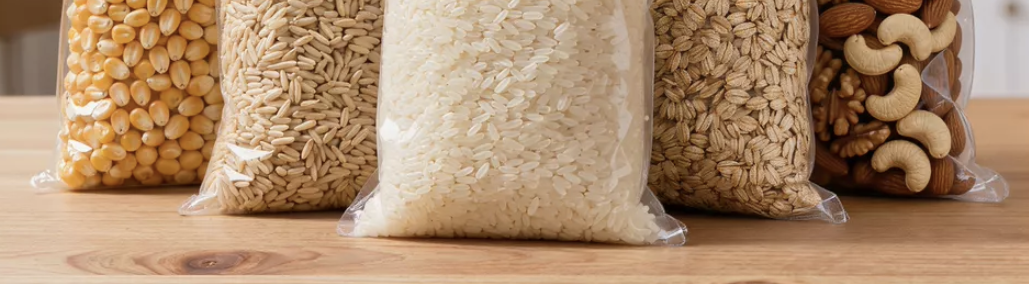
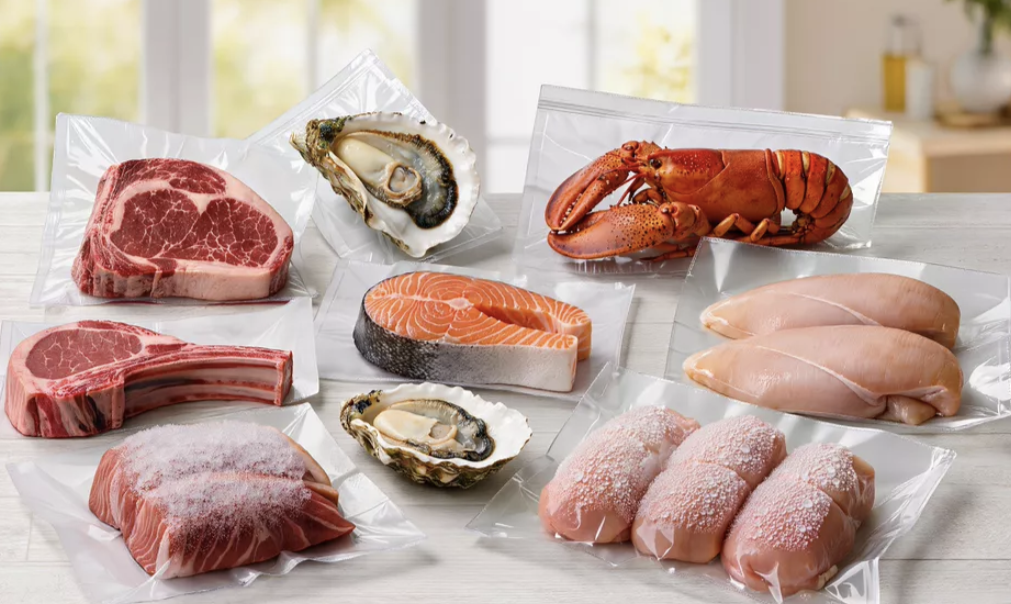
Standard vacuum packaging remains the most versatile and cost-effective solution for a broad array of products, ranging from dry bulk grains and nuts to frozen primal meat cuts. The process involves placing the product inside a high-barrier prefabricated pouch, evacuating the air from the entire chamber, and then hermetically sealing the bag.
Because the air is removed from the surrounding space, the external atmospheric pressure causes the flexible film to collapse tightly and uniformly around the product. This “tight-wrap” effect is highly efficient for industrial logistics; it minimizes the physical footprint of the goods, allowing for higher density in shipping containers and cold storage. Furthermore, standard vacuum pouches offer a rugged, puncture-resistant barrier that is essential for bone-in products or items that undergo rigorous handling during global transit. It is the gold standard for manufacturers who prioritize maximum shelf-life extension and physical protection in a high-volume, low-margin environment.
Vacuum Skin Packaging (VSP): The Premium Aesthetic Solution
In contrast, Vacuum Skin Packaging (VSP) represents a more sophisticated marriage of heat and physics. Unlike standard bagging, VSP utilizes a specialized, highly flexible top film–often a co-extruded ionomer or specialized PE–and a rigid or semi-rigid bottom tray. During the cycle, the top film is heated until it reaches a state of high elasticity. As the vacuum is drawn, the film gently drapes over the food item, conforming to every contour and crevice like a “second skin.”
The engineering advantage of VSP lies in its ability to seal the film to the entire unoccupied surface of the tray, not just the edges. This total-surface seal is a critical technical differentiator: it effectively “locks” the product in place, preventing the migration of liquids. For high-end fresh meats or seafood, this eliminates “drip loss”–the unappealing accumulation of blood or moisture inside the package–thereby maintaining the natural texture and color of the food. Moreover, because the film is not “pulling” against the product with the same blunt force as a standard bag, VSP can package irregular shapes and delicate textures without crushing them, providing a premium 3D visual presentation that is tailor-made for high-end retail displays and self-service counters.
Technical Innovation: The Core of Stable Performance
Reliability in vacuum technology is measured by the stability of the vacuum level and the consistency of the thermal seal. Since its founding in 1995, DJPACK has focused on refining the mechanical structure of its equipment to ensure that lower energy consumption does not come at the cost of preservation performance.
Modern DJPACK systems utilize advanced pneumatic components and high-efficiency vacuum pumps. By optimizing the internal piping and valve response times, the machines achieve the desired vacuum degree faster, which reduces the duty cycle of the motor. This structural refinement results in a more stable performance profile, minimizing downtime during peak production seasons. Furthermore, the integration of PLC (Programmable Logic Controller) systems allows for micro-adjustments in sealing temperature and vacuum time, ensuring that every cycle is perfectly tailored to the thickness and material of the specific food-grade film being used.
Enhancing Profitability through Shelf-Life Extension
The primary goal of vacuum sealing in the food sector is the inhibition of aerobic bacteria. Whether it is a tabletop vacuum sealer for a small kitchen or a large-scale automatic tray sealer for an industrial plant, the technology focuses on achieving a residual oxygen level that meets the stringent requirements of the specific food type. By effectively extending the shelf life of perishables, DJPACK helps food producers reduce return rates and expand their geographical distribution range, directly contributing to higher profit margins.
The evolution of vacuum packaging technology reflects a broader shift toward precision engineering and customer-centric design. By focusing on the “quality first, integrity-based” philosophy, Wenzhou Dajiang Vacuum Packaging Machinery Co., Ltd. continues to refine its research and development processes. The goal is not merely to sell a machine, but to provide a comprehensive packaging solution that enhances the client’s brand value and market recognition. Through constant innovation in skin packaging and high-efficiency vacuum technology, DJPACK remains at the forefront of the industry, helping global food partners achieve higher output with lower operational costs.
For more information on customized vacuum sealing solutions, please visit: https://www.djvacpack.com/
This article was originally published by IssueWire. Read the original article here.