(WorldFrontNews Editorial):- Hangzhou, Zhejiang May 6, 2026 (Issuewire.com) – As fashion cycles shorten and customization becomes the norm, international buyers are increasingly looking toward China for technological leadership. Finding a Certified Garment Pattern Cutter Exporter from China is no longer just about sourcing equipment; it is about partnering with an innovator that understands the delicate balance between high-speed production and meticulous accuracy.
This guide explores the essential standards of precision and quality that define industry leaders and how advanced cutting solutions are reshaping the future of garment assembly.
I. Defining Excellence in the Global Cutting Industry
The criteria for selecting a certified exporter have shifted from basic mechanical reliability to integrated intelligent systems. A certified exporter is distinguished by its adherence to international quality management standards and its ability to provide comprehensive technical support across borders. For a company like IECHO (Hangzhou IECHO Science & Technology Co., Ltd.), which operates a massive 60,000-square-meter manufacturing base, excellence is rooted in a robust R&D framework where over 30% of the workforce is dedicated to innovation.
When procurement teams evaluate Chinese exporters, they prioritize suppliers who offer more than just hardware. They seek “Intelligent Cutting Solutions”–systems that can seamlessly bridge the gap between digital design and physical fabric. This requires a deep commitment to quality control, treating it as the cornerstone of corporate survival. Certified exporters implement rigorous occupational health, safety, and environmental management policies, ensuring that the technology produced is not only efficient but also sustainably manufactured.
II. Achieving Precision through Technical Innovation
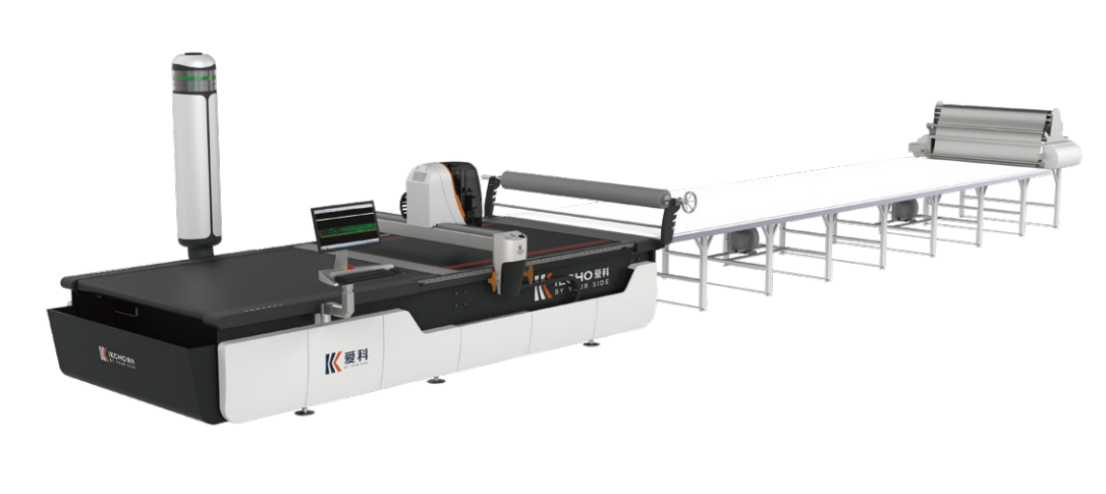
The core of any garment pattern cutter lies in its ability to execute complex geometries with zero margin for error. Precision is not merely a marketing term; it is a measurable output of mechanical engineering and software synchronization. Modern systems, such as the GLSC Automatic Multi-layer Cutting System, exemplify this by utilizing advanced vacuum suction and intelligent knife correction technology.
One of the primary challenges in garment cutting is the displacement of fabric layers during high-speed operations. To combat this, industry-leading machines employ high-frequency vibration motors that can reach speeds of up to 6,000 rpm. This power allows the blade to slice through dense or multiple layers of textile with consistent vertical accuracy. Furthermore, the integration of “Intelligent Cooling” for the knife ensures that synthetic fabrics do not fuse together due to heat friction, maintaining the integrity of every pattern piece.
Beyond the hardware, the software ecosystem is what truly drives precision. The software acts as the brain of the operation, managing the cutting path optimization and ensuring that the machine reacts in real-time to fabric density variations. By utilizing sophisticated algorithms, the software minimizes the gap between patterns (zero-gap cutting), which significantly improves material utilization and reduces waste–a critical factor for high-volume garment exporters.
III. The Workflow: From Digital Pattern to Finished Cut
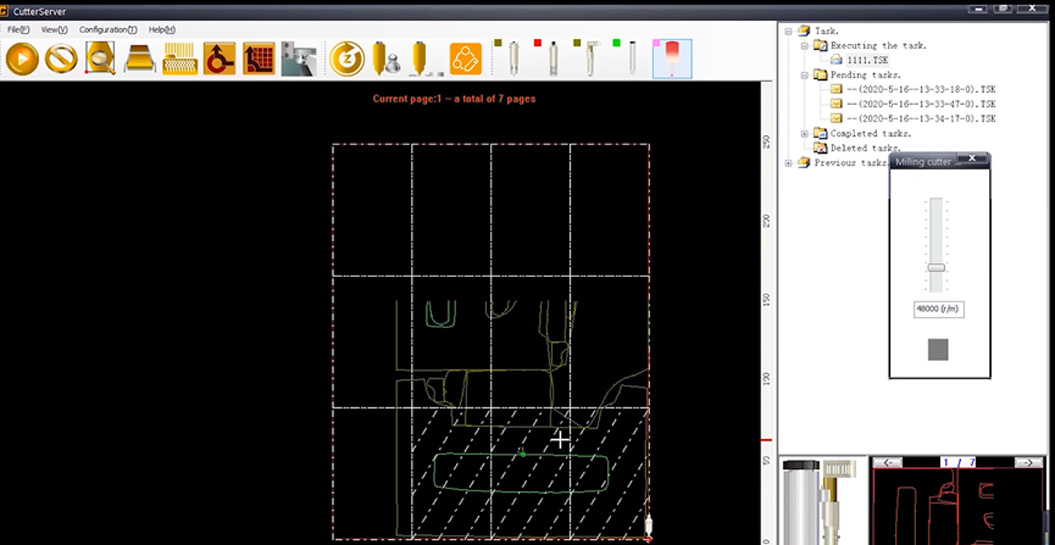
Understanding the complete automated cutting workflow is vital for buyers to identify the production efficiency and Return on Investment (ROI) of a certified system. This process is not a simple mechanical movement but a precise transformation from virtual design to physical reality. The process typically begins with the digital ingestion of patterns; through a dedicated software interface, the system accurately reads various standard CAD files and transmits them to a specialized server for complex logical processing.
- Data Preparation and Path Algorithm Optimization:
In the initial stage, the software plays the role of the “brain.” It not only supports the seamless import of multiple industry-standard formats such as DXF, PLT, and HPGL but also holds core competitiveness in its built-in path smoothing algorithms. The software automatically identifies sharp corners, arcs, and complex curves within the graphics and performs compensation calculations based on the physical characteristics of the tool. Through optimization, the cutting head runs at the most scientific trajectory, avoiding invalid empty strokes. This pre-processing not only shortens the single cutting cycle but also minimizes heat accumulation during the cutting process, ensuring smooth and burr-free edges.
- Material Stabilization and Vacuum Suction Technology:
Once the fabric is laid flat on the cutting table via an automatic spreading machine, a high-power, frequency-controlled vacuum suction system is activated. This is a key step in ensuring cutting accuracy. For multi-layer thick materials, traditional mechanical fixation can easily lead to displacement deviations between the surface and bottom layers. The intelligent vacuum system can adjust the suction intensity in real-time according to the size of the cutting area, tightly compressing multiple layers of material into a stable whole. This technology prevents fabric displacement and ensures uniform force when the blade penetrates the material, guaranteeing 100% consistency in size between the top and bottom patterns.
- Execution and Real-time Dynamic Monitoring:
During the formal cutting process, operators monitor the operation through an intuitive human-machine interface. The system provides real-time feedback on blade speed, cutting depth, and current running coordinates. For fabrics with different textures, such as high-elasticity materials or dense synthetic fibers, the system allows operators to fine-tune parameters without stopping processing. Furthermore, intelligent tool sensors monitor blade wear; if a deviation from the preset resistance value is detected, the system automatically prompts or performs intelligent compensation, ensuring that cutting quality remains consistent even during hours of continuous operation.
IV. Global Service and Market Reliability
The final hallmark of a premier Chinese exporter is its global footprint and service infrastructure. Technical complexity requires reliable after-sales support. Leading suppliers maintain a presence in major manufacturing hubs–ranging from Guangzhou and Hong Kong to overseas distributors in over 100 countries.
A “7 * 24” service hotline and a dedicated operation and maintenance team are no longer luxuries; they are necessities for maintaining uptime in a global supply chain. This service-oriented philosophy ensures that whether a factory is in Southeast Asia, Europe, or the Americas, they receive the same high-quality technical assistance. By redefining intelligent cutting technology through continuous dialogue with global users, China’s certified exporters are not just selling machines; they are empowering the digital transformation of the entire textile industry.
For more information on intelligent cutting solutions, visit: https://www.iechocutter.com
This article was originally published by IssueWire. Read the original article here.