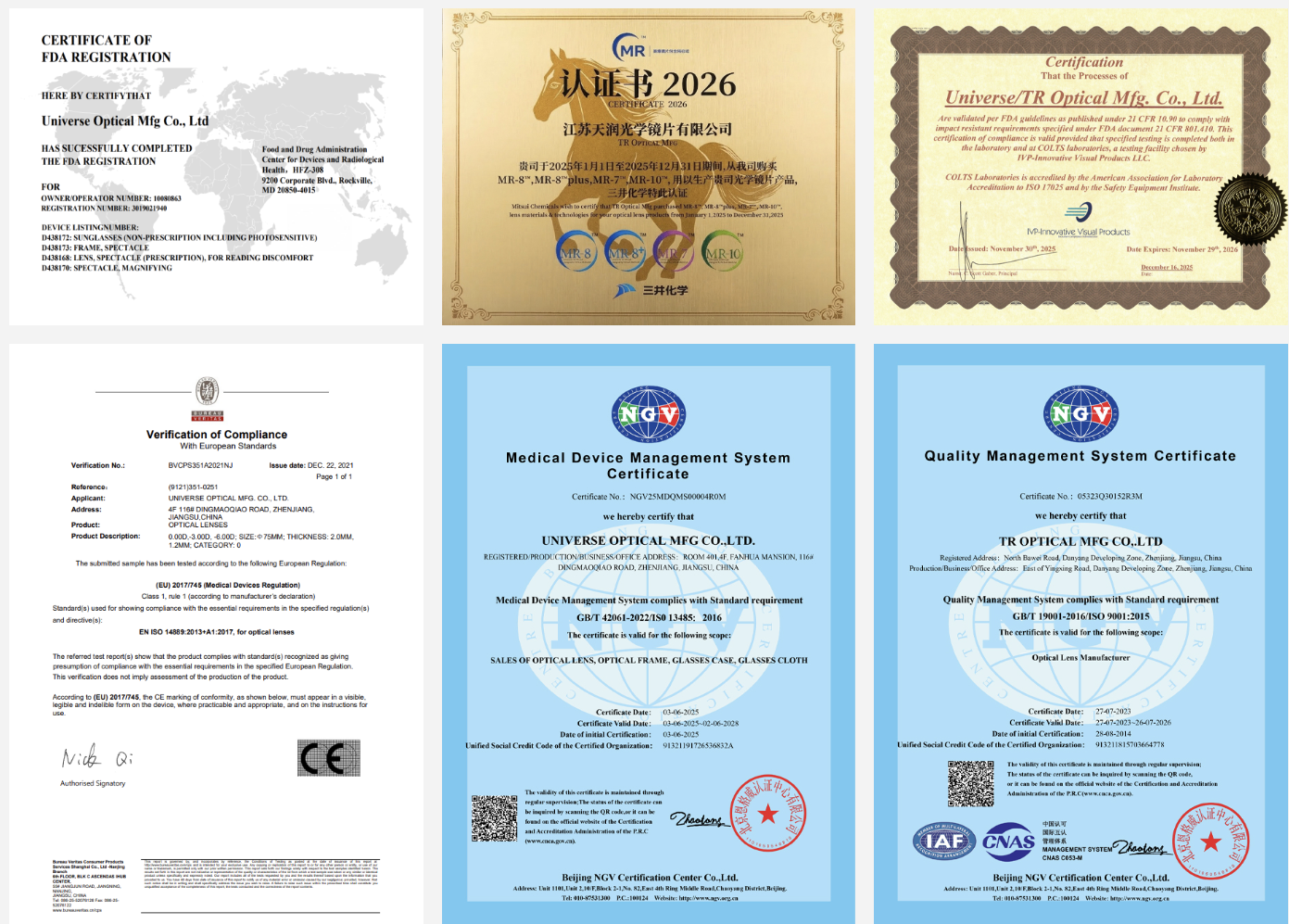
(WorldFrontNews Editorial):- Zhenjiang, Jiangsu May 11, 2026 (Issuewire.com) – What defines a high quality optical lens supplier from China? As the global demand for precision eyewear continues to escalate, discerning international brands are increasingly looking beyond mere manufacturing capacity to evaluate the systemic rigor behind the production line. A premier High Quality Optical Lens Supplier from China is characterized not only by its output but by its adherence to stringent international standards, such as ISO 13485, which governs the consistency and reliability of every optical component produced.
The landscape of Chinese lens manufacturing has evolved from volume-centric production to high-tech, precision-driven engineering. At the forefront of this shift is Universe Optical, an independent manufacturer established in 2001. By integrating German quality benchmarks with advanced automation, the company illustrates how ISO 13485 management transforms raw materials into high-performance optical solutions.
I. Raw Material Integrity and Authorized Sourcing
The foundation of a high-quality lens begins long before the casting process. Under ISO 13485 standards, procurement is a critical component of supplier control and risk management. Quality is dictated by the purity of the monomer and the stability of the chemical composition. Leading suppliers ensure excellence by acting as authorized agents for premium materials, such as PPG’s CR39, ensuring that every batch complies with medical-grade biocompatibility and safety standards.
By maintaining rigorous material traceability and historical records, the production cycle avoids the common pitfalls of yellowing or internal stress often found in lower-tier products. This phase also involves the selection of high-index materials (1.60, 1.67, and 1.74), which allow for thinner, lighter lenses without compromising structural integrity. Each batch of incoming material undergoes refractive index testing and purity checks to ensure it meets the predefined technical specifications required for global export.
II. Precision Surfacing and Digital RX Lab Management
Modern lens production relies heavily on the transition from semi-finished blanks to customized prescriptions. ISO 13485 protocols dictate that the surfacing process must be governed by validated processes and regularly calibrated, high-precision equipment. In a Rodenstock-certified RX lab environment, the integration of Schneider and SCL surfacing systems allows for digital freeform technology. This technology optimizes the back surface of the lens, reducing peripheral distortion and providing a wider field of view for the wearer.
The management of a digital RX lab requires a seamless flow of data between the lens design software and the generator. Each lens is tracked via a unique identifier, ensuring that the specific diopter, cylinder, and axis requirements are executed with micron-level accuracy. This systematic approach eliminates human error and ensures that whether a lens is destined for a domestic clinic or a global eyewear brand, the optical performance remains identical.
III. Advanced Vacuum Coating and Surface Treatment
A significant differentiator in lens quality is the durability and performance of the coating layers. The ISO 13485 framework monitors the controlled environmental conditions of the vacuum chambers–specifically the temperature, humidity, and vacuum pressure–to ensure optimal adhesion and prevent contamination. Utilizing Leybold and SCL coating machines, the production process applies multiple layers of Anti-Reflective (AR) coating, Super Hydrophobic layers, and Blue Light Cut protection.
The technical complexity of these coatings is vital for modern applications. For instance, high-performance lenses must achieve a light transmission rate exceeding 98% while maintaining a low-friction surface that resists smudges and oil. Through rigorous abrasion resistance tests (such as the salt-water boil test and steel wool test), manufacturers verify that the physical properties of the coating can withstand daily wear in diverse climates, from humid tropical regions to dry, high-altitude environments.
IV. Precision Edging and Automated Finishing
The final physical shaping of the lens is where technical innovation meets functional application. Utilizing MEI and Schneider edging systems, the finishing process ensures that the lens geometry perfectly matches the frame specifications. This is particularly critical for high-wrap sports eyewear and specialized industrial safety glasses, where a precise fit is necessary to maintain the protective seal and optical alignment.
ISO 13485 control in this stage focuses on the rigorous validation of the cutting tools and the accuracy of the beveling. A lens that is poorly edged can introduce mechanical stress that leads to cracking or optical aberrations, potentially compromising user safety. By employing automated finishing lines, suppliers can maintain high throughput while ensuring that every lens–whether a standard single vision or a complex progressive–meets the rigorous mechanical tolerances required for high-end eyewear collections.
V. Final Quality Assurance and Global Distribution
The final stage of the ISO 13485 production cycle is a comprehensive Quality Assurance (QA) audit that encompasses both optical power verification and regulatory compliance checks. Every lens is subjected to a “final pass” check using automated lensmeters and high-intensity light inspection to detect minute inclusions, scratches, or coating inconsistencies. This dual-layer inspection–human expertise supplemented by digital precision–is what separates a certified medical device manufacturer from a local manufacturer.
Today, these high-performance solutions are exported to over 100 countries, serving as the backbone for various eyewear applications, including digital device protection, outdoor sports, and professional clinical correction. The ability to maintain these standards consistently while adhering to international medical device regulations has established a new benchmark for Chinese manufacturing, proving that when engineering precision is combined with systemic management, the result is a product that meets the world’s most demanding optical requirements.
For more information on high-precision lens manufacturing and global distribution, visit the official website: https://www.universeoptical.com/
This article was originally published by IssueWire. Read the original article here.