(WorldFrontNews Editorial):- Shenzhen, Guangdong May 31, 2026 (Issuewire.com) – Redefining Cost: The Supply Chain Logic of Market Leaders
Market leaders often evaluate electronics manufacturing through the lens of Total Cost of Ownership (TCO) rather than simple unit price. While traditional procurement models focus on individual component costs, modern industrial leaders prioritize risk mitigation and operational continuity. Selecting a professional turnkey PCB assembly supplier allows organizations to shift the burden of logistics and management toward experts capable of ensuring delivery certainty. Venture Electronics Tech Ltd.(Venture Electronics) serves as a primary example of this shift, integrating design oversight with a robust global supply chain. This approach transforms the traditional administrative overhead of managing multiple vendors into a streamlined path toward product commercialization. By consolidating technical expertise and procurement under one roof, companies can effectively navigate the complexities of modern electronics production.
The Essence of Manufacturing Models: Responsibility and Resource Allocation
Understanding the distinction between consigned and turnkey models is essential for strategic planning. In a consigned arrangement, the client acts as a de facto project manager. The client must maintain internal teams for component sourcing, logistics, and inventory management, while the factory merely provides assembly services. This model demands significant internal resources to manage material shortages or lead-time discrepancies.
Conversely, a turnkey service operates through a lead contractor methodology. Clients provide technical files like Gerber data and Bill of Materials (BOM). Venture Electronics then manages the entire lifecycle from Design for Manufacturing (DFM) analysis to final functional testing. This model includes professional component procurement through authorized channels such as DigiKey and Mouser. By closing the loop between material acquisition and assembly, the turnkey approach removes the friction points typical of fragmented supply chains.
Quantifying the Decision: Four Pillars of Performance
The choice between these models often rests on four critical operational dimensions that define long-term success.
- Time Efficiency and Market Agility
Consigned models frequently suffer from synchronization issues. If a single passive component is delayed or out of stock, the entire production line halts. This leads to missed market windows and wasted assembly capacity. Turnkey providers mitigate these risks through established procurement networks and proactive alternate part management. Venture Electronics supports rapid prototyping with turnarounds ranging from 8 to 48 hours. This speed allows engineers to validate designs quickly and accelerate the transition to full-scale production.
- Invisible Costs and Capital Utilization
While consigned material might appear cheaper on paper, the hidden costs are substantial. Companies must account for specialized labor, shipping fees, storage requirements, and material waste. For instance, sensitive components like BGAs require strict moisture control; improper handling during transport results in high scrap rates. A turnkey model offers transparency. Although it includes a management fee, the total expenditure often decreases due to volume-based pricing and the elimination of inventory carrying costs. This efficiency releases capital for other strategic investments.
- Quality Assurance and Traceability
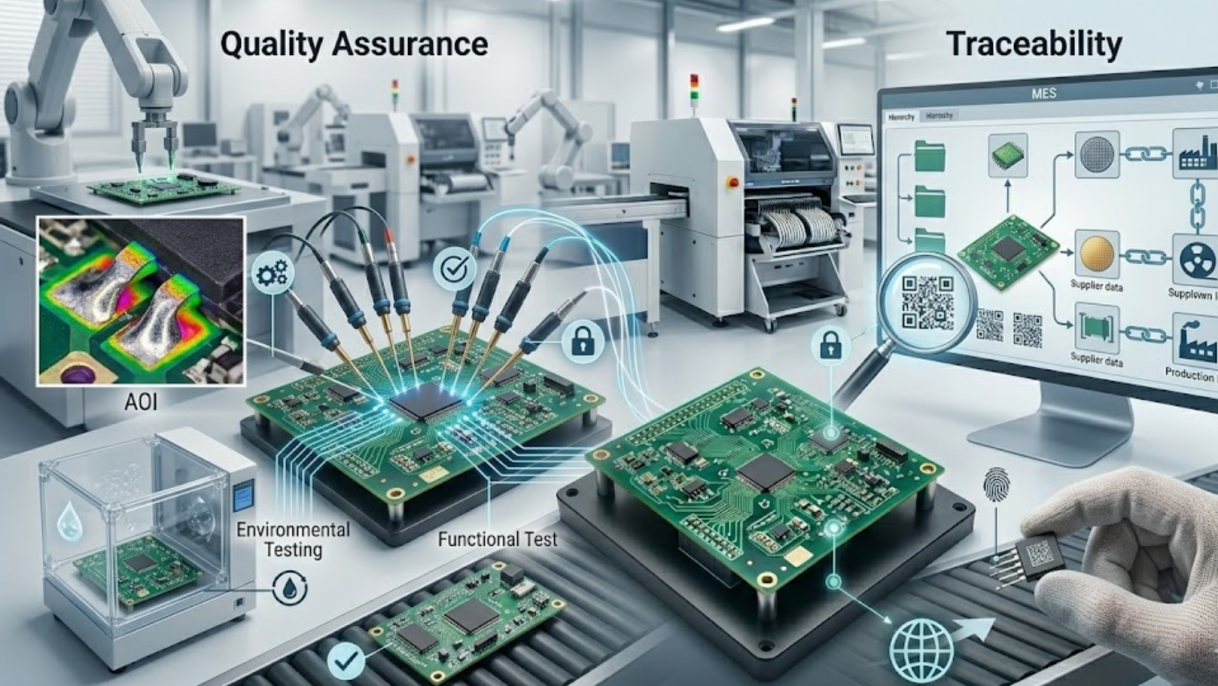
Material integrity remains a significant concern in the electronics industry. Consigned models force clients to bear the full risk of counterfeit or refurbished parts. Managing multiple sub-suppliers makes it difficult to maintain a consistent chain of custody. A professional turnkey partner implements rigorous Incoming Quality Control (IQC) and full material traceability. Venture Electronics utilizes advanced inspection technologies, including 100% X-Ray and In-Circuit Test (ICT), to guarantee the reliability of every joint and component. This creates a single point of accountability for the entire build, ensuring that defects like solder bridges or faulty components are identified before the product leaves the facility.
- Engineering Support and Technical Barriers
Fragmented manufacturing often leaves a gap between design and execution. Without a deep understanding of DFM, clients may inadvertently design boards that are difficult or impossible to assemble efficiently. Turnkey suppliers bridge this gap by providing complimentary DFM reviews and optimization suggestions before production begins. This technical oversight identifies potential errors early, reducing the need for expensive re-spins and ensuring that the final product meets high-precision industrial standards.
Strategic Priorities for Industry Pioneers
Market leaders prioritize Turnkey solutions to maintain a sharp focus on their core competencies. By outsourcing the logistical complexities of PCB assembly, organizations can dedicate more energy to product definition and market expansion. During periods of global component shortages, the procurement leverage of a specialized turnkey partner becomes a vital safeguard for production capacity.
The value proposition extends beyond simple assembly. Advanced capabilities like BGA rework, conformal coating, and the assembly of complex rigid-flex boards meet the stringent requirements of the medical and aerospace sectors. Venture Electronics provides specialized services for harsh environments, including nitrogen vacuum reflow soldering and electronic potting. These technical advantages ensure that industrial equipment operates reliably at temperature extremes from -55°C to 125°C.
Implementation Path: From Model Selection to Project Execution
The transition to a professional turnkey model requires a tiered strategic approach tailored to the product lifecycle. During the Research and Development (R&D) phase, market leaders utilize the “No MOQ” (No Minimum Order Quantity) policies inherent in flexible turnkey services. This allows for rapid prototype iterations to validate both electrical functions and mechanical fit without the burden of excess inventory.
As a project enters the mass production ramp-up stage, a “Partial Turnkey” strategy may be employed based on Bill of Materials (BOM) complexity. In this scenario, clients provide long-lead-time proprietary chips while Venture Electronics manages the procurement of all general components, effectively balancing cost efficiency with supply chain control.
From Contract Factory to Manufacturing Partner
The evolution from traditional outsourcing to a manufacturing partnership represents a fundamental shift in industrial logic. Engaging a turnkey provider is not merely a transaction for labor; it is the integration of a partner with end-to-end supply chain control. This collaboration ensures that technical specifications translate accurately into functional, high-reliability hardware.
Industrial clients seeking to optimize their production cycle should consider starting with small-batch turnkey orders. This allows for a direct evaluation of the seamless transition from design files to finished functional prototypes. By consolidating the supply chain, companies secure a more resilient and scalable manufacturing foundation.
For more information on professional electronics manufacturing services, please visit: https://www.venture-mfg.com/

Media Contact
Venture Electronics Tech Ltd.
+86-0755-85296692
Building 36, Chentian Industrial Area Xixiang, Bao an District, Shenzhen, GuangDong, China
This article was originally published by IssueWire. Read the original article here.