(WorldFrontNews Editorial):- Shenzhen, Guangdong Jun 24, 2026 (Issuewire.com) – Why Density Shows Up in Every Food Plant
Walk into any beverage plant and you will find density measurement somewhere. Usually more than one somewhere. Syrup concentration, juice blending, sugar dissolution, dairy standardization — these are all density-dependent processes, whether the operator calls it that or not.
The reason is practical. Density correlates with soluble solids content in most food liquids. Measure the density and you know the concentration. For syrup manufacturers, that means knowing the Brix value without sending a sample to the lab. For dairies, it means verifying fat content or total solids in real time.
In the old days, plants used hydrometers and manual sampling. A technician dips a hydrometer into a sample cup, reads the scale, writes it down. That still works. But it tells you what the density was twenty minutes ago, not what it is now. Inline density measurement closes that gap.
Brix, Density, and the Correlation That Makes It Work
Brix is a shorthand for soluble solids content, expressed as sucrose mass percentage. A 20 °Bx syrup contains 20 grams of sucrose per 100 grams of solution. The food industry uses Brix as a quality specification, and density is the fastest way to get there.
For pure sucrose solutions, the relationship between density and Brix is well established. The ICUMSA (International Commission for Uniform Methods of Sugar Analysis) tables give you the conversion. Most inline density meters used in food plants are configured to output Brix directly, using that conversion curve.
The conversion is temperature-sensitive. The ICUMSA tables are referenced to 20 °C. If your process runs at 40 °C or 60 °C — common in syrup production — the density reading needs temperature compensation before the Brix conversion is applied. A meter without compensation will read low by roughly 0.3 to 0.5 °Bx per 10 °C of temperature rise.
Sanitary Design Is Not Optional in Food Plants
A density meter in a food plant has to be cleanable. That sounds obvious, but it rules out a lot of industrial instruments that were designed for chemical or oil and gas service.
The wetted surface needs to be smooth — typically 0.8 micrometers Ra or better. Any roughness becomes a place for bacteria to settle. The instrument also needs to withstand Clean-in-Place (CIP) cycles. That means resistance to caustic soda (typically 2-4% NaOH at 60-80°C) and sometimes nitric acid for passivation.
Dead legs are another concern. If the density meter has a cavity where product can stagnate, that spot becomes a microbial growth site. Sanitary designs minimize or eliminate dead legs. The 3A sanitary standard, widely used in North America, specifies that any dead leg should be less than 1.5 times the pipe diameter.
Surface finish matters beyond just smoothness. Electropolishing is common for food-grade instruments. It closes the surface pores of the stainless steel and makes it easier to clean. For dairy applications especially, that electropolished surface also resists adhesion of milk stone and other mineral deposits.
Where Inline Measurement Changes the Process
A beverage plant we worked with was blending syrup and water to make a finished drink. They were sampling the blend tank every 30 minutes and adjusting the syrup ratio based on the lab result. The problem: by the time the lab result came back, the tank had moved on. They were always adjusting for the past, not the present.
After installing an inline density meter on the blend line, the syrup dosing became feedback-controlled. The meter reads the density of the mixed product in real time. If it drifts off specification, the control system adjusts the syrup flow. The batch is correct the first time, every time.
That is the real value of inline measurement in food plants. It is not just about having the number faster. It is about using that number to control the process, not just record it.
How to Specify a Density Meter for Food Applications
Start with the hygiene standard that applies to your plant. 3A, EHEDG, and FDA are the common ones. If you export to the EU, EHEDG compliance matters. If you supply to US retailers, 3A is often required. The density meter needs to carry the right certification, not just claim to be ‘sanitary.’
Accuracy requirement depends on the product. For high-Brix syrup (above 60 °Bx), a density accuracy of ±0.001 g/cm³ translates to roughly ±0.1 °Bx. That is tight enough for most blending applications. For lower-concentration products like milk or juice drinks, the accuracy requirement is often less stringent — ±0.002 to ±0.003 g/cm³ is usually acceptable.
Viscosity matters more than you might think. Honey, concentrated fruit puree, and some dairy products have viscosities that change with temperature and shear. The density meter needs to handle that viscosity range without drift. Vibrating element designs (tuning fork or vibrating tube) typically handle up to 10,000 mPa·s without issue, but verify this against your actual product.
Output and integration. Most food plants want 4-20mA for the density signal and RS485/Modbus for configuration and diagnostics. If the meter feeds into a batching system, make sure the response time is fast enough. A meter with a 10-second response time will not help you control a batch that completes in 5 minutes.
LONNMETER for Food and Beverage Applications
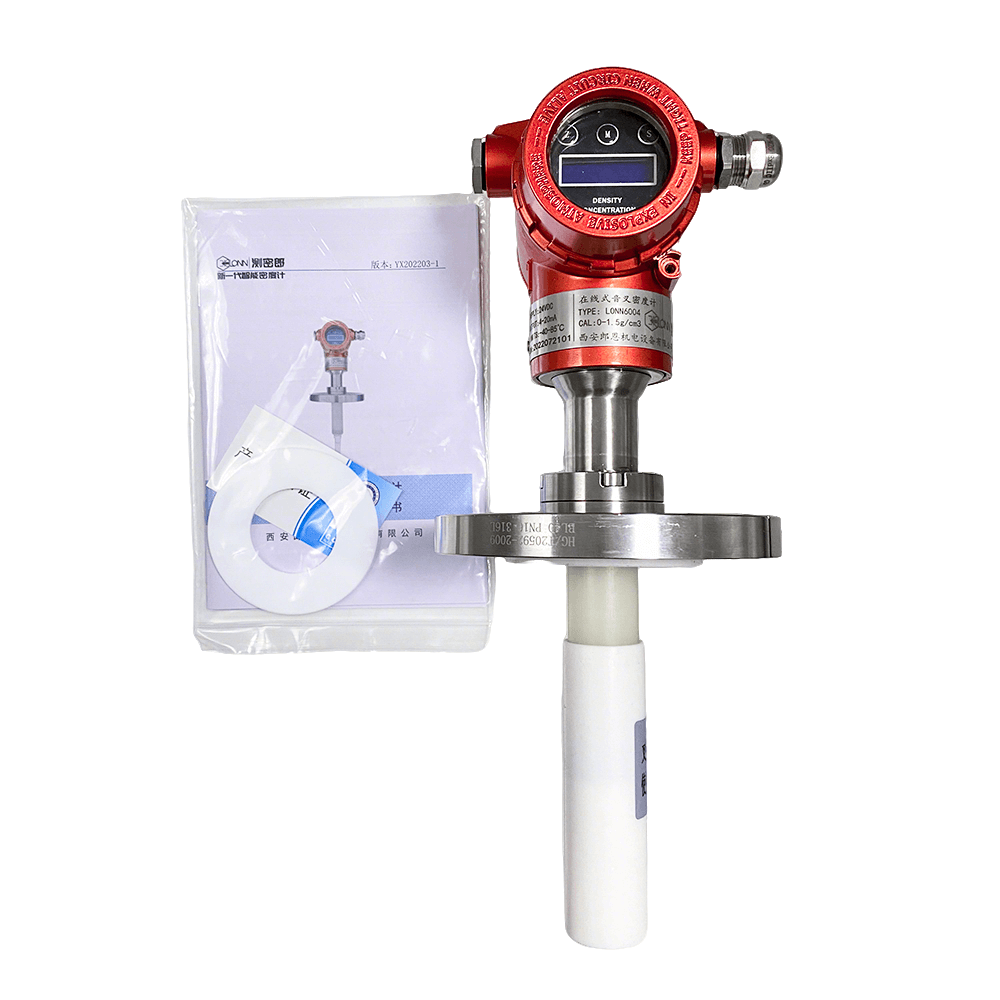
The LONNMETER LONN700 sanitary inline density meter is built for food plant conditions. The wetted parts are 316L stainless steel with electropolished surface finish. The design is CIP-compatible and has no dead legs in the measurement section.
For syrup and sugar applications, the LONN700 is calibrated against the ICUMSA conversion tables, so the output reads directly in Brix. The temperature compensation is configurable, so you can set the reference temperature to match your process or your quality lab standard.
In dairy applications, the same instrument handles the lower density range (1.03-1.05 g/cm³) with the same sanitary design. The output can be configured for degrees Brix, density in g/cm³, or any linear conversion that matches your product specification.
If you are specifying density measurement for a food or beverage application and want to discuss sanitary requirements, calibration approach, or integration with your batching system, the LONNMETER technical team can review your process and recommend a configuration.
This article was originally published by IssueWire. Read the original article here.