Independent archive outlines asymmetric Indian censorship frameworks that delayed the Jaswant Singh Khalra film for three and a half years while government-aligned cinema cleared in weeks.
(WorldFrontNews Editorial):- Fresno, California Jul 4, 2026 (Issuewire.com) – THE TITLE CHANGED, NOT THE RECORD The Death Certificate Project Marks the Uncut Release of Satluj — and Calls for an Honest Reckoning with How India Certifies Cinema That Implicates Its Own Power
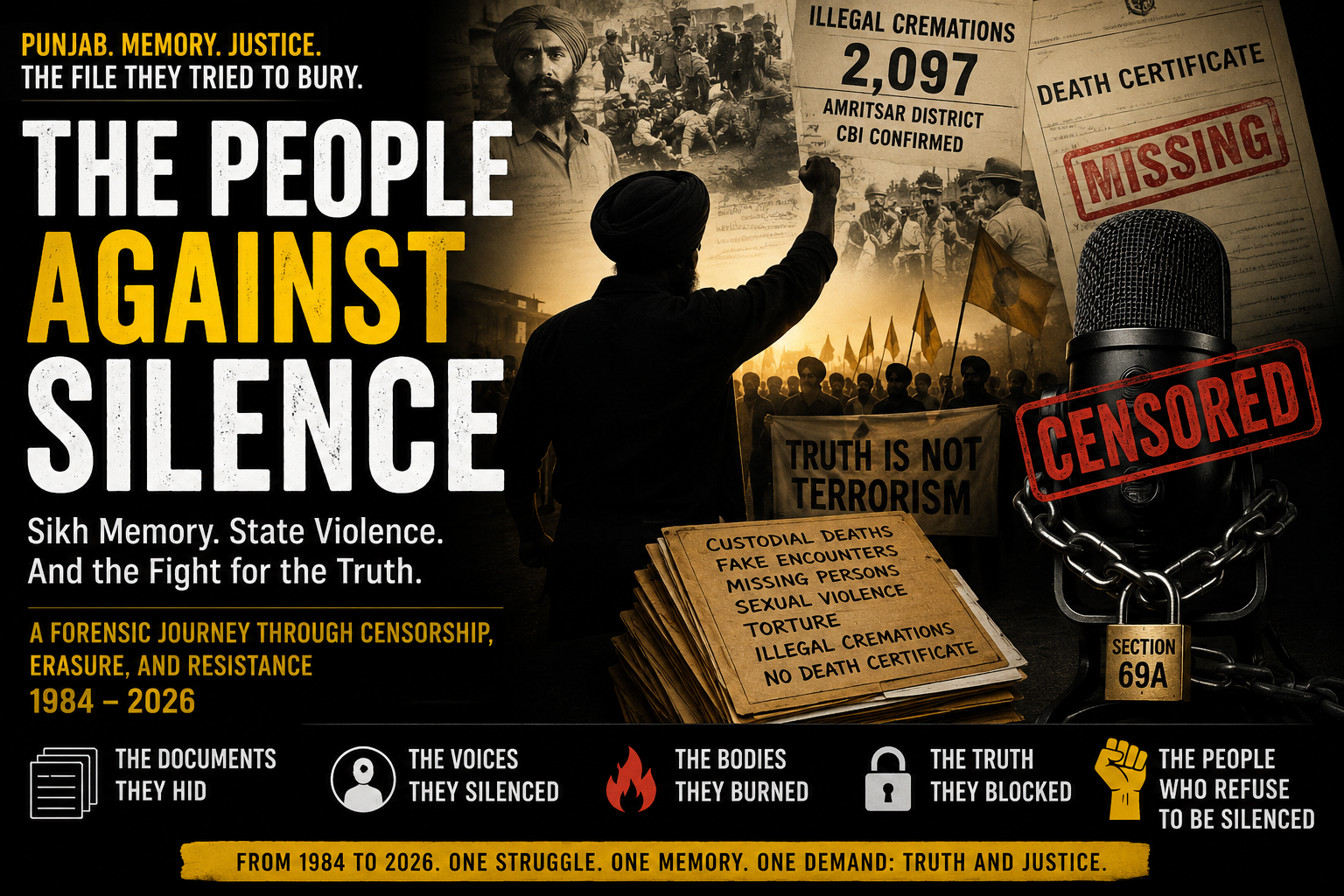
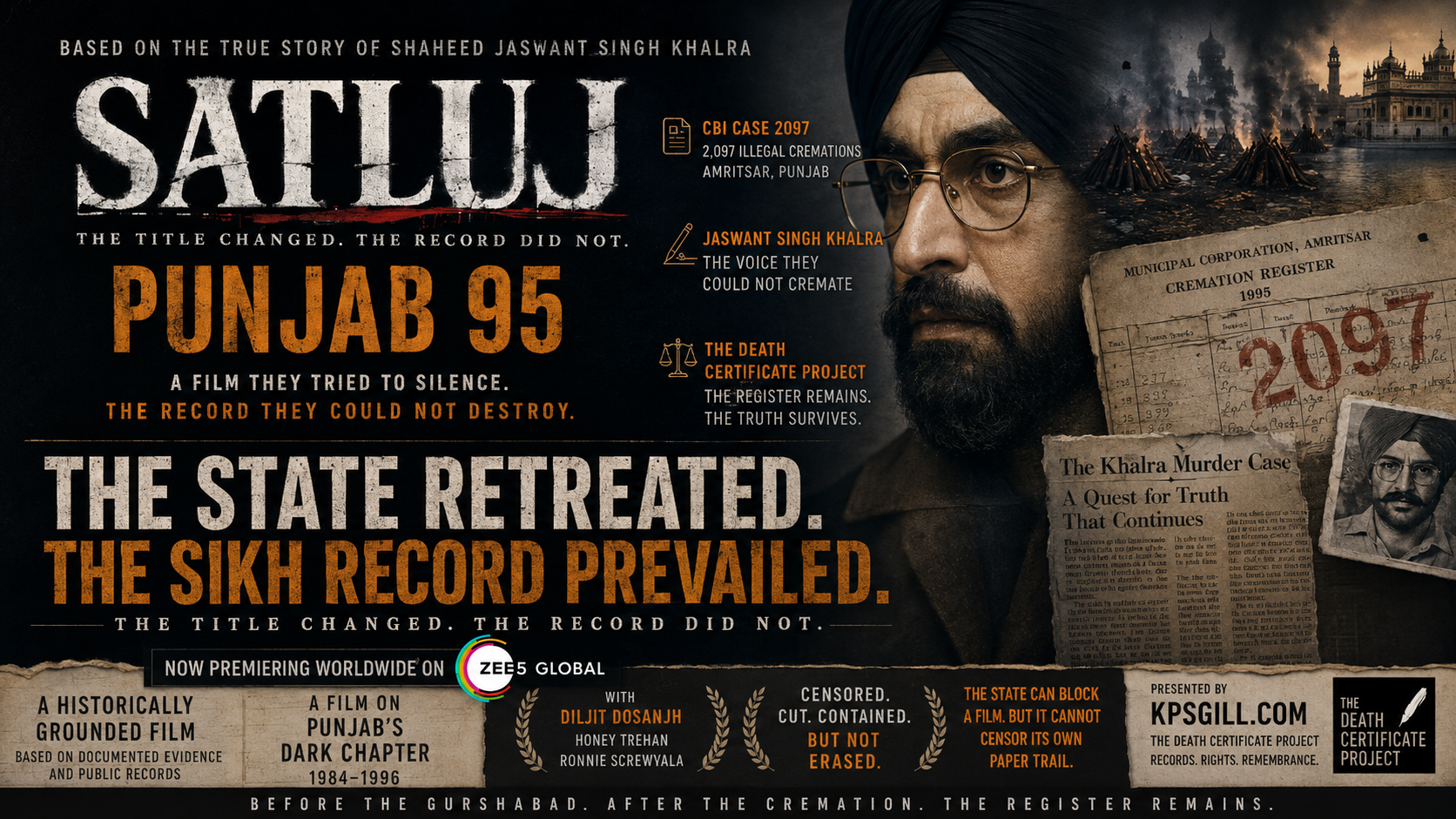
Satluj, the film once titled Punjab ’95 and, before that, Ghallughara, began streaming today on ZEE5 and ZEE5 Global — arriving more than three and a half years after it was first submitted, in December 2022, to India’s Central Board of Film Certification. Directed by Honey Trehan and carried by Diljit Dosanjh in the role inspired by him, the film recounts the life and 1995 killing in police custody of Jaswant Singh Khalra, the Amritsar bank officer whose discovery of municipal cremation registers led investigators to confirm 2,097 illegal cremations in Amritsar district alone. Across a succession of interviews given at different, weary stages of the fight, Trehan has described a certification process that never converged toward a release but kept climbing — a tally of demanded cuts that moved, by various accounts, from 21 to 37 to 45 to 65 to 85 and finally, by most reports, to 127 — among them a demand that the protagonist be stripped of Khalra’s own name, that “Punjab” and “Tarn Taran” be deleted, that Gurbani be excised, that real dates be altered, and that the film disclaim any connection to fact.
The Death Certificate Project, an independent forensic archive that has spent years reconstructing the record of Punjab’s illegal cremations and the administrative silence surrounding them, states its position without ornament: the film lost its title. It did not lose its evidence.
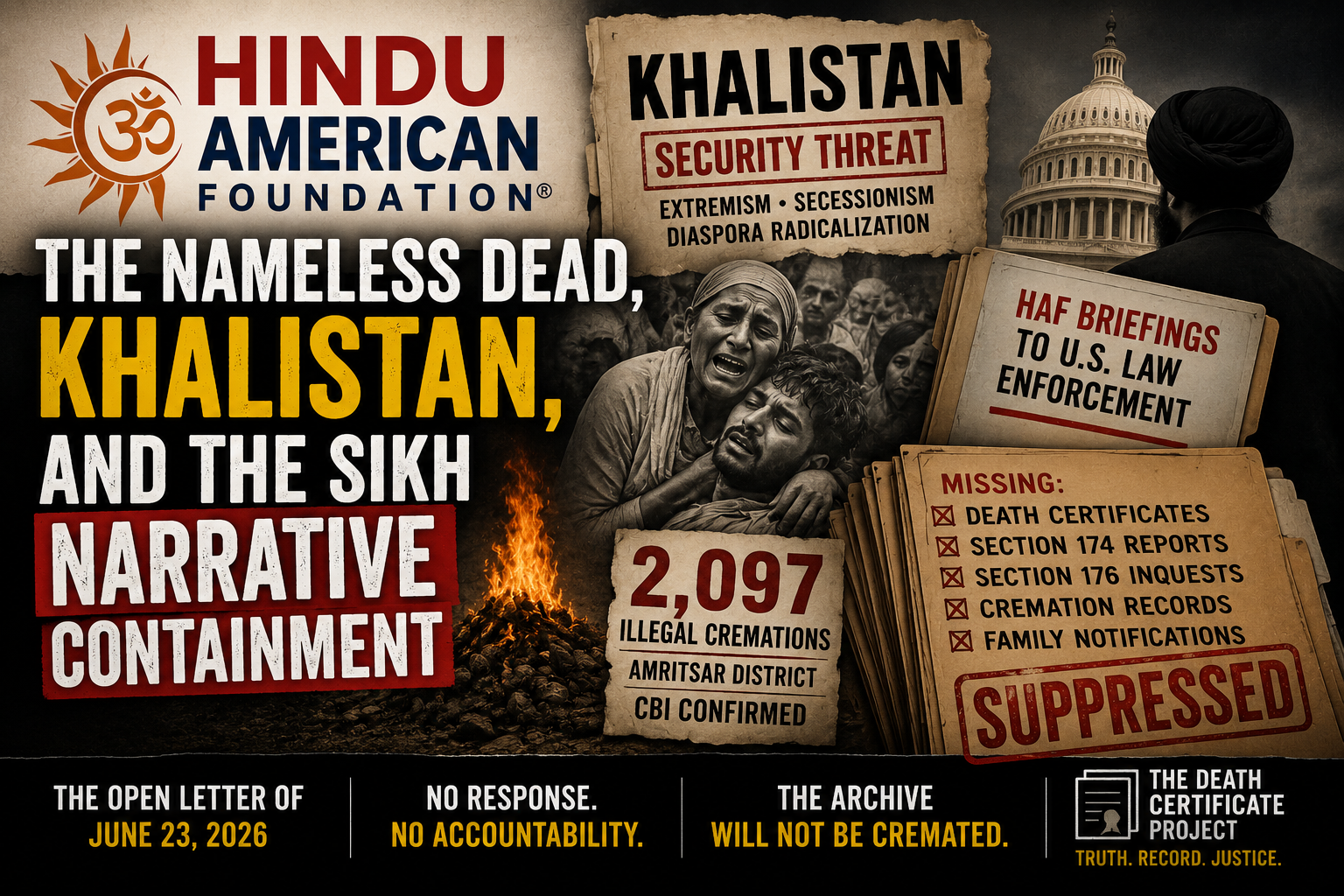
Most people encountering this statement will have arrived from coverage of the film rather than from any prior acquaintance with this Project, and they are owed a plain account of why we are speaking at all. The Death Certificate Project is a non-governmental research archive founded by Dr. Kanwar Partap Singh Gill, a physician, to document a particular failure of the Indian state: the mass, unregistered cremation of bodies by Punjab Police during the insurgency years, and the decades in which no inquest, no register, and no certificate followed. Satluj dramatizes the man who first exposed that failure; this archive has spent years cataloguing it in his wake. In April of this year, months before the film reached a single viewer, an arm of the Indian government sought to have this Project’s own website blocked inside India, under the same statute ordinarily reserved for matters of national security. We do not write about this story from a comfortable remove. We are, in a small but exact sense, one of its exhibits.
We do not claim to have secured this film’s release, shaped its certification, or persuaded ZEE5 to carry it whole. Our claim is narrower, and the more durable one: our written opposition, filed April 29, 2026, to a government notice seeking to block our sister archive, KPSGILL.com, placed the Khalra record inside a live administrative file — one that any future attempt at digital erasure must now openly confront, in writing, rather than quietly execute.
“Satluj is a historic release, but it is also a managed one,” said Dr. Kanwar Partap Singh Gill, founder of The Death Certificate Project. “The film survived, and the evidence survived with it. But the road it was made to travel tells us something serious about how this country certifies history when that history implicates its own police and its own administrators. We did not arrive at this comparison by instinct. We built it, film by film — and it was not one board’s caution. It was a pattern, and the pattern has a shape.”
What follows distinguishes, throughout and without exception, between what has been proven in a courtroom or a government report, what has been alleged by named and credible sources, what this Project infers from the shape of the record, and what the Sikh community has carried as memory long before any tribunal thought to ask.
I. What Happened Today
The film began streaming, domestically and abroad, without a theatrical release and without the title under which it was written — but, according to Trehan, to producer Ronnie Screwvala, and to ZEE5’s own content leadership, without a single cut from the finished work. Diljit Dosanjh leads a cast that includes Arjun Rampal, Kanwaljit Singh, Suvinder Vicky, and Geetika Vidya Ohlyan. The film had once been slated for Toronto in 2023; it was withdrawn amid the certification fight — a withdrawal that occurred, pointedly, in the same country where Khalra gave his final public testimony in April 1995, five months before his abduction.
A genuine act of cultural survival has taken place, and it deserves to be called that without inflation. It should not, however, be mistaken for an unqualified victory. The film reached its audience uncut but not unaltered: its title was surrendered, its theatrical release never attempted, and the word “Punjab” gone from the marquee before a single ticket could have been sold. What occurred is best understood as a managed release — the state’s most survivable way out of a standoff it had allowed to run for three and a half years, achieved by trading the manuscript for the marquee rather than destroying either outright.
II. The Man the Censor Could Not Rename
Jaswant Singh Khalra directed a bank in Amritsar and investigated human rights abuses for the Akali Dal’s human rights wing. In the winter of 1994 and into 1995, while searching for colleagues who had vanished, he found what the state had not meant for him to find: municipal registers recording the purchase of firewood and the cremation of bodies logged, again and again, as unidentified or unclaimed. He made the evidence public in India that January and carried it, three months later, before an audience in Canada. On the morning of September 6, 1995, he was taken from outside his own home in Amritsar while washing his car, held without record at the Jhabal police station in Tarn Taran, and killed within the month. No arrest was ever entered on any register, no inquest followed, and no death certificate exists for him to this day — the absence from which this archive takes its name.
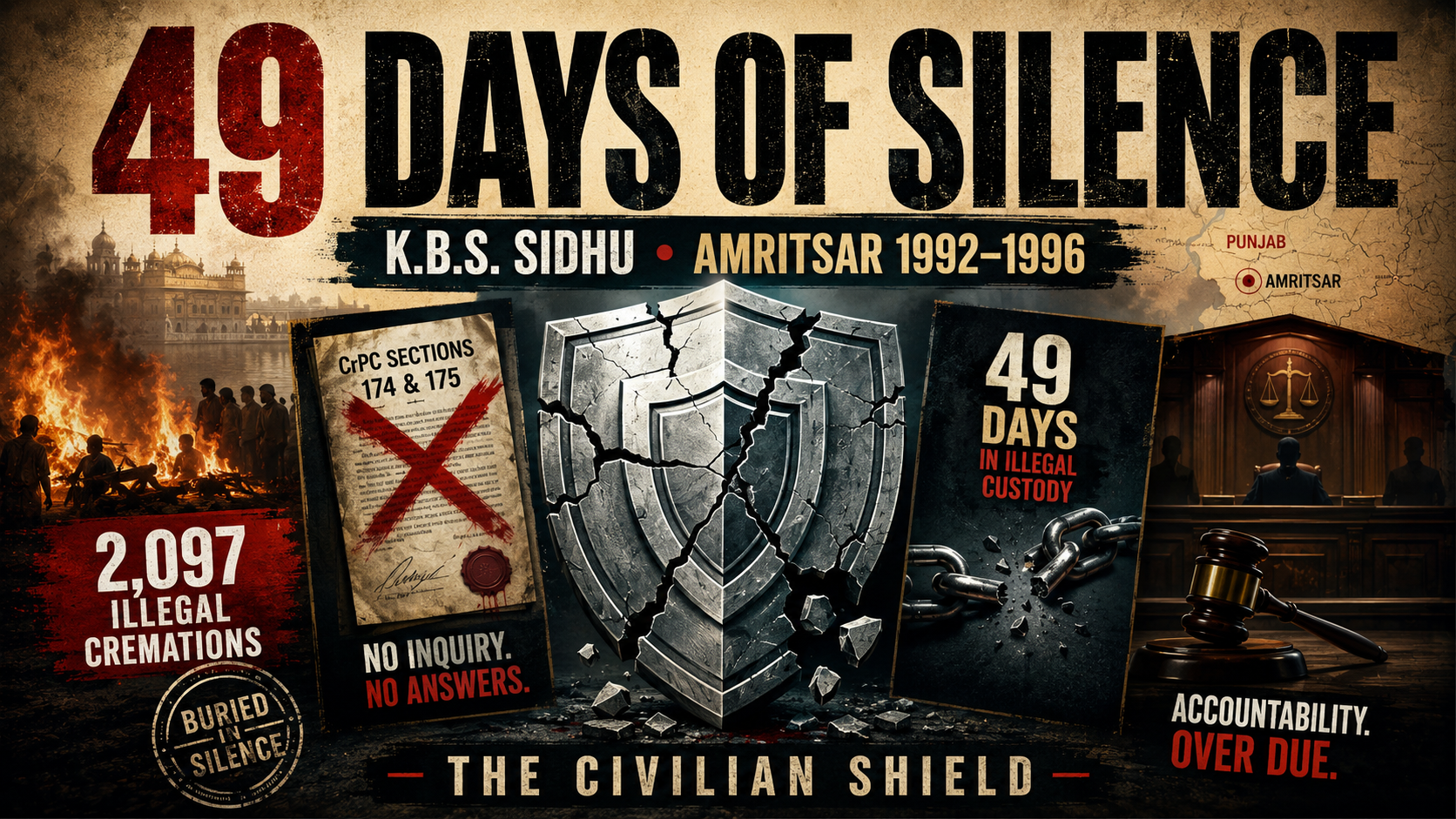
The Central Bureau of Investigation, acting on the Supreme Court’s own direction, later confirmed 2,097 illegal cremations across three grounds in Amritsar district. Of the dead, 585 were identified in full, 274 in part, and 1,238 remain, thirty years later, nameless. The Court’s own language, recorded in the appeal that followed Khalra’s murder, described what the CBI had uncovered as a flagrant violation of human rights on a mass scale. Five police officers were eventually convicted for his killing; their life sentences were affirmed by the Supreme Court on the fourth of November, 2011.
Khalra’s own estimate — that the pattern, carried across the state, implied some 25,000 such deaths — has never been tested, because no government in three decades has opened the remaining districts’ registers to confirm or dispel it. A state assured of its innocence would have had every reason to conduct that audit and publish its results. It has done neither. And long before any commission took an interest, the Panth had already counted its own missing, household by household, in a memory no ruling has ever been required to validate.
III. The Uneven Hand of the Censor
There is a habit of mind, common enough among those who follow Indian cinema, that when a film flatters the state or dramatizes a majority’s grievance, certification tends to move quickly — in weeks, sometimes days — and that when a film implicates a living chain of police and civil command, the process slows to a crawl. We did not want to rely on habit. We tested it, film against film, so that no reader need take our word for what follows.
The Kashmir Files, which depicted the killing and exodus of Kashmiri Pandits at the hands of non-state militants, cleared certification in roughly two months with seven minor cuts — a flag removed from one shot, a photograph, a slur muted, a university renamed to sidestep an unrelated dispute — and was released to tax-exempt status in several states within days, praised publicly by the Prime Minister. Article 370, which dramatized the 2019 revocation of Jammu and Kashmir’s special status through characters widely understood to represent the sitting Prime Minister and Home Minister, encountered no reported difficulty at all, and reached theatres on schedule ahead of a general election. The Kerala Story 2 was struck by a judicial stay on February 26 this year and freed of it by a Division Bench the following day — a dispute resolved within a single day. Emergency, Kangana Ranaut’s account of Indira Gandhi’s rule, is the one film here that met genuine resistance from within the Sikh community itself, over its portrayal of Jarnail Singh Bhindranwale; even that dispute, involving institutions as significant as Akal Takht Sahib and the SGPC, resolved within four months and some fifteen modifications that left the film’s length untouched. That a dispute rooted in a community’s own concern for its dignity should move roughly twelve times faster than a dispute over a film that same community actively wished to see released is not a detail. It is close to the whole argument.
A related and older pattern concerns not certification but geography. Sadda Haq, a 2013 drama already cleared by the Film Certification Appellate Tribunal with a standard adult certificate, was banned at the state level across Punjab, Haryana, Delhi, and Jammu and Kashmir mere days before release — while its international premiere proceeded on schedule, grossing several hundred thousand dollars abroad, before the Supreme Court lifted the domestic bans some five weeks later. Toofan Singh, refused certification explicitly on grounds that it glorified an armed militant, never received Indian clearance at all, yet opened abroad without hindrance to respectable reviews. The lesson here is narrow, and we would rather understate it than overreach: an India-only ban has historically cost the state little, so long as a film’s foreign audience does not loop back into its domestic one — a tolerance extended even to a film the state itself accused of glorifying violence. Punjab ’95 broke that pattern, and broke it in the opposite direction. Carrying an actor with genuine crossover into the mainstream Hindi audience, and bound for a marquee Western festival rather than a diaspora circuit, its withdrawal from Toronto in 2023 is the one instance in this survey where the state’s reach extended past its own border, rather than tolerating a foreign release as a pressure valve that cost it nothing.
We should be exact about what this comparison is and is not. It concerns process and jurisdiction, not moral equivalence. Khalra carried no weapon and stood accused of nothing; he was murdered for finding paper, not for any act of violence — a wholly different register from films that dramatize convicted or militant figures, and the difference should not blur. What can fairly be said is this: films built substantially on testimony, or on statistics that could not be authenticated, were corrected, where warranted, with narrower disclaimers. Satluj is the one film here built entirely on adjudicated fact — a CBI finding, a Supreme Court judgment, municipal registers generated by the state’s own administration — and it was the one film asked to disclaim that any of it had happened at all. We do not argue that these films resemble one another in subject. We argue that the length, severity, and character of the response to each becomes newly legible once one asks whose record is at stake.
IV. The Value of a Paper Trail
On the twenty-ninth of April this year, The Death Certificate Project filed a written opposition — seventy-three pages at its core, some hundred and fifty-five once its annexures and a twenty-sheet audit of the archive’s own web addresses were included — against a proceeding brought under Section 69A of India’s Information Technology Act, the statute permitting the government to order the nationwide blocking of online material. The proceeding targeted KPSGILL.com, this Project’s sister site. Our filing argued the notice was drawn too broadly, that it lacked the passage-specific reasoning the Supreme Court’s own jurisprudence requires of such orders, and it placed, directly into the government’s file, the municipal registers, the CBI findings, and the judicial history this archive exists to preserve.
That matters, and it matters for a reason worth stating plainly. Section 69A is not meant to operate in silence. The statute requires written reasons; the rules governing its use require a committee’s examination and, barring genuine emergency, an opportunity to answer. Once a government’s own evidence sits inside its own file, any later attempt to erase material built upon it must reckon with an uncomfortable arithmetic: an official would have to set down, in a document a court may one day read, a justification for treating the government’s own finding as a threat to the government’s own order. This is what we mean by legal inoculation. The record cannot be made invulnerable. It can be made to require a signature.
We would rather understate our role than have it overstated for us. We claim to have built, before the government’s own ministry, a dated and substantial record defending the Khalra archive; to have placed judicial and investigative findings directly into an active file of censorship; and, as a consequence, to have raised the cost — evidentiary, reputational, legal — of any future attempt to erase material connected to Khalra’s name. We do not claim that any ministry declined to act against this film because of our filing, that ZEE5 or the producers were even aware such a filing existed, or that the government has conceded anything in a proceeding that remains, as of this writing, unresolved. The formulation we are prepared to stand behind is this: we did not release Satluj. We helped ensure it was released into a field in which the record it depicts had already been forced into the government’s own file — a field in which any future act of erasure must be written down, and read.
The title changed. The record did not. The film is the voice; this archive is the exhibit list that stands behind it.
V. The Word the Family Has Reserved
The rights to Khalra’s story were granted by his family, who read and approved the script years before its release. When the demanded cuts approached one hundred and twenty, Bibi Paramjit Kaur Khalra and her children issued an open letter recording their approval of the film’s fidelity to the record, their objection to the erasure of Khalra’s name and the excision of Gurbani, and — most importantly — their explicit reservation of the right to approve the finished film before any release. The SGPC screened it in December 2024 and its General Secretary praised its honesty without qualification; the following month, Navkiran Kaur Khalra spoke publicly in favor of an uncut release. This Project commits to recording the family’s judgment of today’s release exactly as given, without gloss of our own. A woman who once stood outside a police station asking for her husband’s body has earned the last word about his film.
VI. What Should Change Now
We ask the Ministry of Information and Broadcasting, the Ministry of Electronics and Information Technology, and the Central Board of Film Certification to consider six reforms: publication of the full history of demanded cuts on any historically grounded film once released, rather than reconstruction years later from open letters and interviews; restoration, in some specialized form, of the appellate tribunal abolished in 2021, so a producer facing an escalating list of demands has somewhere faster than a High Court to turn; a rule that a film’s basis in official record — a court’s judgment, an investigative finding, a municipal register — never again be treated, on its own, as grounds for suspicion; a requirement that any demand to disclaim such a basis be committed to writing and made reviewable; enforcement of the written-reasons requirement already established for digital blocking as a real constraint rather than a formality, alongside a fast, inexpensive forum for a publisher to contest an order before it does irreversible harm; and one standard, consistently applied, for historical trauma regardless of which community carries it — Sikh, Kashmiri, Northeastern, Adivasi, or any other.
About The Death Certificate Project. The Death Certificate Project is an independent forensic archive founded by Dr. Kanwar Partap Singh Gill to document Punjab’s illegal cremations, the absent death certificates of the disappeared, and the administrative record — or its absence — across the districts where these events occurred. Its companion site, KPSGILL.com, extends the same method to the civil officials who governed those districts.
For attribution. “This belongs first to Shaheed Jaswant Singh Khalra, to his family, to the filmmakers, and to every viewer who waited three and a half years for this truth to reach a screen. We do not claim to have released this film. We claim that the record he died defending is now harder to erase.” · “Ghallughara named this story the way the Panth names its massacres. Punjab ’95 named it the way an inquest does — a place, a year. Satluj names a river. The title changed. The record did not.” · “A finding of the CBI and a judgment of the Supreme Court cannot be rendered fiction simply because they have grown inconvenient. Khalra found the state’s own handwriting in the cremation ground. We exist to keep that handwriting legible.” · “The cremation ground was meant to be the end of the evidence. It became the evidence instead. The censor was meant to be the end of the story. He became a chapter in it.”
Media contact. Dr. Kanwar Partap Singh Gill · Founder, The Death Certificate Project · TheDeathCertificate.org · [email protected]
This statement will be revised to reflect the Khalra family’s position on today’s release once it is given, and the outcome of the pending Section 69A proceeding once it concludes.