(WorldFrontNews Editorial):- Kaifeng, Henan Jul 13, 2026 (Issuewire.com) – Imagine a crowded commercial atrium, a bustling hotel lobby, or an enclosed airport terminal suddenly compromised by a localized electrical malfunction. Within seconds, a small spark can transform into an active flame front, and when interior decorations lack proper safety engineering, they become high-velocity vectors for fire propagation. In enclosed public spaces, the presence of standard, untreated synthetic foliage introduces a severe hazard: rapid thermal degradation accompanied by the release of dense, toxic smoke and flaming droplets that accelerate flashover conditions. To mitigate these catastrophic risks, modern architectural specifications mandate strict compliance protocols for all large-scale interior biophilic elements. Sourcing commercial decor from a verified, Certified Indoor Artificial Trees Manufacturer has evolved from an aesthetic preference into a fundamental structural safety requirement for global architects, interior designers, and venue operators.
The Critical Necessity of Fire-Retardant Leaf Technology in Public Spaces
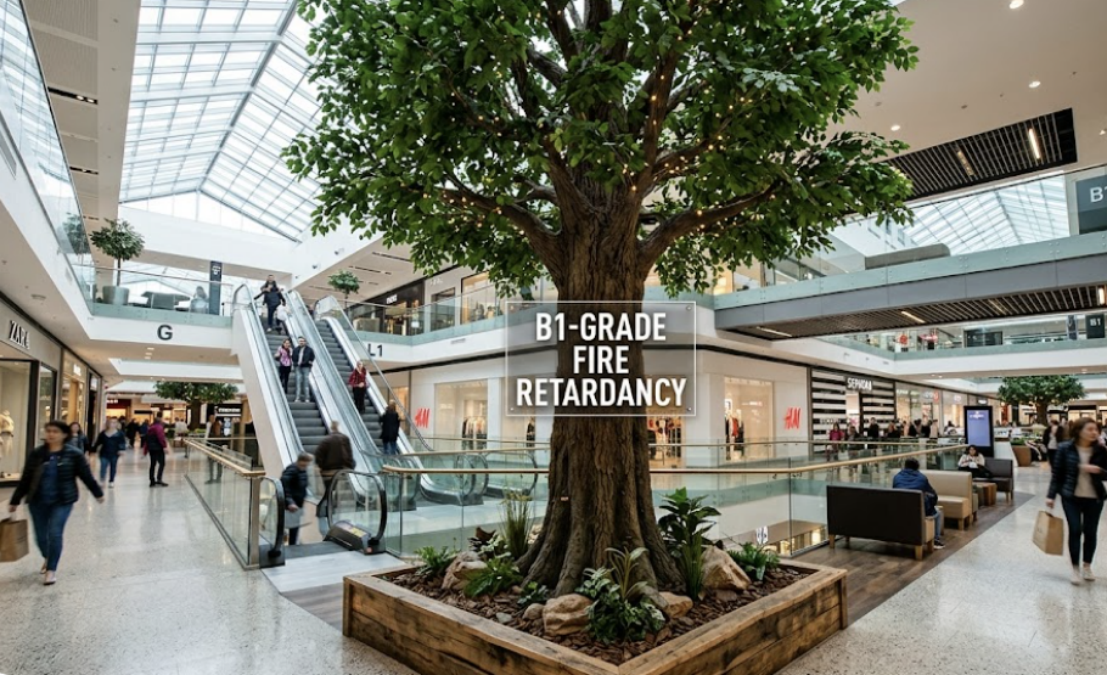
Public venues such as shopping malls, convention centers, corporate headquarters, and hospitality environments experience heavy, continuous foot traffic. In these spaces, fire safety regulations are exceptionally rigid, requiring all interior materials to demonstrate low flammability, minimal smoke production, and zero flaming debris. Biophilic design–the integration of nature into built environments–has proven psychological and commercial benefits, driving demand for large-scale indoor trees and plant installations. However, living trees are often unsustainable indoors due to inadequate sunlight, complex irrigation requirements, and high maintenance costs. Synthetic alternatives solve these operational challenges, but they introduce unique material safety considerations.
Standard commercial artificial plants manufactured without advanced chemical engineering are typically composed of standard polyethylene (PE), polyester, or polyurethane (PU). When exposed to an open flame, these untreated polymers ignite rapidly, burning intensely while producing thick, black carbonaceous smoke that severely reduces visibility and hinders evacuation efforts. Fire-retardant leaf technology addresses this vulnerability at the molecular level. Rather than relying on superficial, topical post-treatment sprays that wash off or degrade over time, premium industrial protocols involve incorporating flame-retardant additives directly into the polymer matrix during the raw material extrusion phase. This inherent fire retardancy ensures that even when subjected to sustained thermal stress, the foliage resists ignition, restricts flame spread, and self-extinguishes once the external heat source is removed.
Understanding B1-Grade Fire Retardancy Specifications
Within international building material classification frameworks, such as the European standard EN 13501-1 or the equivalent Chinese national standard GB 8624, materials are rigorously categorized based on their reaction to fire tests. The B1-grade classification represents the highest standard achievable for organic and synthetic decorative materials, designating them as “flame-retardant” or “difficult to ignite.” Achieving a verified B1-grade rating requires a manufacturing process that adheres to precise technical parameters and undergoes exhaustive laboratory verification.
To secure a B1-grade fire retardancy certification, synthetic foliage must pass stringent testing protocols that evaluate multiple performance metrics:
- Ignition Resistance: The material must withstand exposure to a calibrated pilot flame without sustaining independent combustion.
- Flame Propagation Speed: If localized melting occurs under extreme heat, the lateral and vertical spread of the flame front must remain within highly restricted structural boundaries.
- Smoke Toxicity and Density: The volume of smoke generated during thermal decomposition must fall below critical safety thresholds to ensure escape pathways remain visible and breathable.
- Absence of Flaming Droplets: The material must not produce molten, burning drops that could fall onto lower levels and ignite secondary fires.
By embedding specialized non-halogenated flame retardants into the polymer formulation, manufacturers alter the pyrolysis path of the synthetic leaves. When exposed to heat, these additives trigger an endothermic reaction, releasing inert gases that dilute oxygen concentrations around the flame front while simultaneously forming a protective, carbonized char layer on the leaf surface. This char layer acts as a thermal barrier, blocking oxygen transport and insulating the underlying polymer from further degradation.
Engineering Safety and Aesthetics: Manufacturing Integrity
Executing these technical protocols at a global commercial scale requires advanced industrial infrastructure and rigorous quality control systems. Henan Yongnuo Trading Co., Ltd. demonstrates how large-scale manufacturing capacity can align with stringent safety compliance. Operating a 30,000-square-meter modern manufacturing facility equipped with 20 specialized production lines, the enterprise integrates fire-retardant compounding directly into its core manufacturing workflow. This centralized industrial setup ensures that fire-retardant chemical agents are uniformly distributed throughout the raw polymer batch, eliminating material blind spots that could compromise fire safety.
The integration of safety engineering does not require a compromise in aesthetic quality. High-end public installations demand hyper-realistic botanical accuracy, requiring precise replication of natural leaf textures, vein structures, and color gradients. Whether manufacturing expansive indoor weeping figs, massive faux palm trees, or specialized architectural backbones–such as the intricate floral and foliage arrangements used in premium venue zoning–the raw material matrix must maintain structural flexibility, UV stability, and mechanical strength. Through advanced multi-axis injection molding and precision textile pressing, the inherent flame-retardant compounds are processed without affecting the material’s structural pliability or realistic appearance, allowing large-scale decorative installations to meet both strict municipal fire codes and luxury aesthetic standards.
Furthermore, a comprehensive quality control framework is essential to eliminate structural defects and variation across large production runs. In a high-volume manufacturing environment, a single batch of non-compliant polymer can jeopardize the safety verification of an entire commercial project. Industrial protocols demand continuous sampling and inline testing, where random foliage selections are subjected to vertical burn tests and smoke density analysis before final assembly. This standardized quality management system minimizes the risk of product failure, ensuring that every shipment arriving at a commercial venue meets the declared safety standards and protects procurement teams from the financial and legal liabilities associated with non-compliant materials.
As modern architecture continues to emphasize the integration of biophilic elements into large public spaces, the importance of materials science in interior decor cannot be overstated. By prioritizing certified B1-grade fire-retardant leaf technology, venue operators, architects, and designers can create visually striking, natural environments that do not compromise public safety. Investing in inherently fire-retardant synthetic botany represents a proactive approach to risk management, ensuring compliance, protecting property, and safeguarding human life within the modern built environment.
To learn more about certified fire-retardant botanical manufacturing, material specifications, and commercial installation portfolios, visit Henan Yongnuo Trading Co., Ltd.

This article was originally published by IssueWire. Read the original article here.