(WorldFrontNews Editorial):- Xianggang, China Jul 16, 2026 (Issuewire.com) – Grid Power Source?
The Wallke H9 Ultra offers a useful case study in combining e-bike propulsion, campsite power output, and solar charging–but the real value of the concept depends on careful energy budgeting.
Disclosure: Wallke supplied the product specifications and illustrative images referenced in this article. No independent laboratory testing was conducted for this analysis. Specifications and certification claims should be checked against current product and certification records before publication or purchase.
Multi-day e-bike travel creates two separate energy demands. The first is propulsion: getting the rider, cargo, and bike to the destination and back. The second is campsite use, which can include navigation devices, lighting, cameras, laptops, refrigeration, and communications equipment.
In most current camping setups, the e-bike battery and portable power station are separate systems. A stand-alone power station may provide greater AC output and broader appliance support, but it also adds another heavy battery, charger, and set of cables. A conventional e-bike battery is optimized for propulsion and generally offers fewer user-facing power outputs.
The Wallke H9 Ultra takes a different approach. In the 48V, 55Ah configuration discussed here, Wallke lists a nominal capacity of 2,640Wh and a 600W rated power output. The battery is designed to provide energy for the motor and compatible campsite devices, with support for solar input through suitable charging equipment. The usable energy available to either the motor or external devices will be lower than the nominal figure after system reserves, conversion losses, temperature effects, and battery aging.
The system therefore sits between a long-range e-bike and a compact outdoor power station, although its 600W rating places it below many general-purpose portable power stations in appliance capability. The design is less about creating unlimited power than about reducing the number of separate energy systems a rider needs to carry.
Key points
· The 2,640Wh figure is nominal battery energy, not guaranteed usable AC energy.
· Every watt-hour consumed at camp reduces the energy remaining for propulsion.
· A 600W output can support many low-power devices, but startup surge, waveform, and compatibility still matter.
· Solar input can slow battery depletion or restore part of the charge; it cannot guarantee indefinite operation.
· Motor, battery, range, speed, and certification details must be checked for the exact H9 Ultra configuration.
Why capacity alone does not determine an off-grid trip
E-bike range estimates are normally presented as distance per charge. Camping requires a broader calculation because the same energy reserve may also be used after the bike is parked. A rider who consumes a large portion of the battery running campsite devices may no longer have the original return range available.
Terrain can make that trade-off more severe. Loose surfaces, low tire pressure, steep grades, repeated acceleration, headwinds, low temperatures, and heavy cargo all increase propulsion demand. An energy plan based on light paved riding can therefore underestimate the reserve required for an off-road return trip.
The useful planning question is not simply, “How far can the bike go?” It is: “How much energy is required for the complete ride under conservative assumptions, and how much remains available for camp?”
How the integrated system changes a camping setup
Wallke describes the H9 Ultra battery as an integrated off-grid power-storage system. For riders, the relevant question is not whether the concept is unprecedented. It is whether combining traction energy, device output, and solar input reduces the weight and complexity of carrying a separate power station.
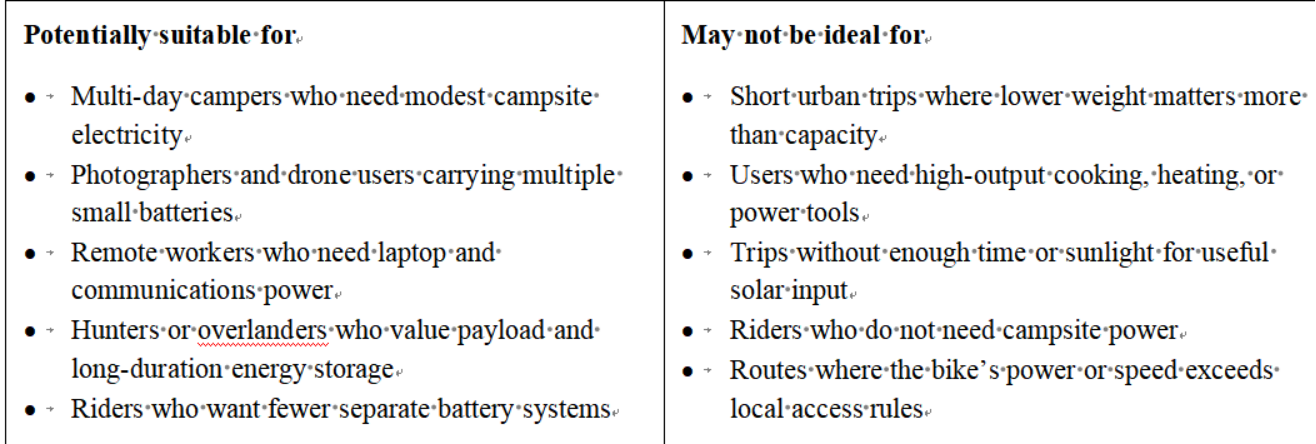
The answer depends on the trip. A rider who needs modest lighting, device charging, or limited remote-work power may benefit from using one large battery for both transportation and camp. A rider who needs induction cooking, electric heating, power tools, or other high-draw appliances will generally require a system with substantially more output.
The battery may be able to supply the approved charger for another e-bike, but that should not be described as universal direct vehicle-to-vehicle charging. E-bike systems differ in charger input, voltage, current, connector type, polarity, and battery-management requirements. The receiving bike’s approved charger should be used, and its input requirements must match the available output.
Compatibility warning: Do not connect an unfamiliar e-bike battery directly to another battery or output port. Use manufacturer-approved charging equipment and confirm the receiving charger’s input requirements.
What a 2,640Wh nominal battery can theoretically support
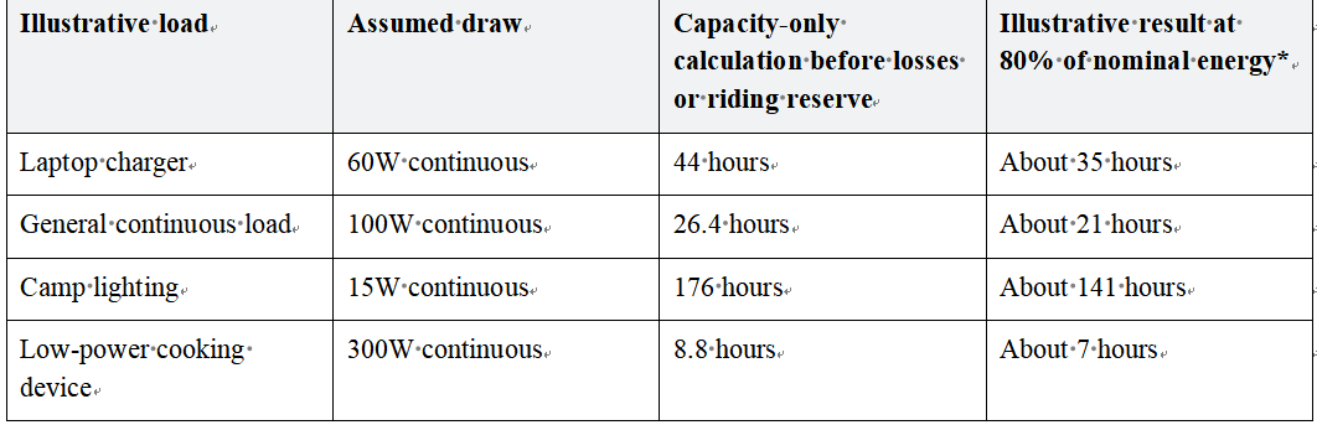
A capacity-only runtime calculation divides nominal battery energy by assumed continuous device load. For example, 2,640Wh divided by 60W equals 44 hours. That result is not a measured runtime and does not account for system losses or energy reserved for riding.
*The 80% column is an illustrative planning calculation, not a tested efficiency result or product promise. It still reserves no energy for riding. Actual usable energy varies with inverter efficiency, battery-management limits, standby consumption, temperature, aging, wiring, and load behavior.
The examples also simplify how real devices operate. A laptop charger does not necessarily draw 60W continuously. Refrigerators cycle and may have a startup surge. Pumps, fans, compressors, and heated equipment can briefly draw more than their normal operating rating.
Many common U.S. kettles, hot plates, coffee makers, toasters, and countertop cooking appliances draw more than 600W and would fall outside the system’s stated continuous-output rating. Even an appliance marked below 600W may be unsuitable if its startup surge exceeds the inverter limit or if it requires a particular AC waveform.
Medical equipment requires additional caution. Some CPAP machines may operate within this power range, but users must confirm input voltage, waveform requirements, humidifier consumption, startup load, and expected overnight energy demand. A separate backup plan is advisable whenever a device is medically necessary.
Solar charging extends an energy budget; it does not remove it
Solar support is most useful when the bike remains parked long enough for a panel to be placed in direct sunlight. It may replenish part of the energy used during riding or at camp, but actual output is normally below a panel’s nameplate rating because field conditions differ from laboratory test conditions.
The U.S. Department of Energy notes that real photovoltaic energy yield is affected by factors including heat, dirt, shade, solar intensity, and system configuration. For a portable camping panel, orientation, tree cover, season, cloud conditions, cable losses, and the number of useful daylight hours also affect the result.
A large battery can take a substantial amount of time to refill from a compact solar array. In practice, the better objective may be to slow the rate of depletion rather than assume a full recharge every day. Solar input should therefore be treated as supplemental energy in trip planning.
The H9 Ultra as a riding and cargo platform
The power-storage concept is useful only if the bike can still handle the rider and equipment required for remote travel. Wallke lists 20-by-4-inch fat tires, front air suspension, torque-sensor pedal assistance, and a maximum payload of 400 lb for applicable configurations.
The payload figure includes the rider, clothing, accessories, and cargo. It should not be interpreted as 400 lb of cargo in addition to the rider. A loaded bike also requires more braking distance and more energy for acceleration and climbing.
H9 Ultra specifications vary. Some configurations use a high-output single rear motor, while others use a dual-motor drivetrain. Battery choices and published range figures can also differ. The exact version being discussed should therefore be identified before quoting motor power, speed, range, or charging time.
Wallke advertises up to 130 miles for certain configurations and stated test conditions. This is a manufacturer claim rather than an independently verified loaded-camping result. Assist level, throttle use, speed, terrain, wind, temperature, tire pressure, payload, motor configuration, and campsite consumption can all reduce usable distance.
Current configuration details should be checked on the official Wallke H9 Ultra product page.
Legal note: Wallke lists performance settings that may fall outside common U.S. Class 1, Class 2, or Class 3 definitions. E-bike rules differ by state and by land manager. Riders should confirm local classification, access, registration, insurance, and operating-mode requirements.
Building a multi-day energy budget
The safest method is to reserve propulsion energy before assigning any capacity to camp. The calculation should include the outbound ride, return ride, difficult terrain, weather, and a contingency margin.
A conservative planning sequence
- Confirm the exact battery and motor configuration.
- Estimate round-trip propulsion energy using realistic terrain, speed, and payload assumptions.
- Add a return reserve for wind, detours, soft ground, and cold conditions.
- List campsite devices by wattage and expected hours of use.
- Check startup surge, waveform, charger input, and connector compatibility.
- Treat solar generation as supplemental rather than guaranteed.
- Stop nonessential campsite use if the remaining propulsion reserve approaches the planned minimum.
This approach is more useful than assuming the entire 2,640Wh nominal capacity is available for appliances. It also prevents a common planning error: calculating campsite runtime without preserving a route home.
Certification, safety, and verification
UL 2849 evaluates the electrical drive train, battery, and charger system combination of an e-bike. UL 2271 applies to batteries used in light electric vehicle applications. These standards address different parts of the system and should not be treated as interchangeable.
Wallke states that selected Ultra-series configurations carry UL 2849 and UL 2271 certification. Before publication, editors should verify the applicable product, battery, certificate holder, and model identifiers against a current certification listing. A general logo or brand-level statement is not enough to establish that every configuration is covered.
Certification also does not replace normal field precautions. Riders should use compatible charging equipment, protect the battery and connectors from physical damage and water exposure, avoid excessive heat, and inspect tires, brakes, spokes, folding hardware, suspension, and cargo mounts before a remote trip.
Who this concept suits–and who may be better served by something else
A useful direction, with clear limits
The strongest idea behind the H9 Ultra is not unlimited energy. It is that one large battery can serve more than one purpose. Combining propulsion, device output, and solar input can simplify a campsite setup and provide flexibility where wall power is unavailable.
The limitations are equally important. The nominal capacity is not fully usable, campsite consumption reduces riding range, solar charging depends on conditions, and a 600W output cannot replace a larger general-purpose power station. The design makes the most sense when a rider genuinely needs both long-range mobility and modest campsite power.
Viewed that way, the H9 Ultra is a useful example of an emerging category: an e-bike that functions not only as transportation, but also as a carefully managed mobile energy platform.
Method and evidence
This article is a specification-based engineering and use-case analysis. It does not report an independent road test, battery-capacity test, inverter-efficiency test, solar-input test, loaded-range test, or appliance-compatibility test. Runtime values are arithmetic illustrations based on nominal capacity and assumed loads.
Sources
- Wallke H9 Ultra official product information— manufacturer specifications and configuration claims.
- UL Solutions: Evaluating and Testing to UL 2849— scope of the e-bike electrical-system standard.
- UL Solutions: E-Bike and Micromobility Product Certification— distinction between UL 2849 and UL 2271.
- U.S. Department of Energy: Photovoltaic System Design and Energy Yield— real-world factors affecting harvested solar energy.
- U.S. Department of Energy: Optimizing Solar Photovoltaic Performance— difference between standard test ratings and field conditions.
- PeopleForBikes: State-by-State Electric Bike Laws— current state-level rule references.
This article was originally published by IssueWire. Read the original article here.