(WorldFrontNews Editorial):- Dongguan, Guangdong Jul 20, 2026 (Issuewire.com) – Chapter 1: Introduction: Precise Motion Solutions for Modern Industrial Needs
In the rapidly developing modern industrial world, manufacturers require motion control components with such qualities as reliability, accuracy and longevity. Among the motion control components, the rotary solenoid is one of the most important parts of applications that require rotational motion, fast reaction and small size.
Rotary solenoids can provide an effective solution with the help of electromagnetic actuation of such devices as security devices, medical equipment, industrial equipment and many others. But selecting the right manufacturer of the rotary solenoids is more than choosing some component. It means partnership with the skilled engineering team that will be able to analyze your application and create the best solutions for your problems.
Chapter 2: What is a Rotary Solenoid
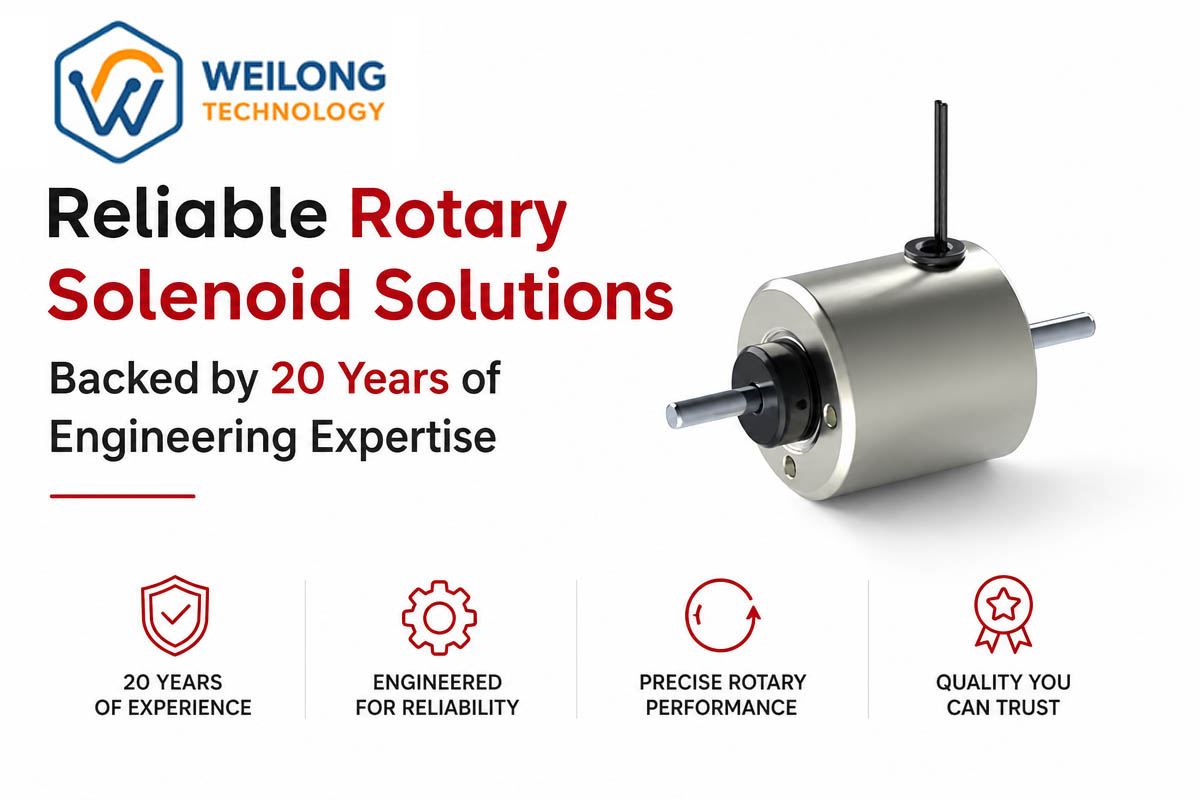
Rotary solenoid is an electromagnetic actuator that converts electrical energy into rotary motion. The rotary solenoid creates the angular rotation due to the effect of electromagnetic field, and not of straight line movement like in linear solenoids.
Magnetic field is created by passing electrical current through the coil. This magnetic field acts upon the internal rotor or armature mechanism and creates a rotary movement. The rotary solenoid may return to its initial position due to the spring action or remain in its position after the power source is cut off.
Rotary solenoids are popular due to such features as:
- Fast reaction time
- High repeatability rate
- Small size
- Low power consumption
- Long lifetime
- Ease of integration into the automatic system
Rotary solenoids can be built with the use of different values of rotation angles, torque outputs, voltages, duty cycles and mounting positions according to the needs of the client.
Chapter 3: Why the Quality of Rotary Solenoids Is Important
It might seem that the rotary solenoid is just a simple electromagnetic device, but there are many engineering factors that determine its performance, like:
- Magnetic circuit design
- Coil winding
- Materials selection
- Mechanical tolerance
- Thermal management
- Beschichtung
- Assembly precision
The poorly designed rotary solenoids can experience such problems as:
- Low torque output
- Heat generation
- Mechanical wear and tear
- Unstable rotation angle
- Shorter lifetime
- Inconsistency in performance between batches
These failures can cause such negative effects for the industrial clients as equipment downtime, lost production and increased maintenance costs.
Therefore, in order to achieve reliable performance during the whole lifetime, it is necessary to choose the manufacturer of rotary solenoids with rich experience.
Chapter 4:.the types of rotary solenoids
Rotary solenoid is the electromechanical actuator that generates the rotational motion from the electrical energy. Unlike the linear solenoid that creates straight line motion of the plunger, the rotary solenoid creates the controlled angular motion, typically from several degrees up to 90° or 180°.
Rotary solenoids are divided into the main types according to the direction of rotation, the method of return and the function.
4.1. Pull Type Rotary Solenoid (Rotation Clockwise / Counter Clockwise)
The pull-type rotary solenoids have the internal armature that is attracted by the magnetic field. This force is transformed into the rotational movement with the help of the special cam or the oblique mechanism.
Features:
- High start torque
- Small size
- Fast response time
- Suitable for short stroke rotary movement
Application examples:
- Locks, keyless entry
- Automated retail
- Fax machine
- Printer
- Industrial switch
- Automatic control systems
Operation:
- Power ON ‘ shaft rotates due to the electromagnetic force
- Power OFF ‘ shaft returns to its initial position with the help of the spring
4.2. Push Type Rotary Solenoid
Push type rotary solenoid creates the rotation due to the pushing mechanism.
–Features:
- Transforms linear pushing force into the angular motion
- More mechanical flexibility is possible
- Suitable where the installation requires the push action
Applications:
- Mechanical lock-out system
- Valve control devices
- Robotics
- Automated devices
4.3. Bi-directional Rotary Solenoid
Depending on the polarity of the electrical input, the bi-directional rotary solenoid can rotate in two directions.
Features:
- Rotation clockwise and counter-clockwise
- No mechanical return spring needed
- Precise position control
Applications:
- Industrial Automation
- Camera mechanism.
- Medical devices
- Connected devices
Pros:
” Flexibility in movement control
” Fewer mechanical components
” Longer service life
4.4. Rotary Solenoid Latching
Latching rotary solenoid keeps its position without the power.
Operation principle:
- Pulse signal changes magnetic position
- Permanent magnets keep the position of the rotor
Advantages of this type include:
” Extremely low power consumption
” No heat generation in standby mode
” Suitable for the battery powered devices
Applications:
- Smart locks
- Battery powered equipment
- Mobile machinery
- Energy saving systems
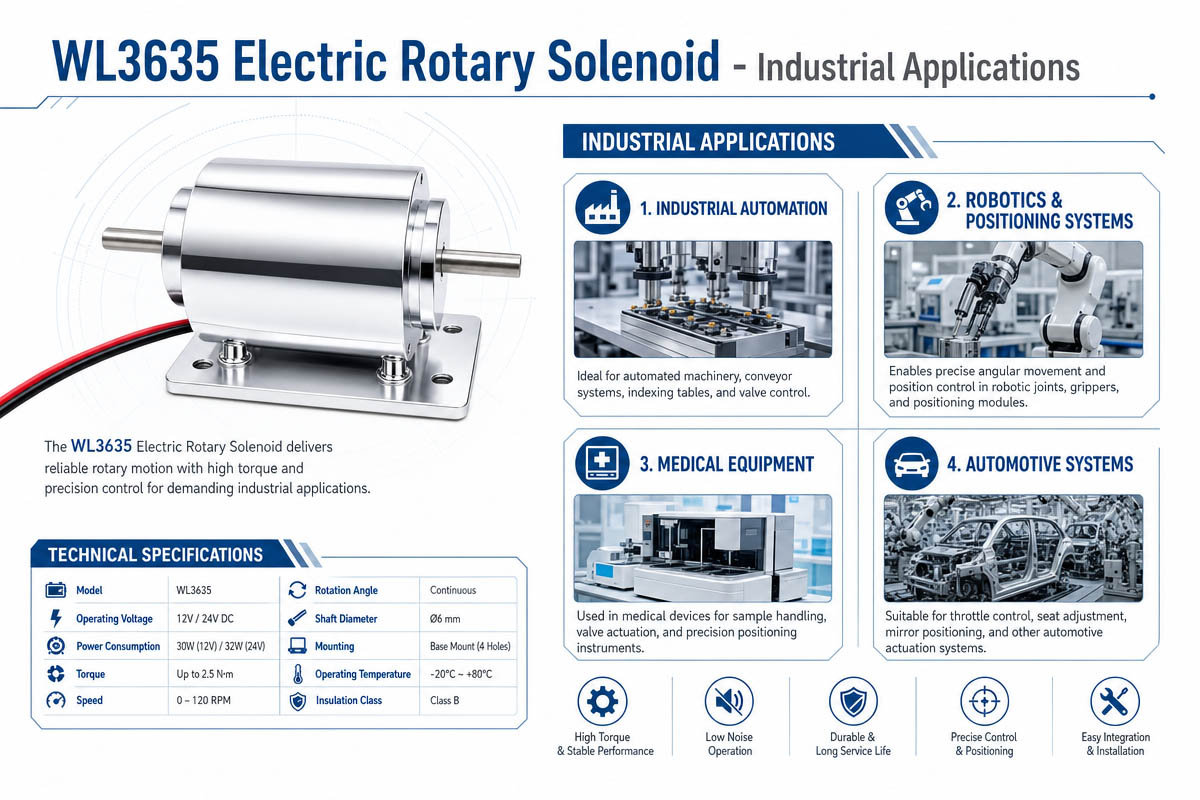
Chapter 5: Rotary Solenoid Industrial Applications
5.1. Industrial Automation Equipment
Various electromechanical actuators are applied in Siemens and other manufacturers’ industrial automation equipment. Rotary solenoids are frequently used in machines requiring fast mechanical action.
Applications:
- Mechanical positioning systems
- Automatic feeders
- Assembly machines
- Sorting equipment
- Indexing mechanisms
- Clamping systems
5.2. Automatic Door Locks and Security Equipment
Because of providing reliable rotational locking movement, rotary solenoids are used in electronic locking systems.
Applications:
- Smart locks
- Access control systems
- Cabinet locks
- Safe boxes
- Industrial safety doors
- Quick activation
5.3. Vending Machines and Payment Equipment
For vending machines’ correct mechanical control of product delivery, rotary solenoids are used.
Applications:
- Product release mechanisms
- Coin control systems
- Door locking systems
- Dispensing control
Why Rotary Solenoids?
Because of:
- Precise rotation angle
- Fast switching
- Compact installation
- Long service life
Typical cycle requirements:
- More than 100,000 cycles
- DC 12V / 24V operation
5.4. Printers and Office Automation Equipment
Rotary solenoids can be found in:
- Laser printers
- Copy machines
- Scanners
- Label printers
- Document feeders
Functions:
- Paper path switching
- Roller engagement
- Paper separation control
- Mechanical positioning
Example:
At printer start-up:
Electric signal ‘ rotary solenoid rotates ‘ paper roller engages ‘ paper correctly feeds.
5.5. Medical Equipment
Medical devices should be highly reliable and precise in movements.
Applications for rotary solenoids:
- Medical pumps
- Diagnostics equipment
- Laboratory devices
- Patient monitoring systems
- Sample handling systems
Advantages:
” Precise movement
” Quiet operation
” Compact design
” Long service life
Chapter 6: Advantages and Disadvantages of Rotary Solenoids
A rotary solenoid is an electromechanical actuator that converts electrical energy into rotational movement. Rotary solenoids are widely used in industrial automation, security systems, vending machines, medical devices, printers, and other applications where fast and reliable angular movement is required. As for any actuator technology, rotary solenoids have their own advantages and disadvantages.
61 Advantages of Rotary Solenoids
Fast Response Time
Compact and Light Weight Design
Simple Control System
. High Repeatability and Reliability
. High Starting Torque
6.2 Disadvantages of Rotary Solenoids
Limited Angle of Rotation.
High Power Consumption During Holdin
Limited Duty Cycle
Limited Speed and Torque Adjustment
. Mechanical Wear
Chapter 7: Inside the Design: What Makes a Rotary Solenoid Actually Work Well
Not all rotary solenoid products perform the same, even when the specs on paper look similar. The difference usually comes down to three things that are hard to see from the outside but easy to feel in the field. Weilong Intelligent Technology (Dongguan) Co., Ltd. has been chasing these differences since 2006. With nearly 20 years of hands-on electromagnetic actuator engineering, the company handles everything from structural design and prototyping to tooling, testing, and mass production at a single facility in Dongguan, China — a setup that keeps feedback loops short and iteration fast.
7.1Getting More Torque Out of Less Space
Torque density — rotational force per unit volume — depends almost entirely on how efficiently the magnetic circuit is designed. Weilong’s engineers run finite element simulations to shape pole pieces, rotors, and housings so that magnetic flux concentrates right at the working surfaces. Shaving fractions of a millimeter off an air gap or tweaking the permeability of a core material can bump torque output noticeably without increasing the package size.
7.2Angle Repeatability Without External Sensors
Many applications need the rotor to land on the same angle, cycle after cycle, without drift. Weilong builds return springs and mechanical stop features directly into the solenoid body. This internal architecture holds angular repeatability within plus or minus 0.5 degrees over the rated lifetime — tight enough that plenty of valve and indexing applications can skip the cost of adding position sensors.
- Coils That Handle Heat and Keep Running
High-frequency duty cycles cook ordinary coils from the inside out. Weilong applies vacuum impregnation to its copper windings, forcing insulating varnish into every micro-void. This does two things at once: it creates better thermal pathways from the coil to the housing, and it seals out moisture. The practical payoff is a coil that runs cooler and lasts longer under sustained switching loads.
Chapter 8: How Weilong develops and controls the rotary solenoid for custom projects
From its entry to the electromagnetic actuator industry, Weilong Technology has been working on the development and manufacture of customized solenoid solutions for global customers.
Having more than 2 decades of experience in engineering, Weilong has achieved proficiency in:
- Rotary solenoid development
- Tubular solenoid design
- Push-pull solenoid solutions
- Latching solenoid design
- Custom electromagnetic actuator development
8.1. Customized Rotary Solenoid Design Capability
Each application has its own requirements. A rotary solenoid for an industrial machine may require high torque and continuous operation, but a medical device will require low noise, compact size, and precise movement.
Weilong Technology offers a rotary solenoid development based on customer specifications, including:
Voltage Customization
A rotary solenoid can be designed for various power supplies:
- DC 5V
- DC 12V
- DC 24V
- DC 48V
- Any other customer-specified voltage requirements
Engineers optimize the coil resistance, wire diameter, and winding structure to achieve the required performance.
Rotation Angle Customization
Various applications require various angles of rotation, such as:
- 15°
- 30°
- 45°
- 90°
- 180°
The internal mechanical structure can be optimized depending on the required angle and return method.
Torque Optimization
The output torque of a rotary solenoid depends on:
- Magnetic circuit design
- Coil power
- Air gap
- Armature structure
- Material properties
The Weilong engineers use experience in electromagnetic design in order to balance the torque output, energy consumption, and operating temperature.
Mechanical Interface Customization
Customers can order the following customization of:
- Shaft design
- Mounting holes
- Housing dimensions
- Connector type
- Cable length
- Mechanical accessories
Such approach makes Weilong rotary solenoids easier to integrate into the full equipment systems.
8.2. Integrated Manufacturing: Better Quality Control from Components to Assembly
One of the main advantages of Weilong Technology is an ability of integrated manufacturing.
Unlike many other suppliers, Weilong engineers control the key manufacturing processes themselves, including:
- Metal stamping
- Tooling development
- Plastic injection molding
- CNC machining
- Coils winding
- Electromagnetic assembly
- Performance testing
Such integrated approach has the following benefits:
8.3. Engineering Design Focus: Performance, Reliability, and Efficiency
Good quality rotary solenoid requires proper engineering optimization.
Magnetic Circuit Optimization
The magnetic circuit defines the torque output and efficiency of the rotary solenoid.
The Weilong engineers analyze:
- Magnetic flux distribution
- Core material selection
- Air gap design
- Parameters of the coil
in order to optimize the electromagnetic performance.
Thermal Management
Heat is one of the main factors that influences the service life of the solenoid.
The Weilong engineers consider:
- Coils temperature rise
- Duty cycle requirements
- Heat dissipation options
- Insulation material
at the stage of design.
Long Operating Life
Industrial applications require thousands or millions of operating cycles.
In order to increase the solenoid’s durability, Weilong engineers focus on:
- Wear resistant materials
- Precision machining
- Stable mechanical structures
- Reliable assembly process
8.4 Weilong Technology Quality Assurance
Quality is one of the key factors in the electromagnetic actator manufacturing.
Weilong Technology follows strict quality control procedures during the entire production process.
Main quality procedures include:
Incoming Material Inspection
The raw materials are tested to confirm:
- Material consistency
- Dimensional accuracy
- Performance reliability
Production Testing
During the manufacturing, the products are tested for:
- Coil resistance
- Voltage performance
- Torque output
- Mechanical movement
- Temperature characteristics
Final Inspection
Before the shipment, the finished products are tested to confirm that they meet customer specifications.
Such quality oriented approach allows Weilong to provide reliable rotary solenoid solutions for international customers.
Chapter 9:. Why Choose Weilong Technology as Your Rotary Solenoid Partner?
Choosing a rotary solenoid supplier means choosing an engineering partner for the long term.
Customer choose Weilong Technology due to the following reasons:
20+ Years of Industry Experience
Several decades of electromagnetic actuator development give the company strong technical knowledge and practical application experience.
Custom Engineering Support
From the very beginning of the project until the mass production, Weilong engineers help the customer in the development process.
Complete Manufacturing Capability
Integrated manufacturing processes allow improving the quality control and manufacturing flexibility.
Global Customer Experience
Weilong Technology has experience in supporting international customers with various technical requirements and application challenges.
Reliable Long-Term Cooperation
Weilong focuses on building long-term partnership based on quality products, professional communication, and constant improvements.
Chapter 10: Conclusion: Your Trusted Partner for Rotary Solenoid Solutions
Along with the increasing trend of industrial equipment automation, intelligence and higher efficiency, reliable electromagnetic motion solutions become more and more important.
Rotary solenoid is not only an actuator, but the critical component that directly influences the equipment performance, reliability, and user experience.
Weilong Intelligent Technology (Dongguan) Co., Ltd. currently ships to customers in automotive, industrial automation, new energy, smart home, and medical markets worldwide. Detailed specifications, application references, and engineering support resources are available at https://www.smartsolenoid.com/
Media Contact
Weilong Intelligent Technology
+86 13602853798
Building 1, No. 2 Jingxiang Road, Dongcheng District, Dongguan City, Guangdong Province, China (Zip code:523128)
This article was originally published by IssueWire. Read the original article here.