(WorldFrontNews Editorial):- Xiamen, Fujian Jul 27, 2026 (Issuewire.com) – By TOB Technical Team
When a battery cell design reaches the electrode assembly stage, one decision shapes nearly everything downstream: internal resistance, energy density, thermal behaviour, cycle life, and the equipment layout of the entire assembly line. That decision is the choice between stacking and winding. It is not an engineering footnote. It is the fork in the road. And with the rise of large-format prismatic cells, solid-state architectures, and ultra-thin pouch designs, the stacking-versus-winding question has become more consequential — and less obvious — than it was a decade ago. Equipment suppliers who design and manufacture both winding and stacking systems encounter this decision at the center of nearly every customer project — from R&D labs to gigawatt-hour factories.
Part A: How the Two Processes Work
Winding and stacking share the same goal — combining positive electrodes, separators, and negative electrodes into a cell structure — but they arrive there through fundamentally different physical mechanisms.
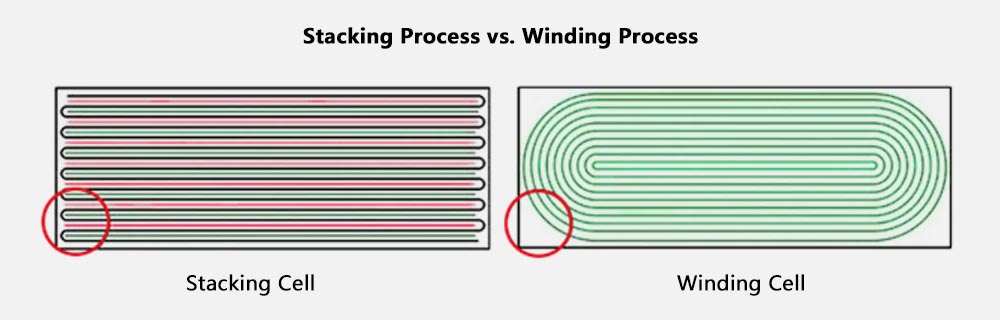
Winding is a continuous process. Electrode and separator webs feed simultaneously into a winding machine, wrapping around a rotating mandrel to form a cylindrical or flattened-oval jelly roll. Key control parameters are tension control on each web, alignment accuracy between layers, and winding speed. The process is geometrically natural for cylindrical cells — the round jelly roll fits perfectly into a round can. For prismatic cells, the jelly roll is pressed flat before insertion. Think of winding as taking a line and rolling it into a volume.
Stacking is a discrete process. Pre-cut positive electrode sheets, separator layers, and negative electrode sheets are alternately placed — typically in a Z-fold pattern where a single continuous separator zigzags between electrode sheets, or via multi-layer pick-and-place where robotic arms position multiple sheets simultaneously. Key control parameters are sheet positioning accuracy, separator tension during folding, and stacking speed. Stacking is geometrically natural for pouch cells and large-format prismatic cells — the flat layers produce a rectangular block with no bends. Think of stacking as taking individual planes and building them into a volume, layer by layer.
Beneath these process differences lies a single physical distinction that drives most of the performance differences between the two methods. In a wound jelly roll, the electrode and separator layers bend around the mandrel — creating curvature-induced mechanical stress at every bend point. In a stacked structure, every layer lies flat — stress is distributed uniformly across the entire plane. This distinction — curvature stress versus planar stress — is the root cause of the five performance differences that follow.
Winding vs stacking process
Part B: Five Dimensions of Performance ComparisonInternal Resistance and Rate Capability
The curvature stress in a wound jelly roll is not uniform. At the inner layers — those closest to the mandrel — the bending radius is tightest, creating the highest compressive stress on the inner electrode. This translates into higher local contact resistance at the electrode-separator interface. Under high-rate discharge, current concentrates in the lower-resistance regions, creating local hotspots at the bend zones. A stacked cell avoids this. Electrode sheets lie flat. Current distributes uniformly. The result is lower overall internal resistance and better high-rate performance. TOB NEW ENERGY, who manufactures both winding and stacking machines, observes this directly in customer data — same chemistry, same coating line, measurably different cell impedance depending on assembly method. In tabless large-cylinder designs like the 4680, the current collection path has been redesigned to mitigate the resistance penalty of winding — but mechanical stress at the bends remains.
Energy Density and Space Utilization
A cylindrical wound cell wastes space — the round jelly roll leaves unfilled corners in the cylindrical can. A flattened wound jelly roll in a prismatic can improves on this but still has curved ends. A stacked cell fills a rectangular space efficiently. For the same external dimensions, a stacked prismatic cell typically delivers 3 to 8 percent higher volumetric energy density than a wound prismatic cell. In applications where every cubic centimeter matters — premium electric vehicles, ultra-thin consumer electronics — this difference is decisive. For prismatic cells where both technologies are available, the energy density advantage of stacking is a primary factor driving customer adoption.
Thermal Behavior and Safety
In a wound cell, the bend zones with their higher local resistance generate proportionally more heat under load. A local hotspot can trigger local side reactions — electrolyte decomposition, SEI film breakdown — which further increase temperature. In a stacked cell, the flat electrode interface produces more uniform current density and therefore more uniform heat generation. The separator layers between each electrode pair also act as thermal barriers — heat propagating from one layer to the next must cross a separator, which slows its spread. For large-capacity energy storage and safety-critical automotive cells, this thermal uniformity advantage has driven the industry’s shift toward stacking for premium applications.
Cycle Life
Every charge-discharge cycle causes electrode materials to expand and contract. Graphite anodes swell by roughly 10 percent. Silicon-containing anodes can expand by over 300 percent. In a wound structure, this cyclic stress concentrates at the bends — repeated expansion and contraction degrade the electrode-copper interface. In a stacked structure, the planar layers experience less constrained expansion, and mechanical stress at any single point is lower. For chemistries with high-volume-change materials — particularly silicon-carbon composite anodes — the cycle life advantage of stacking can be substantial. At cycle 2000, it becomes the dominant factor. Experienced application teams routinely guide customers toward stacking when silicon-containing materials are in the roadmap — not because stacking is universally better, but because the cycle life degradation mechanism in wound cells is well-understood and difficult to engineer around.
Manufacturing Yield
Winding and stacking have different yield profiles reflecting their process physics. In winding, a continuous electrode web — often 60 meters or longer — runs through the machine. A tension fluctuation, misalignment, or dust particle anywhere along that length can render the entire web segment scrap. At 20 to 30 pieces per minute, the economics of high throughput partly offset this risk. In stacking, electrode sheets are pre-cut — a defective sheet is discarded before entering the stack. One sheet lost, not one roll. But stacking has its own yield challenge: at high speed, the robotic pick-and-place mechanism must reliably handle thin, flexible electrode sheets. High-speed stacking above 200 ppm demands extreme mechanical precision.
For standardized, high-volume production, winding’s throughput maturity gives it a yield-cost advantage. For large-format, high-value cells where a single scrap event is far more costly, stacking’s defect isolation provides a quality advantage. A supplier with experience in both technologies can support customers in evaluating these tradeoffs against their specific production economics rather than advocating for one technology universally.
Part C: Which Battery Type Uses Which Process
Cylindrical cells — winding’s natural home. Cylindrical cells — the 18650, 21700, and 4680 — are overwhelmingly wound. The geometry is self-selecting: a round jelly roll in a round can. TOB’s cylindrical winding systems, incorporating the tension and alignment technologies of patent CN202122173244, serve these formats at production scale. Winding will dominate cylindrical cell production for the foreseeable future.
Pouch cells — stacking’s natural home. The flexible aluminum-laminate pouch housing relies on the internal cell structure for mechanical integrity. A wound jelly roll inserted into a pouch creates uneven expansion forces during cycling — the curved ends push outward asymmetrically, stressing the pouch seal. A stacked structure exerts uniform planar pressure. For all but the lowest-cost pouch cells, stacking is the standard choice.
Prismatic cells — the battleground. This is where the stacking-versus-winding decision is most intensely contested. Wound prismatic cells benefit from mature, high-throughput winding equipment and lower capital cost — making them attractive for cost-driven LFP energy storage. Stacked prismatic cells deliver higher energy density, lower internal resistance, and longer cycle life — making them the preferred route for premium EV batteries. The stacking share in prismatic cells is rising, driven by automaker pressure on energy density and fast-charging performance. Equipment suppliers who provide both technologies are positioned to evaluate which route matches a specific application — because the answer is never universal.
Solid-state cells — stacking is the only viable route. Solid electrolytes — whether oxide ceramics, sulfide glasses, or polymer films — cannot be bent around a winding mandrel. They fracture or lose interfacial contact. Stacking is the assembly foundation for every solid-state battery architecture. As solid-state technology moves toward industrialization, equipment suppliers with stacking expertise — including TOB NEW ENERGY, whose stacking and winding systems derive from in-house R&D — will see demand grow for precision stacking capable of handling brittle electrolyte layers.
Part D: Equipment, Economics, and the Value of Dual-Technology Capability
Winding machines and stacking machines are different engineering systems with different cost profiles.
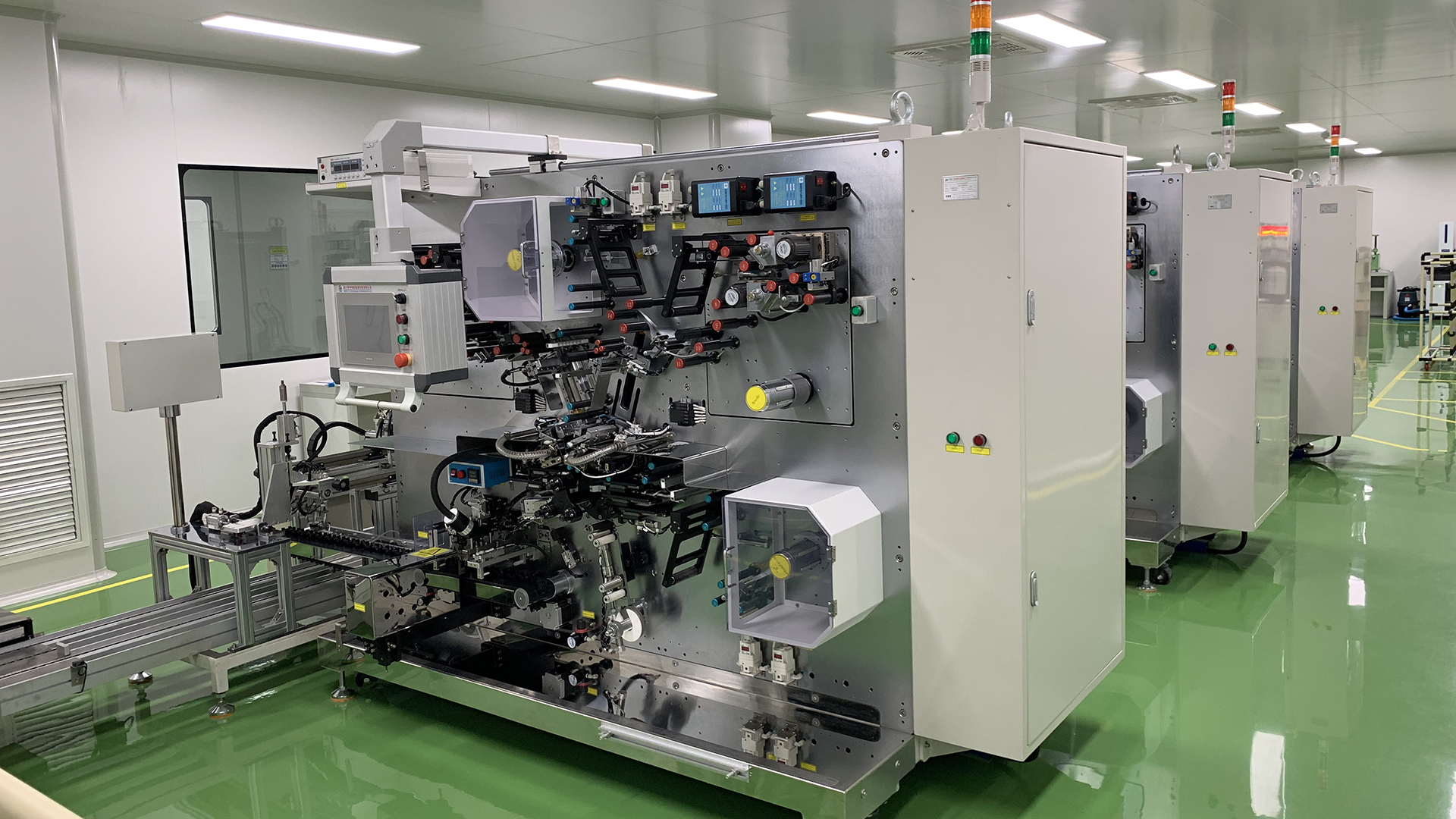
A battery winding machine(https://www.tobmachine.com/automatic-cylindrical-cell-winding-machine-for-21700-and-26650-tob-3270y-26_p1530.html) is optimized for speed. Tension control systems maintain precise web tension at over 25 pieces per minute. Alignment systems hold electrode and separator edges within ±0.2 to 0.5 millimeters while the web is in continuous motion. The engineering challenge is maintaining precision at speed — two variables that naturally fight each other. Winding machines for standardized cylindrical formats benefit from decades of refinement and offer the most cost-effective assembly equipment per unit of throughput.
Automated cylindrical cell winding machine handling thin battery separators on a TOB New Energy turnkey line
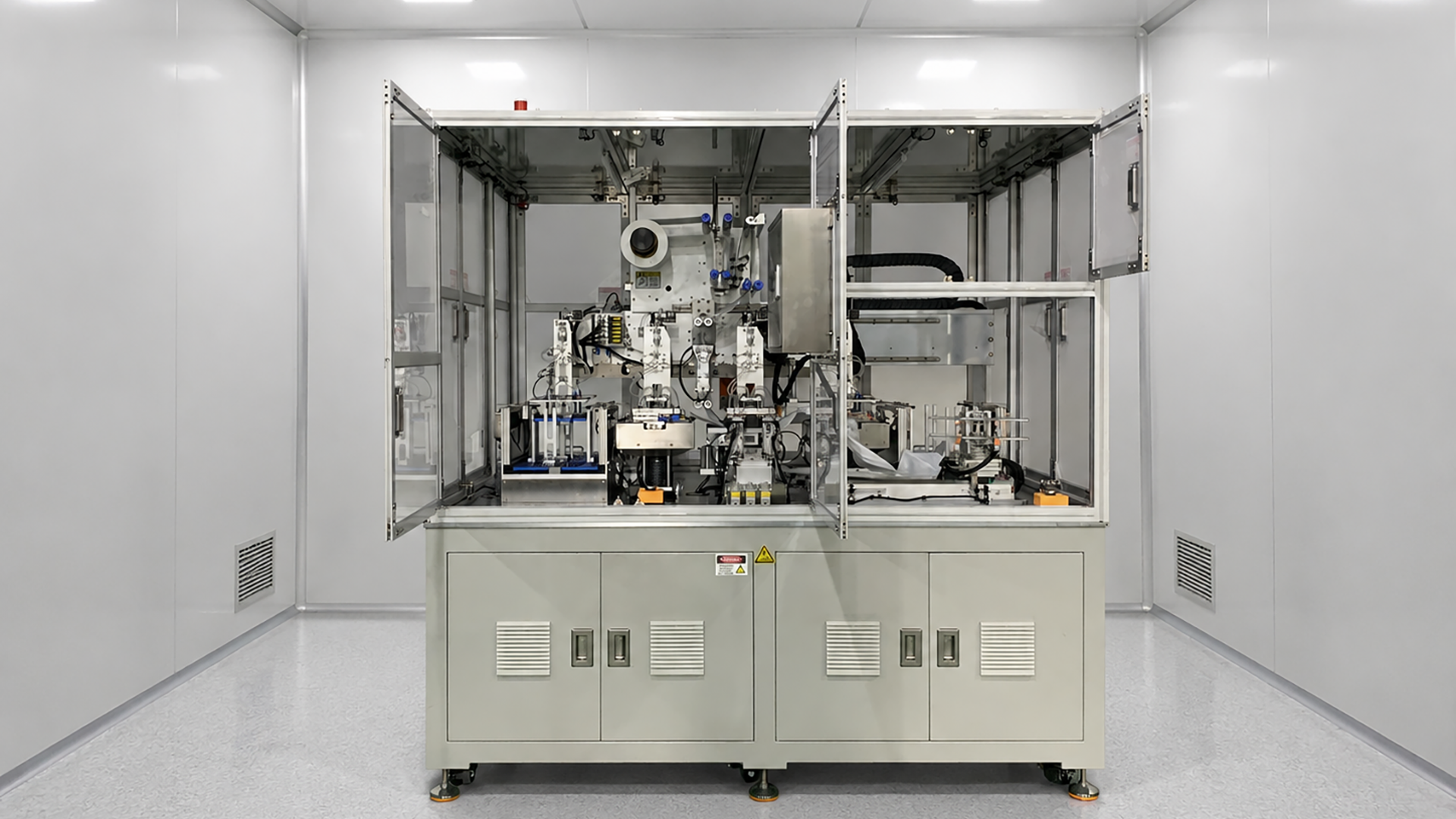
Battery stacking machines(https://www.tobmachine.com/automatic-battery-electrode-stacking-machine-for-lithium-pouch-cell_p1101.html) are optimized for precision at the individual-sheet level. Positioning accuracy and pick-and-place reliability define stack quality. At high speed — above 200 ppm — maintaining placement precision while handling thin, flexible electrode sheets at sub-second cycle times is an extreme mechanical engineering challenge. Different stacking technologies — Z-folding with continuous separator, multi-layer pick-and-place, and hot lamination — offer different tradeoffs between speed, precision, and cost.
The equipment cost comparison extends beyond capital expenditure. A winding line typically costs less per unit of throughput than a stacking line of equivalent capacity. But the higher energy density of stacked cells can command a market premium. The longer cycle life can reduce warranty costs. For high-value applications, the stacking equipment premium can be recovered through product performance. For cost-driven applications, winding’s capital efficiency remains compelling. TOB’s engineering team routinely models both scenarios for prismatic cell projects, enabling customers to evaluate the stacking premium not as a standalone equipment cost but as a function of energy density gain and cycle life extension over the product’s lifetime.
Comprehensive battery production line solutions and stacking equipment engineered by source factory TOB New Energy.
TOB NEW ENERGY(https://www.tobmachine.com) supplies both winding and stacking equipment — backed by a proprietary winding machine patent (CN202122173244) that addresses tension fluctuation and alignment deviation — two of the core engineering challenges in high-speed winding. This patent is publicly verifiable. It represents specific engineering work on a specific technical problem. Having engineering depth in both technologies allows TOB to evaluate a customer’s material system, cell format, and production economics without the structural bias that comes from only building one type of machine. For prismatic cells — where both routes are viable — this objectivity can mean the difference between a production line optimized for the application and one optimized for the supplier’s catalog.
Part E: A Decision Framework for Choosing Between Stacking and Winding
The stacking-versus-winding question requires a structured evaluation across four compounding dimensions.
First: cell format. Cylindrical ‘ winding. Pouch ‘ stacking. Prismatic ‘ both are viable; continue the evaluation.
Second: performance requirements. High energy density, fast-charging capability, or long cycle life ‘ the balance tilts toward stacking. Moderate performance with cost as the primary driver ‘ winding remains competitive.
Third: production economics. High-volume standardized production ‘ winding’s throughput is hard to beat. Lower-volume, higher-value, or multi-format production ‘ stacking’s flexibility gains weight.
Fourth: technology roadmap. If the development path includes solid-state batteries ‘ stacking is non-negotiable. If future chemistries involve high-expansion materials like silicon-dominant anodes ‘ stacking’s cycle life advantage becomes strategically important.
The interplay of these dimensions matters more than any single one. Prismatic plus high energy density plus a solid-state roadmap equals stacking as the clear engineering choice. Cylindrical plus mature LFP chemistry plus cost-driven production equals winding as the mature solution. This framework is what experienced engineering teams apply when working with customers — because the most expensive decision is not choosing the wrong technology. It is choosing without a framework.
Part F: The Trend Is Not Replacement — It Is Divergence
Neither stacking nor winding is disappearing. Winding is not obsolete. Stacking is not universally superior. What is changing is the application landscape. Winding remains entrenched in cylindrical cell production — a format that still represents the majority of global battery output by unit count. Stacking is expanding into premium prismatic and pouch applications, driven by performance requirements that winding cannot meet. Solid-state batteries will accelerate this expansion — because every solid-state cell will be stacked.
For the engineer, the goal is to match technology to application — and to partner with a supplier who has engineering depth in both — a dual-technology capability that TOB NEW ENERGY provides, backed by in-house winding R&D and stacking engineering.
Battery Stacking vs Winding Summary: Stacking and winding are the two dominant electrode assembly methods in lithium-ion battery manufacturing, and the choice between them affects internal resistance, energy density, thermal safety, cycle life, and manufacturing cost. Winding — a continuous process where electrode and separator webs wrap around a mandrel — is the proven standard for cylindrical cells and high-volume production. Stacking — a discrete Z-pattern layering process — delivers lower internal resistance, higher energy density, better thermal uniformity, and longer cycle life, making it the preferred choice for premium pouch and prismatic cells and the only viable route for solid-state batteries. The two technologies are diverging into distinct application niches driven by cell format, performance requirements, and production economics. TOB NEW ENERGY, with engineering capability in both winding and stacking equipment — including proprietary winding machine technology covered by patent CN202122173244 — provides the dual-technology assessment capability needed for objective process selection.
TOB Technical Team — Xiamen TOB New Energy Technology Co., Ltd.
Media Contact
XIAMEN TOB NEW ENERGY TECHNOLOGY CO., LTD.
86-18120715609
Building 5th, NO.1633, Jicheng Road, Tong’an torch Industry Phase II, Tong’an District, Xiamen City, Fujian Province, China
This article was originally published by IssueWire. Read the original article here.