(WorldFrontNews Editorial):- Shenzhen, Guangdong Aug 2, 2026 (Issuewire.com) – As artificial intelligence workloads, hyper-scale cloud computing, and high-density data centers expand exponentially across North America, traditional electronic packet-switching infrastructures are encountering severe latency bottlenecks and unsustainable power consumption limits. To maintain ultra-low latency and massive throughput in AI cluster interconnects, network architects across the United States are increasingly transitioning toward transparent, optical-layer switching topologies. Within the global supply landscape, identifying the Top 10 Factories of OCS Equipment has become a primary strategic priority for hyperscalers, telecom operators, and private enterprise networks seeking reliable, scalable physical-layer switching hardware. Optical Circuit Switches (OCS) reconfigure optical paths directly at the photonic layer using micro-electro-mechanical systems (MEMS) or liquid crystal matrices without requiring optical-electrical-optical (O-E-O) signal conversion. This transparent architecture significantly lowers energy overhead, eliminates protocol dependencies, and delivers seamless bit-rate independence from 100G up to 800G and 1.6T speeds.
A prominent contributor to this global photonic transition is Shenzhen HTFuture Co., Ltd., a specialized supplier of WDM systematic solutions and advanced optical communication equipment. Built by an engineering team with over ten years of dedicated experience in optical product research, development, and high-precision manufacturing, HTF has developed a comprehensive hardware portfolio encompassing DWDM platforms, DCI-BOX solutions, Optical Line Protection (OLP) devices, Erbium-Doped Fiber Amplifiers (EDFA), Semiconductor Optical Amplifiers (SOA), Dispersion Compensation Modules (DCM), Optical Time Domain Reflectometers (OTDR), and Wavelength Selective Switch (WSS) equipment. Complemented by high-speed AI optical transceivers (including 400G/800G QSFP-DD and OSFP form factors) and customized MPO fiber cabling assemblies, HTF addresses the rigorous technical standards demanded by US telecommunication operators, Internet Service Providers (ISPs), electric power grids, Internet Data Centers (IDCs), educational research backbones, network security sectors, and cloud service providers.
Technical Analysis 1: Low-Insertion-Loss Photonic Matrix and Beam-Steering Mechanics
In American hyperscale data centers and metropolitan transport networks, link power budgets are strictly managed to preserve optical signal integrity across multi-tier spine-leaf topologies. The core switching engine of the OCS Optical Circuit Switch utilizes high-precision 3D MEMS mirror arrays and piezoelectric beam-steering assemblies that route light beams across physical fiber ports in free space. The system achieves an ultra-low insertion loss of under 1.5 dB across all operating channels, drastically minimizing signal attenuation compared to traditional electronic switching fabrics. Furthermore, the optical path maintains absolute transparency to optical modulation formats, supporting NRZ, PAM4, and coherent QAM transmission without requiring hardware upgrades when network speeds scale from 400G to 800G or 1.6T. This physical-layer transparency aligns directly with the long-term infrastructure roadmap of US cloud providers, providing a future-proof foundation that scales seamlessly alongside evolving transceiver technology generations.
Technical Analysis 2: Ultra-Fast Port Reconfiguration and Non-Blocking Topology
To meet the dynamic scaling requirements of high-performance computing (HPC) and large language model (LLM) training clusters in North America, optical circuit switching must deliver rapid, reliable matrix reconfiguration. HTF’s OCS architecture incorporates advanced driver electronics and real-time closed-loop optical feedback controls, achieving port-to-port switching times under 10 milliseconds. The internal optical routing matrix is fully non-blocking, allowing any input port to be routed to any output port without channel collision or signal crosstalk. This capability enables US data center network engineers to dynamically reconfigure optical topologies on the fly, isolating failed compute nodes, reallocating GPU clusters for parallel training jobs, and optimizing bandwidth utilization without interrupting neighboring fiber channels.
Technical Analysis 3: Craftsmanship, Physical Architecture, and Thermal Precision
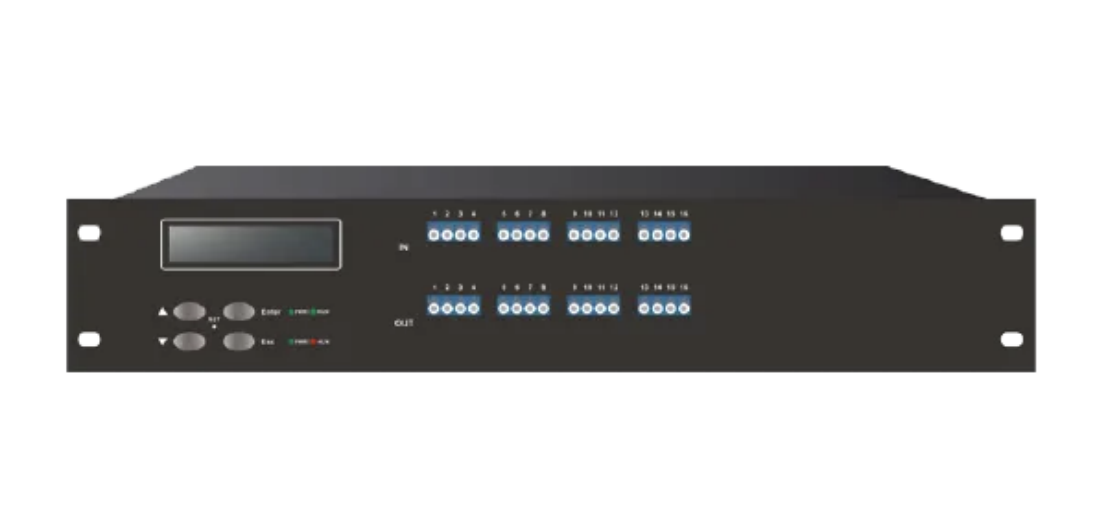
The operational reliability of optical circuit switches relies directly on microscopic mechanical engineering and precise manufacturing standards. The physical design of HTF’s OCS chassis reflects meticulous attention to detail and robust industrial construction tailored for demanding environments:
- Chassis and Mechanical Enclosure: Engineered with high-rigidity 19-inch rack-mountable aluminum-zinc alloy enclosures, featuring anti-vibration structural reinforcement to protect internal free-space optical components from ambient datacenter vibrations and mechanical shock.
- Optical Alignment and Mirror Craftsmanship: Micro-mirrors are manufactured using advanced semiconductor etching processes and gold-coated reflective surfaces, achieving reflectivity exceeding 98.5 percent across the C-band and L-band spectrums.
- Fiber Array Pitch and Termination: Clean room micro-assembly procedures ensure sub-micron alignment tolerances for incoming and outgoing MPO and LC fiber arrays, maintaining consistent insertion loss and minimal return loss across hundreds of optical ports.
- Thermal and Environmental Control: Dual hot-swappable redundant power supply modules are paired with intelligent variable-speed cooling fans and localized thermoelectric coolers (TEC) to maintain precise internal temperature stability, guaranteeing long-term beam pointing accuracy across varying operational thermal environments.
Technical Analysis 4: Integration with DWDM, WSS, and High-Speed Transceiver Ecosystems
Modern North American telecommunications and cloud interconnect architectures demand seamless integration between physical-layer switches, wavelength division multiplexing (WDM) systems, and high-speed transceivers. HTF’s OCS platform is engineered to operate harmoniously alongside DWDM and DCI-BOX platforms, Wavelength Selective Switches (WSS), Optical Line Protection (OLP) units, and Erbium-Doped Fiber Amplifiers (EDFA). When deployed at edge data centers, electric utility communication backbones, or long-haul transport nodes, the OCS can dynamically re-route wavelength-multiplexed channels during fiber cuts or maintenance windows. Moreover, HTF’s matching portfolio of 400G and 800G QSFP-DD/OSFP transceivers and custom MPO fiber assemblies ensures complete end-to-end physical layer compatibility, simplifying deployment and reducing interoperability testing overhead for US network integrators.
Technical Analysis 5: Software-Defined Networking (SDN) Control and US Compliance Standards
For deployment in top-tier American enterprise and operator networks, physical hardware must integrate cleanly into automated management ecosystems. The OCS architecture features an open Software-Defined Networking (SDN) management interface supporting standard protocols such as NETCONF, RESTCONF, and OpenFlow, as well as SNMP and Web-GUI interfaces. This open software integration allows US network operators to orchestrate optical circuit paths programmatically via centralized controllers, executing automated path protection, telemetry monitoring, and dynamic bandwidth allocation. Compliant with international Rhos, CE, and FCC standards, the hardware offers flexible customization modes that allow partners to tailor software protocols, port density configurations, and form factors to exact network deployment constraints.
By uniting precision optical engineering, low-power physical-layer routing, and seamless software integration, HTF provides a resilient, future-ready optical switching foundation tailored to the evolving bandwidth and sustainability demands of the North American market.
For more technical details and product portfolio information, visit the official website at https://htfuture.com/

This article was originally published by IssueWire. Read the original article here.