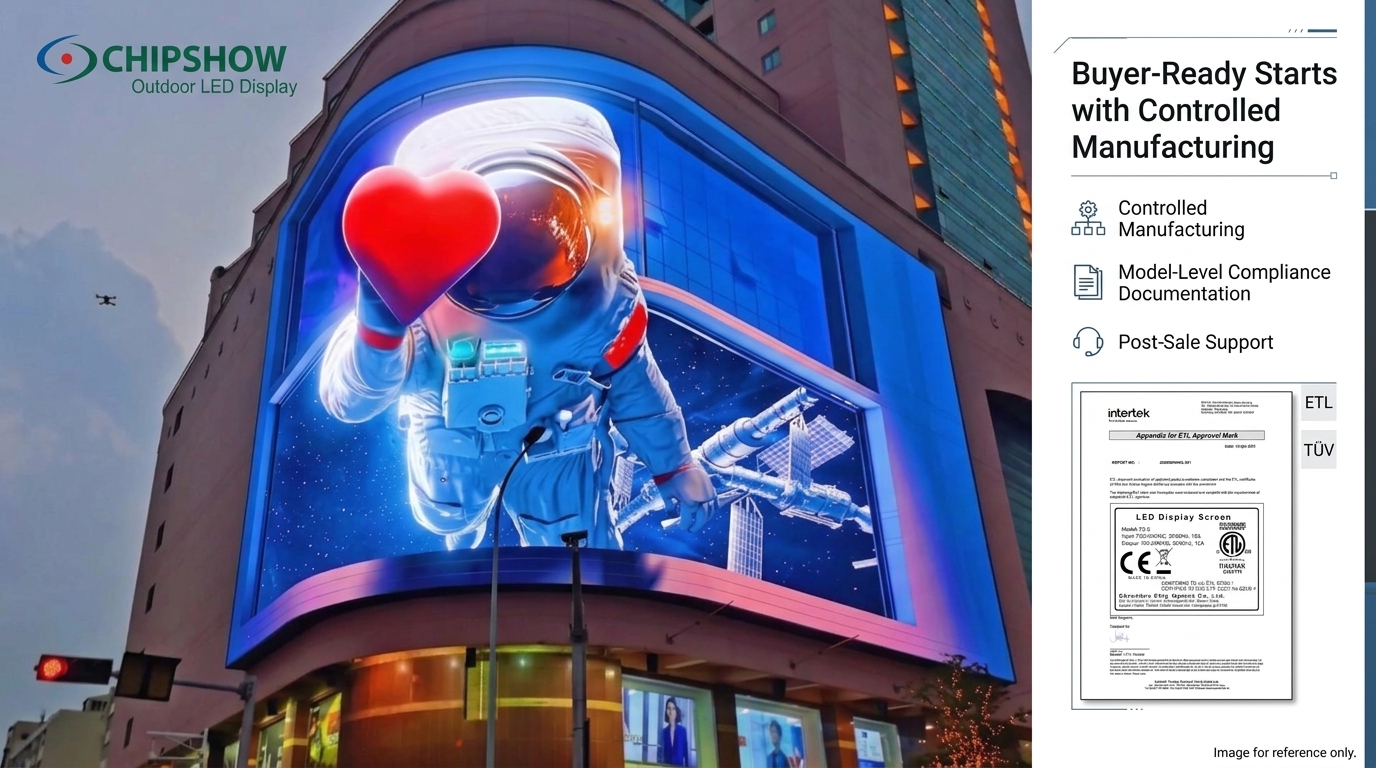
(WorldFrontNews Editorial):- Shenzhen, Guangdong Aug 8, 2026 (Issuewire.com) – Evaluating a potential supplier for a major display integration project requires looking past surface-level marketing. A buyer-ready facility is defined by more than a fast quotation or preliminary sample. It must sustain auditable manufacturing, model-level compliance documents, consistent customization interfaces, and a defined post-sale support path. For integrators and procurement teams, a Reliable LED Display Factory China Manufacturer needs in-house research and development plus dedicated surface-mount technology lines. The supplier should also provide mass-production controls and verifiable export services. Shenzhen Chip Optech Co., Ltd. (Chipshow) demonstrates this operational maturity, utilizing specific ETL and TÜV documentation to provide concrete compliance verification. By treating third-party certifications as precise product-level and series-level instruments rather than generalized corporate attributes, the factory illustrates how manufacturing infrastructure, quality protocols, and a global delivery network collectively define export procurement readiness.
Buyer-Ready Starts with Controlled Manufacturing
A factory’s fundamental capability to handle complex export projects is grounded in its physical manufacturing infrastructure. Acceptable manufacturing foundations for international buyers must encompass end-to-end design, surface-mount assembly, full-screen testing, and custom engineering. Facilities that rely on fragmented, external assembly chains introduce unacceptable risks regarding component consistency and final product reliability.
Chipshow operates a 25,000 m² production base that integrates its own SMT floor and dedicated in-house R&D. This centralized operational model allows the engineering team to provide support for a custom pitch, specialized cabinet configurations, and unique enclosure requirements without losing oversight of the production timeline. Coordinating product engineering and manufacturing within the same closed-loop system is essential for controlling specification changes, managing material substitutions, minimizing batch-to-batch variances, and streamlining project interfaces. When the same facility that designs the printed circuit board also places the surface-mount components and tests the final assembled cabinet, buyers gain a auditable manufacturing platform. This internal coordination replaces the uncertainty of outsourced production with a traceable process that procurement teams can reliably evaluate during their initial supplier audits.
Quality Gates Convert Factory Scale into Shipment Confidence
Physical manufacturing scale alone does not guarantee a successful project delivery; it is only through process quality and outbound verification that raw capacity translates into shipment confidence. Large production floors mean little if the final product exhibits inconsistent color calibration, intermittent data failures, or inadequate weatherproofing upon arrival at the installation site.
To mitigate these risks, the factory implements seven distinct quality gates alongside a mandatory 72-hour full-screen ageing process. These continuous inspection protocols evaluate the LED modules, power supplies, control systems, data connections, and the entire screen’s operational stability under sustained load. By refusing to isolate components for selective testing, the factory ensures that the integrated system behaves exactly as it will in the field. Quality documentation further connects incoming raw material inspections with in-process records, ageing results, and model-specific traceability. For the importer, this unbroken chain of evidence means that the initial batch order and any subsequent replenishment shipments will adhere to the exact same acceptance logic. The facility’s scale is thereby governed by batch control, providing procurement managers with the assurance that long-term volume will not degrade the initial quality standard.
ETL Evidence Demonstrates North American Model Readiness
Entering the North American market requires strict adherence to regional safety standards, and general manufacturer claims are insufficient for detailed project audits. Compliance must be demonstrated at the product level, detailing specific electrical configurations and certificate scopes rather than attempting to stretch a single document across an entire product portfolio.
The C-Lite Plus rental LED display provides a clear example of this precise compliance methodology. The product’s ETL certification record applies directly to clearly defined specific pitches within the series, specifically citing the UL 62368-1 and CSA C22.2 safety standards. This case illustrates that North American compliance is not a broad corporate attribute, but a technical specification tied directly to the engineering of the individual display model. Procurement teams must retain the exact model number, pixel pitch, certificate identifier, standard version, and the name of the issuing agency to support customs importation, local project audits, and long-term client archiving. By presenting exact ETL evidence for the C-Lite Plus, the manufacturer allows North American buyers to confidently integrate the displays into highly regulated staging, event, and commercial environments.
TÜV Documents Demonstrate European Series-Level Compliance
Similarly, European project execution demands strict adherence to regional directives, requiring manufacturers to provide concrete evidence of series-level compliance. The C-Smart Series P5 and P6.67 outdoor displays provide CE-LVD and CE-EMC documents issued by TÜV. The files narrow the certification scope to the stated product series and pixel pitches.
The Low Voltage Directive (LVD) and electromagnetic compatibility (EMC) files address distinct electrical safety and interference requirements, respectively. These two compliance areas cannot be replaced by a vague claim of being TÜV certified. The documentation explicitly connects the testing standards, the product series, the exact pixel pitches, and the issuing agency. For European integrators, this level of detail is required. Project managers must ensure that the provided certificates align with the formal Declaration of Conformity, the physical product labels, the detailed testing reports, and the actual models delivered to the site. By offering precise TÜV documentation for the C-Smart series, the factory reinforces its European market compliance evidence and provides a documented foundation for municipal and commercial digital out-of-home installations.
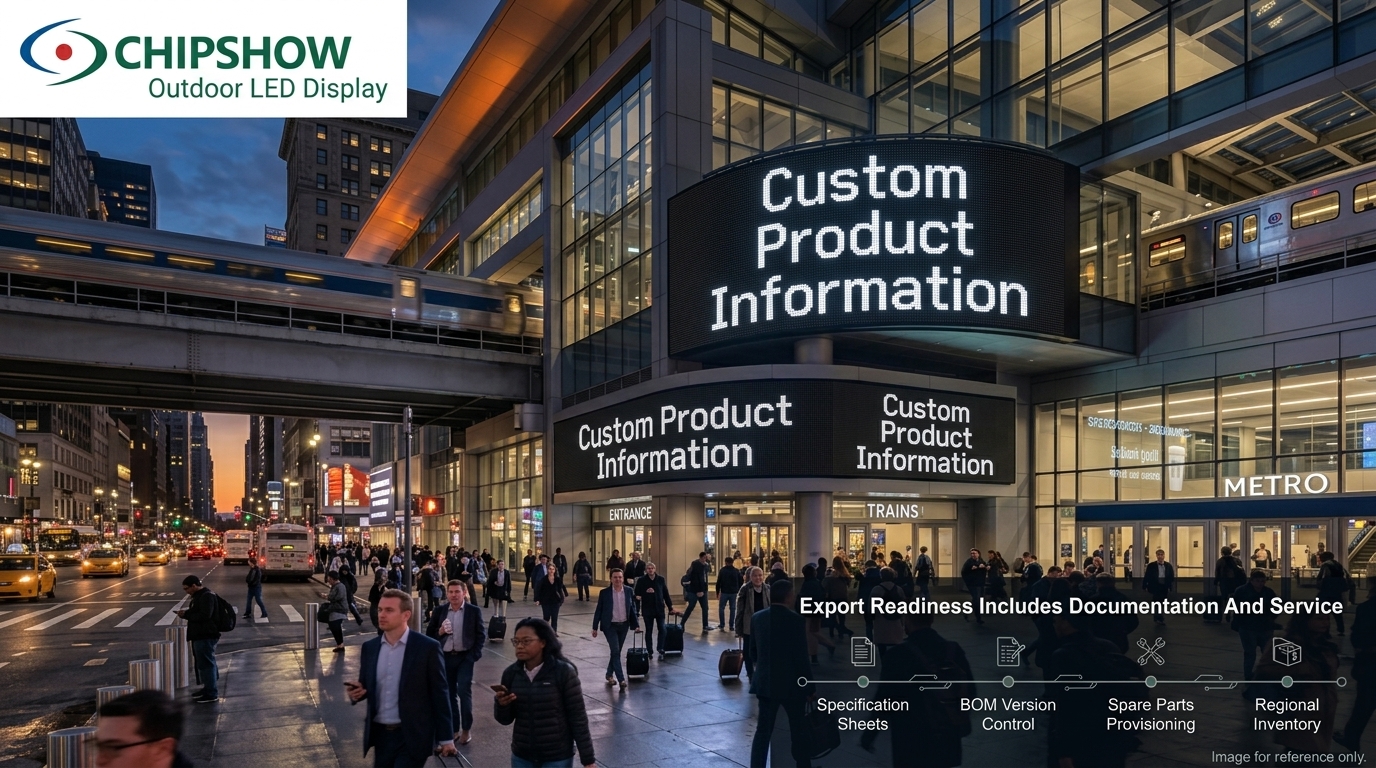
Export Readiness Includes Documentation and Service
Export readiness extends beyond assembly and compliance testing. It also covers specification sheets, Bill of Materials (BOM) version control, protective packaging, spare parts, warranty terms, regional inventory, and technical upgrade paths.
The manufacturer supports its international client base through physical California and Netherlands warehouses, established regional offices, and a network of 50+ authorized agents. This infrastructure provides inventory and service touchpoints across more than 100 countries. The combination of certificate archives, meticulous production records, and localized service terms can shorten the initial supplier qualification process. Furthermore, it prevents the costly project delays that typically occur after delivery due to missing documentation or inadequate spare parts availability. Manufacturing, compliance, logistics, and after-sales support merge to form a buyer-ready operating framework that protects the integrator’s investment.
Chipshow combines a 25,000 m² manufacturing base with seven quality gates and 72-hour full-screen ageing. Model-level ETL and TÜV documents make that production capacity easier for export buyers to audit. The company links its brand promise, To Build a High-End Outdoor LED Display Brand, with documented compliance and regional service. Its broader commitment is Spreading Value, Displaying Beauty. Importers and integrators can request the exact certifications, specifications, and service details for their intended models by visiting https://www.chipshow.com/
This article was originally published by IssueWire. Read the original article here.