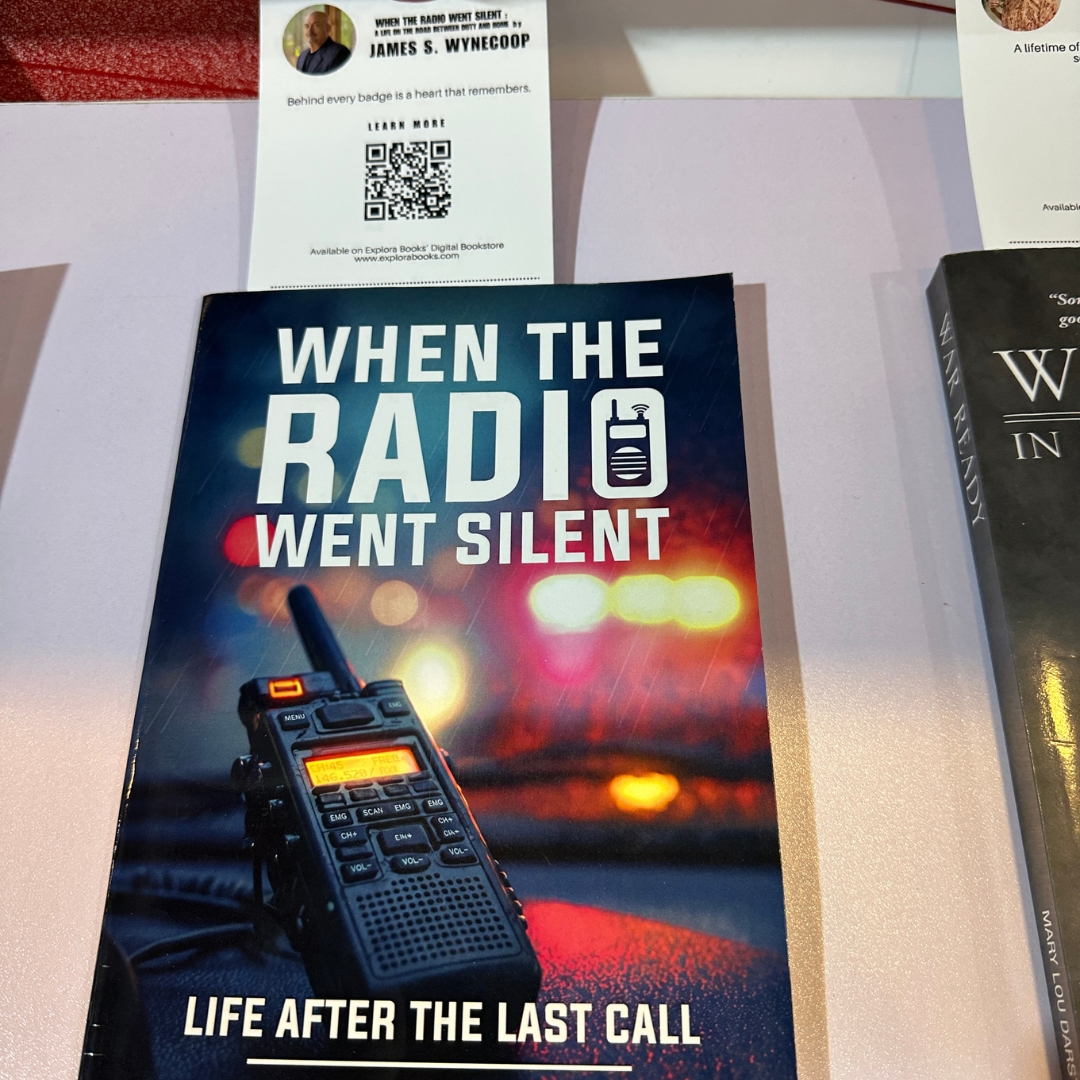
Explora Books presented ‘When the Radio Went Silent’ by James S. Wynecoop at the 32nd Beijing International Book Fair (BIBF), held June 17–21, 2026, at the China National Convention Center (CNCC) in Beijing.
(WorldFrontNews Editorial):- Vancouver, British Columbia Sep 14, 2026 (Issuewire.com) – Featured at the Explora Books booth as part of the publisher’s international exhibition catalog, the memoir introduced readers to an account of rural and tribal law enforcement and the lasting emotional weight carried beyond active duty.
Recognized as the second-largest book fair in the world and the most prominent international publishing event in Asia, BIBF marked its 40th anniversary with programming that foregrounded the global exchange of lived experiences, social realities, and perspectives that often receive less public attention. The fair’s theme, “Using Books as a Medium to Facilitate Communication and Dialogue, Leading to Cooperative Success for All Parties Involved,” reflected a publishing landscape increasingly attentive to nonfiction that examines the human dimensions of institutional work–a space that When the Radio Went Silent occupies with unusual directness and restraint.
Wynecoop opens his memoir with a distinction that shapes everything that follows: in the city, policing begins in a briefing room and ends when the officer returns to the station. In rural and tribal law enforcement, it begins in the driveway. The patrol car was parked where the children learned to ride their bikes. Dispatch is the phone ringing in the kitchen. The people arrested today are the people seen at the store tomorrow. There is no clear boundary between job and private life–and the memoir becomes an account of what that absence costs.
The book is organized not around dramatic incidents but around the experiences that accumulate across a long career: calls that never resolve, loss that arrives without warning, the weight that settles into sleep and patience, and the way silence feels heavier than noise. Wynecoop writes about sitting at the edge of the bed long after the house is quiet, replaying calls with no endings. He reflects on a professional culture that encouraged endurance and discouraged discussion–and on how that same culture can leave consequences that surface long after the moment itself has passed.
What distinguishes the memoir is its attention to those who stand on the other side of the badge. The chapters focused on family are among the book’s most affecting. Wynecoop describes how his family learned to read his expression when he came home, to let silence remain without trying to repair it, and to pause conversations when the radio interrupted. They did not choose the weight; he writes, but they carried it alongside him. That recognition runs throughout the memoir: service affects more than the person wearing the uniform.
The book does not arrive at a simple resolution. Wynecoop does not offer formulas for eliminating stress, nor does he romanticize resilience. Instead, he offers testimony shaped by years of encounters with people at their most vulnerable, frightened, and hopeful. A chapter on faith reflects on how the work complicated certainty while deepening something more difficult to define: not doctrine, but compassion developed one call at a time. Another focuses on the people who made it home–the individuals whose stories ended differently because someone stayed present. These are not victories that fill reports, he notes, but they are often what make lives possible.
The memoir also includes a dedicated section on resources and support for first responders and their families, emphasizing that the book functions not only as a reflection but also as a gesture toward the communities it describes.
For an international fair centered on storytelling as a vehicle for social understanding, the memoir extends beyond law enforcement itself. Its reflections on service, emotional carryover, and the challenge of separating work from private life speak to experiences recognizable across professions and cultures.
When the Radio Went Silent is available through Amazon and other major digital bookstores. For more information about the memoir and James S. Wynecoop’s work, visit James S. Wynecoop’s official website.
About Explora Books
Explora Books is a book marketing firm located in the heart of Vancouver, British Columbia, Canada. The company specializes in self-publishing and marketing, taking pride in its exhaustive research and creative strategies that provide wider avenues for aspiring authors to gain recognition for their works. Explora Books aims to guide authors through the complexities of self-publishing, offering convenient solutions to navigate this process. The firm fosters and redefines creativity and innovation, setting new industry standards. Explora Books is dedicated to empowering authors globally.

Media Contact
Explora Books Ltd
(604) 259-9775
700 – 838 West Hastings St.
This article was originally published by IssueWire. Read the original article here.