(WorldFrontNews Editorial):- Shenzhen, Guangdong Sep 23, 2026 (Issuewire.com) – As electric vehicle architectures continue to evolve, DC-DC conversion has become an important part of vehicle power management. Different electrical systems can operate at different voltage levels, creating a need for reliable power conversion between high-voltage battery systems and lower-voltage vehicle components. For EV manufacturers, system integrators, and power electronics engineers, selecting an appropriate 3kW DC-DC converter for EV applications requires attention to input range, output requirements, conversion efficiency, protection functions, thermal management, and application compatibility.
Huyssen Power has developed a broad power-supply portfolio covering AC-DC power supplies, DIN rail power supplies, programmable power supplies, battery chargers, and DC-DC converters. Established in 2011, the company reports more than 1,300 product models and applications across industries including automotive electronics, EV cars, communications, healthcare, aerospace, consumer electronics, and LED lighting.
Why DC-DC Conversion Matters in EV Power Systems
Electric vehicles commonly incorporate electrical subsystems operating at different voltage levels. A high-voltage battery system may need to provide power to components that require a lower DC voltage. A DC-DC converter performs this conversion while helping maintain an appropriate electrical supply for connected equipment.
For EV applications, the converter therefore needs to be considered as part of the overall power architecture rather than as an isolated component. Input voltage range, output voltage, rated power, current capability, thermal conditions, electrical isolation, and protection functions can all influence whether a particular converter is suitable for a vehicle system.
Huyssen’s DC-DC converter portfolio includes both lower-power models and higher-power solutions. The company’s product range includes a Buck Converter with a 200-500V DC input, 3kW output power, and 0-32V DC output for EV applications. According to the product information, this converter is designed with an ultra-wide input range and can adapt to power battery systems with different voltage levels. The product is also positioned for new energy vehicles and railway vehicles.
Start With the Required Input Voltage Range
Input voltage is one of the first specifications to evaluate when selecting a 3kW DC-DC converter for an EV.
Vehicle battery voltage can vary according to vehicle architecture, battery configuration, operating conditions, and system design. A converter with a sufficiently broad input range can provide greater flexibility when working with different battery voltage levels.
Huyssen’s 3kW EV converter is specified with a 200-500V DC input range. This wide input window is intended to accommodate power battery systems operating across different voltage levels.
For system designers, the nominal battery voltage should not be the only consideration. The minimum and maximum operating voltage should also be evaluated to ensure that the converter remains within its specified operating range under different battery conditions.
Define the Required Output Voltage and Power
After confirming the input range, the next step is to determine the required output voltage and power.
A 3kW DC-DC converter can be appropriate for applications requiring substantially more power than compact auxiliary converters. The actual output requirement should be calculated from the connected load, including normal operating demand and any relevant transient requirements.
Huyssen’s 3kW EV converter provides a 0-32V DC output range, allowing the output configuration to accommodate different low-voltage power requirements within its specified operating range. The product information also indicates that different input and output configurations and multiple models are available for different power battery systems.
Selecting a converter solely because its rated power reaches 3kW can overlook other system requirements. Output voltage, current demand, operating conditions, and integration requirements should be evaluated together.
Consider Conversion Efficiency and Thermal Management
Efficiency becomes particularly important in EV power electronics because conversion losses are ultimately transformed into heat. Higher efficiency can help reduce energy losses and simplify thermal-management requirements.
Huyssen describes its 3kW converter as having high conversion efficiency and positions it for new energy vehicle and railway vehicle applications.
Thermal management should nevertheless be considered at the system level. Installation space, airflow, ambient temperature, enclosure design, operating duty cycle, and surrounding components can all influence thermal performance.
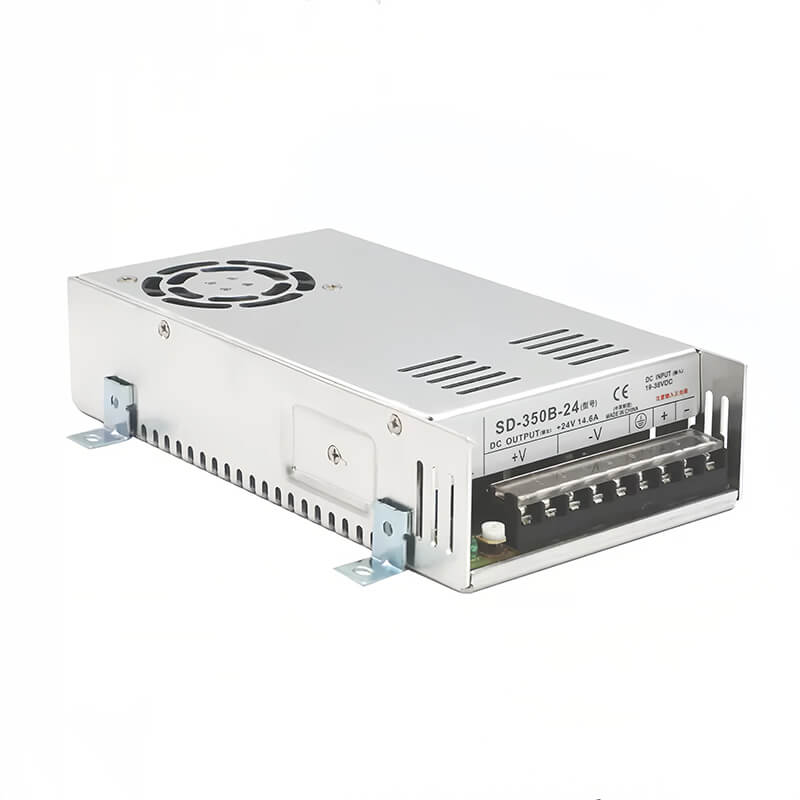
The company’s lower-power SD-350C series illustrates how Huyssen approaches power conversion across different application levels. The 350W converter series uses fan cooling and high-frequency switching technology with synchronous rectification, while the product description states that conversion efficiency exceeds 90%.
This 350W model should not be treated as a specification reference for the 3kW EV converter, but it demonstrates the broader DC-DC conversion technologies represented within Huyssen’s product portfolio.
Evaluate Electrical Isolation and Protection Functions
Protection features are another important consideration when selecting a DC-DC converter for vehicle and industrial applications.
The Huyssen SD-350C series incorporates input over-voltage and under-voltage protection, output over-voltage and over-current protection, short-circuit protection, and over-temperature protection. The product also specifies input and output electrical isolation and withstand voltage up to 1500V.
These features illustrate the types of protection that can be important in DC-DC power conversion. For a specific 3kW EV project, however, the applicable protection specifications should be confirmed against the exact model documentation rather than assumed from another product in the portfolio.
Check Application Compatibility
A DC-DC converter should match the actual operating environment of the target vehicle or equipment.
Huyssen’s DC-DC converter portfolio includes products intended for vehicles, new energy equipment, servo systems, base stations, and other devices. The 350W SD-350C-24 model, for example, is described as suitable for servo systems, base stations, vehicles, new energy vehicles, and various other equipment.
The company’s 3kW converter is specifically listed for EV applications and is also described as suitable for railway vehicles. This broader application positioning highlights the importance of selecting converter specifications according to the electrical architecture and operating environment of the target system.
Consider Product Development and Customization Requirements
Standard specifications may not always match the requirements of a particular EV project. Input and output voltage, mechanical dimensions, installation conditions, power level, thermal requirements, and other design parameters can vary between applications.
Huyssen states that its R&D team provides design services for special requirements and can develop custom-made power supplies when a suitable catalog model is not available. The company’s stated customization process covers requirements communication, on-demand design, design confirmation, sampling, product validation, mass production, quality inspection, and delivery.
This development process can be relevant for EV projects where a standard DC-DC converter does not fully match the vehicle’s power architecture.
Review Quality Control Before Integration
Quality assurance is another factor in selecting a power-conversion supplier.
Huyssen states that its products are engineered to meet worldwide safety standards and that quality and process control are applied throughout the manufacturing cycle. The company also states that products undergo burn-in and automated final testing before shipment. Its production bases are located in Shenzhen and Dongguan.
For EV applications, supplier evaluation should also include verification of the exact model’s certifications, electrical specifications, testing requirements, production consistency, and documentation before system integration.
Huyssen’s Broader Power Electronics Portfolio
The selection of a 3kW DC-DC converter can also be considered within the context of the complete power architecture.
Huyssen’s portfolio includes AC-DC power supplies, DIN rail power supplies, programmable power supplies, battery chargers, DC-DC converters, and other power products. The company reports more than 1,300 models and states that 2-3 new power-supply models are introduced each month as part of its ongoing product development strategy.
For global power-system developers, a broad product portfolio can provide additional options when multiple power-conversion stages are required within the same project.
A Practical Checklist for Selecting a 3kW DC-DC Converter for EVs
Before finalizing a converter, several technical points should be reviewed:
- Input voltage:Confirm the converter covers the full operating voltage range of the battery system.
- Output voltage:Match the output range with the requirements of the connected low-voltage system.
- Rated power:Verify that the converter can support the required continuous load.
- Current capability:Confirm the available output current at the required voltage.
- Efficiency:Evaluate conversion losses and their impact on vehicle energy consumption and thermal management.
- Cooling:Review the cooling method and installation environment.
- Protection:Check available over-voltage, under-voltage, over-current, short-circuit, and over-temperature protection.
- Isolation:Confirm whether electrical isolation is required by the vehicle architecture.
- Application compatibility:Verify suitability for EV, new energy vehicle, railway, or other target applications.
- Customization:Determine whether mechanical or electrical modifications may be required.
- Quality assurance:Review testing, certification, production controls, and documentation for the exact model.
Conclusion
Choosing the right 3kW DC-DC converter for EV applications requires more than comparing rated power. Input voltage range, output requirements, efficiency, thermal management, protection, electrical isolation, application environment, and customization capabilities all contribute to the suitability of a converter within an EV power architecture.
Huyssen Power has developed a broad portfolio of power-conversion products since its establishment in 2011, including DC-DC converters for different voltage and power requirements. Its listed 3kW EV converter supports a 200-500V DC input and 0-32V DC output and is positioned for new energy vehicle and railway applications.
For projects requiring different power levels, Huyssen’s broader DC-DC converter range includes models such as the SD-350C series, while its stated R&D and customization services provide additional options for application-specific power requirements.
Official Website: https://www.huyssenpsu.com/
Media Contact
Shenzhen Huyssen Technology Co., Ltd.
0086-13570841067
This article was originally published by IssueWire. Read the original article here.