(WorldFrontNews Editorial):- Washington, D.C, District of Columbia Nov 12, 2026 (Issuewire.com) – National Book Access Association Releases 2026 Member Survey Showing Small Teams Distribute More Than 7.4 Million Books to Children
Summary: NBAA survey of 42 book access groups in 21 states finds small, volunteer-powered teams gave away 7.4 million books and want help measuring their impact.
The National Book Access Association (NBAA), a national network of nonprofits and programs that provide free books to children and families, today released the results of its 2026 Member Survey. The survey offers one of the first detailed looks at the organizations behind book access work in the United States: how they are staffed, how they reach families, how they are funded, and what support they need next.
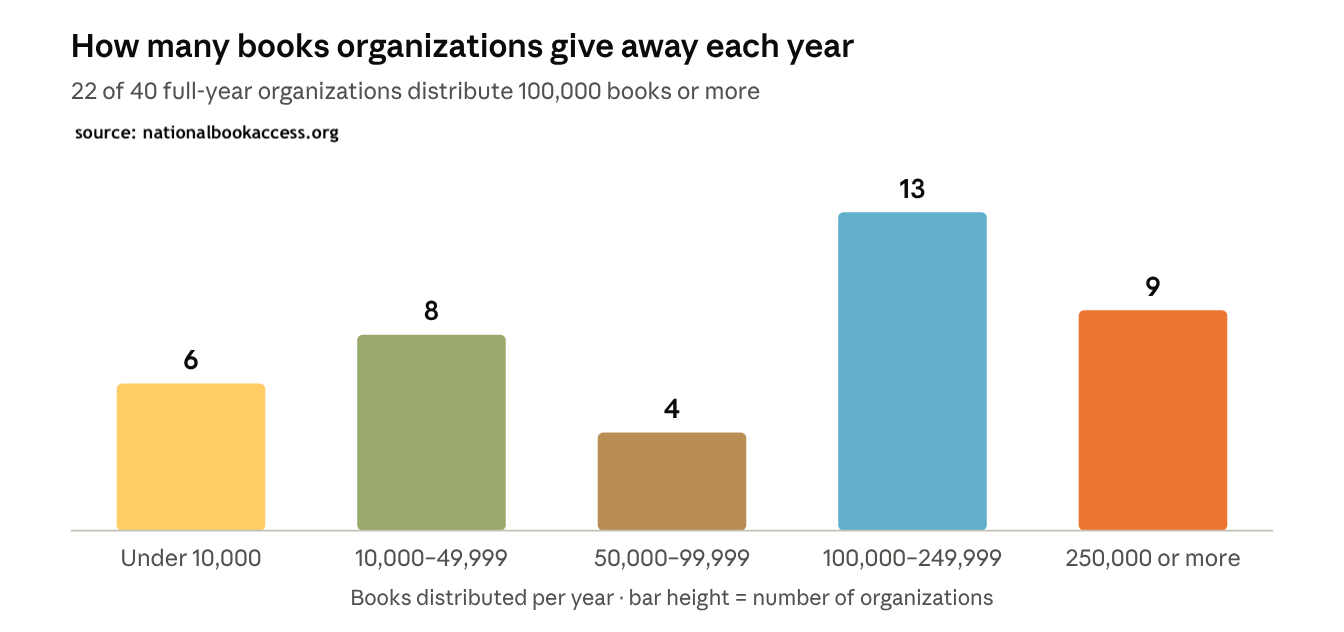
Forty-two organizations in 21 states responded to the survey, which NBAA conducted from September 3 to October 12, 2026. The 40 organizations that reported a full year of activity said they collectively distributed more than 7.4 million print books for children and families to keep.
Those books moved through schools, clinics, child care centers, libraries and community events. According to the survey, most of the organizations doing that work have very few paid employees. The median organization, meaning the one in the middle when all respondents are ranked, reported two full-time and two part-time employees. Nine organizations reported no paid staff at all.
“Our members are moving millions of books with teams you could fit around a kitchen table, and with the help of tens of thousands of volunteers,” said Emily Ball Cicchini, president of NBAA and executive director of BookSpring. “This survey gives us a clearer picture of who is doing this work and what they need. The question in front of all of us is whether we are willing to give these organizations what they need to keep books coming to children year after year, and to measure what those books make possible, together.”
Organizations of very different sizes
The survey found wide differences in scale. The typical respondent distributed about 108,000 books in a year, and 22 of the 40 full-year organizations reported at least 100,000. The five largest distributors accounted for roughly half of all books reported. NBAA notes that the total likely includes some double counting, because member organizations often pass books to one another before those books reach a child.
Financial resources varied even more. Annual resources devoted to book access, including donated goods, ranged from about $5,000 to $13.5 million. The median was $415,000 among the 33 organizations that provided usable estimates. Because these organizations operate in such different ways, the survey report advises against using a single efficiency benchmark for the whole field. A volunteer-run suburban program and a regional distribution hub with an urban warehouse are better compared with peers that serve similar communities and use similar models.
Volunteers and partners make the work possible
Volunteers are a large share of the book access workforce. The median organization reported 300 volunteers a year, and respondents together reported nearly 40,000 people giving their time.
Partnerships are just as important. Thirty-four of the 42 respondents distribute at least some books through other organizations, and the median respondent works with about 80 distribution partners. Schools, libraries and child care centers were the most common channels, cited by 36 respondents. They were followed by community organizations (34), family and public events (28), classroom library collections (23), health care settings (17) and direct mail to children’s homes (12).
A focus on young children and reading together
Nearly every respondent serves young children. Forty-one serve 3- and 4-year-olds, 40 serve children ages 5 to 8, and 37 serve infants and toddlers. Twenty-six also serve teenagers.
Many organizations pair books with reading activities. Twenty-one offer read-aloud storytimes, 20 host book fairs, 11 arrange author visits and nine run workshops for parents or for parents and children together. Twenty-five said they let children choose their own books.
At the median organization, about 62 percent of books distributed are new or like new. About 10 percent are in Spanish or are English-Spanish bilingual, although a few organizations focus heavily on bilingual books.
Funding comes from many sources. Thirty-nine respondents rely on individual donors, 38 on corporate support and 38 on foundation grants. Thirty-four receive donated books, and 16 receive government grants or contracts.
The measurement gap
Every respondent tracks how many books it gives away, but far fewer measure what happens after a book reaches a home. Nineteen organizations said they track children’s attitudes toward reading, 16 track the size of home libraries, 15 track reading habits and six track literacy outcomes. Seventeen said they do not currently measure these effects.
Respondents also count the people they serve in different ways. Only 12 described their figures as unique individuals, meaning each child is counted once. Others count service encounters, rely on estimates from partners or combine methods. For that reason, the survey does not estimate a total number of children reached.
Members said they want to close this gap. Impact and outcome measurement was the most frequently cited priority for NBAA support. Thirty-five of 42 respondents, or 83 percent, rated it a high or moderate priority, and 20 rated it high. Networking with peers was next, cited by 33 respondents.
Some respondents noted that a child’s reading growth has many influences, and that individual programs should focus on what they directly change, such as book ownership, access, choice and family reading. A shared starting point may already be within reach: 27 respondents said they track or could track where their books go by ZIP code, and nine more said they might be able to.
Why consistent access matters
Recent research adds weight to the survey’s findings. In a five-year randomized trial published in April 2026 in the Proceedings of the National Academy of Sciences, researchers Geoffrey Borman of Arizona State University and Hyunwoo Yang of the Chinese University of Hong Kong studied students in high-poverty elementary schools in Milwaukee. Students who were offered up to 34 free books to keep scored higher on the state reading test than peers in comparison schools. Students who received every distribution over the five years gained the equivalent of about half to two-thirds of a typical year of learning, at a cost of roughly $2 per book.
The authors describe book distribution as “a promising and easily scalable strategy for improving literacy outcomes in high-poverty schools.” They also note that the study took place during the COVID-19 pandemic and should be repeated in other settings. Students whose access to books was uninterrupted saw about twice the gains of those whose access was not, a finding that supports tracking whether children are served repeatedly over time.
What comes next
The survey report recommends that NBAA develop a small common dataset for members. That dataset would separate books given to keep from books loaned, individual children from partner organizations, and purchased books from donated ones, and it would record whether children are served more than once. The report also recommends organizing peer learning by organization size and model, connecting experienced members with those looking to grow, and surveying the same organizations again to track change over time.
Thirty-seven respondents said they would take part in a future survey, and two more said they might. In open-ended responses, members also asked for more attention to diversity and representation in books, more direct communication from the association, collective advocacy, and webinars focused on learning rather than vendor promotion.
About the survey
The 2026 NBAA Member Survey was conducted from September 3 to October 12, 2026, and invited both active and prospective member organizations to respond. Forty-two organizations participated. All figures are self-reported. Annual totals exclude one commercial supplier and one organization reporting a partial year. Results describe responding organizations and should not be generalized to the entire book access field.
Study cited: Borman, G. D., and Yang, H. (2026). Cumulative access to print books improves literacy achievement: Evidence from a five-year randomized trial in high-poverty schools. Proceedings of the National Academy of Sciences, 123(17), e2521416123. https://doi.org/10.1073/pnas.2521416123
About the National Book Access Association
The National Book Access Association (NBAA) was founded in 2022 by 12 nonprofit book access organizations and now has 400 members. NBAA offers more than 40 networking and professional development events each year, plus an annual virtual conference.
NBAA’s vision is that everyone, regardless of income or status, should have free access to own, share, read and enjoy books. Its shared mission is to strengthen the impact of book distribution organizations through strategic collaboration, resource-sharing and professional development, in order to increase the capacity of the sector to provide equal access to books for all people. The NBAA is a sponsored project of First Book.
Media Contact
Maria Dismondy Association Director
National Book Access Association
Phone: 248-302-1800
Email: [email protected]
Media Contact
National Book Access Association
248-302-1800
National Book Access Association c/o First Book1319 F St NW, Suite 1000