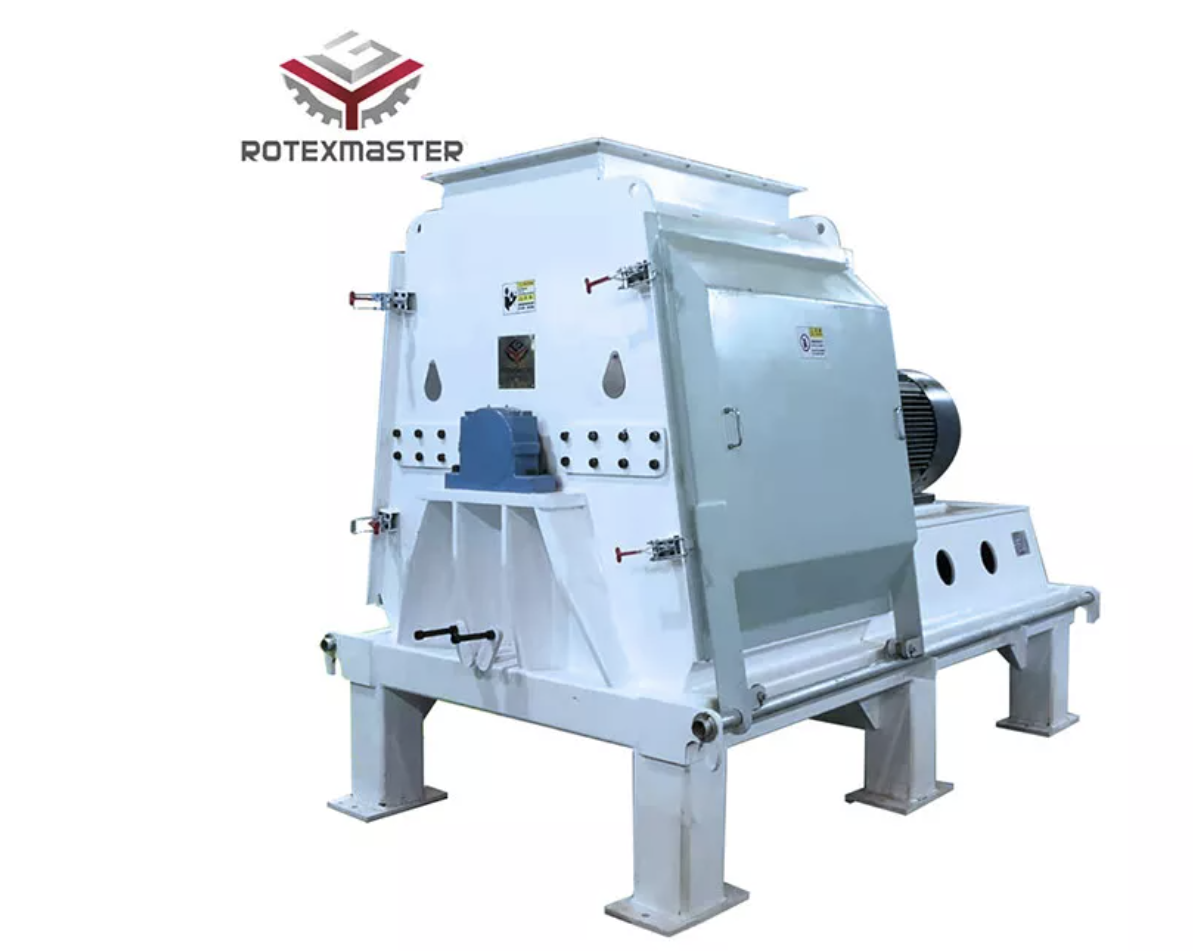
(WorldFrontNews Editorial):- Jinan, Shandong May 23, 2026 (Issuewire.com) – The global supply chain has focused significantly on identifying a High Quality Hammer Mill Machine Manufacturer In China capable of delivering reliable, industrial-grade reduction machinery that balances structural durability with high operational efficiency. Within this competitive industrial landscape, Shandong Bolida Machinery Co., Ltd. has positioned itself as a highly integrated entity that moves beyond simple equipment assembly. Known globally under its brand name BOLIDAMACHINERY, the enterprise represents a modern synthesis of scientific research, technology development, large-scale manufacturing, and international trade. By maintaining a deep focus on the mechanical principles of size reduction and environmental protection engineering, the firm provides an instructive case study on how Chinese industrial machinery manufacturers have transitioned from manufacturing execution to technological leadership.
Analysis 1: Structural Scaling and Industrial Manufacturing Infrastructure
A comprehensive evaluation of any machinery manufacturer must begin with its underlying operational infrastructure, as the scale of production facilities directly influences manufacturing consistency and quality control. Operating with a registered capital of 35 million RMB, the company maintains an expansive production footprint covering an area of more than 80,000 square meters. This substantial spatial infrastructure accommodates advanced manufacturing machinery, specialized assembly lines, and rigorous quality testing stations.
Supported by a dedicated workforce of more than 300 skilled professionals, including specialized engineers and scientific research personnel, the manufacturing environment is structured around systemic quality management. The physical and human capital density allows for the simultaneous execution of complex engineering designs and high-volume output without compromising structural tolerances. For international industrial clients, this operational scale provides a reliable guarantee of production capacity, ensuring that large-scale project orders for comprehensive biomass processing or waste management lines can be fulfilled within predictable, structured timelines.
Analysis 2: Technical Innovations in Core Rotor Dynamics and Discharge Design
When analyzing size reduction equipment, the performance limitations of a hammer mill are primarily dictated by its drive mechanism, rotor dynamics, and product discharge efficiency. Conventional hammer mills often suffer from mechanical energy transmission losses due to complicated belt drive arrays, which also increase maintenance overhead. To mitigate these inherent mechanical inefficiencies, modern industrial designs utilize a direct-coupling configuration where the electric motor connects to the rotor assembly directly.
Through this direct-coupling engineering, the rotational speed of the rotor assembly can reach up to 3000 revolutions per minute (r/min). This structural approach substantially minimizes intermediate power transmission losses, maximizing energy conversion efficiency and lowering the overall kilowatt consumption per ton of processed material. Furthermore, optimization is evident in the discharge configuration. Instead of traditional unidirectional output, advanced systems feature bilateral discharge windows, effectively increasing the active discharge area. This configuration prevents material accumulation inside the grinding chamber, ensures seamless processing, and significantly escalates hourly capacity while minimizing structural wear on the screen components.
Analysis 3: Parametric Analysis and Equipment Specifications
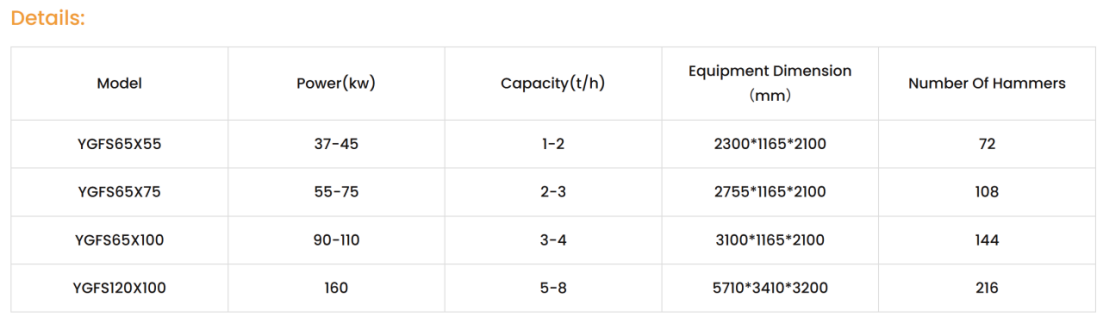
An objective assessment of technical capability relies heavily on empirical equipment data. A review of standard industrial model specifications demonstrates how engineering design scales alongside processing requirements. By looking at specific variations in physical footprint, power allocation, and internal components, operators can align precise technical parameters with their specific material processing objectives.
The technical breakdown of standard industrial models reveals the following operational parameters:
- Model YGFS65x55:Operating with a power rating between 37 kW and 45 kW, this system integrates 72 individual hammers within its internal assembly. It delivers a reliable throughput capacity of 1 to 2 metric tons per hour (t/h), occupying physical equipment dimensions of 2300 mm x 1165 mm x 2100 mm.
- Model YGFS65x75:Designed for intermediate industrial demands, this model operates via a 55 kW to 75 kW power source. The internal rotor is configured with 108 hammers, scaling the throughput capacity to 2 to 3 tons per hour within dimensions of 2755 mm x 1165 mm x 2100 mm.
- Model YGFS65x100:This heavy-duty model utilizes a power range of 90 kW to 110 kW and features an expanded array of 144 hammers. It achieves a processing capacity of 3 to 4 tons per hour, with equipment dimensions measured at 3100 mm x 1165 mm x 2100 mm.
- Model YGFS120x100:Representing the highest tier of high-capacity industrial processing, this system is driven by a 160 kW motor and features a complex array of 216 hammers. It is engineered to process between 5 and 8 tons of raw material per hour, requiring a larger physical installation footprint of 5710 mm x 3410 mm x 3200 mm.
To ensure long-term operational viability across all models, the particle sizing of the internal screen can be precisely adjusted based on specific raw material demands. Additionally, to comply with strict industrial environmental standards, these systems are engineered to operate in close integration with a dedicated Cyclone separator and an industrial Bag Dust Collector, achieving superior dust extraction and collecting fine particulates from the workplace environment safely.
Analysis 4: Diversified Application Scenarios and Global Quality Compliance
The real-world value of industrial size-reduction machinery is proven by its adaptability across different raw material inputs and strict regulatory frameworks. High-efficiency size reduction technologies are not restricted to a single raw material; instead, they serve as the foundational processing step for multiple primary sectors, including biomass fuel fabrication, forestry residue utilization, agricultural waste processing, and urban or rural environmental remediation.
The versatile processing capabilities of these systems allow them to handle diverse organic feedstocks, including:
- Forestry industry residues, wood chips, and raw timber off-cuts.
- Agricultural crop residues, including wheat straw, corn stalks, and rice husks.
- Diverse fibrous biomass materials requiring precise size standardization prior to pelletization or briquetting.
To sustain operations across diverse global markets, industrial equipment must strictly comply with recognized international standards. The manufacturer’s quality and safety systems have successfully obtained ISO9001-2000 international quality management certification, alongside European CE certification and comprehensive SGS technical identification. These verified credentials have allowed the enterprise to expand its footprint far beyond domestic borders. Today, its specialized equipment is distributed across more than 10 domestic provinces and autonomous regions, and exported to international markets across Europe, North America, South America, Southeast Asia, and Africa. This extensive international presence reflects the global industrial sector’s ongoing shift toward verified, highly standardized processing solutions.
Corporate website for further technical details and product inquiries: https://www.biopelletmachinery.com/
This article was originally published by IssueWire. Read the original article here.