Dual-Spacecraft Architecture Will Conduct Rapid-Response Apophis Sample Return Mission While Establishing the Foundation for a Permanent Planetary Defense Network
(WorldFrontNews Editorial):- Washington, D.C, District of Columbia Jun 18, 2026 (Issuewire.com) – The Defense Security Resilience Foundation (DSRF) today announced the Interstellar Comet Explorer (ICE), a proposed dual-spacecraft planetary defense mission designed to establish the first operational cislunar interceptor architecture capable of rapidly responding to asteroid threats, transient objects, and future interstellar visitors.
The mission represents a significant departure from traditional planetary defense approaches, which rely primarily on detection and long-term mitigation planning. Instead, ICE introduces the concept of persistent operational readiness through spacecraft stationed in cislunar space and maintained in a state of continuous response capability.
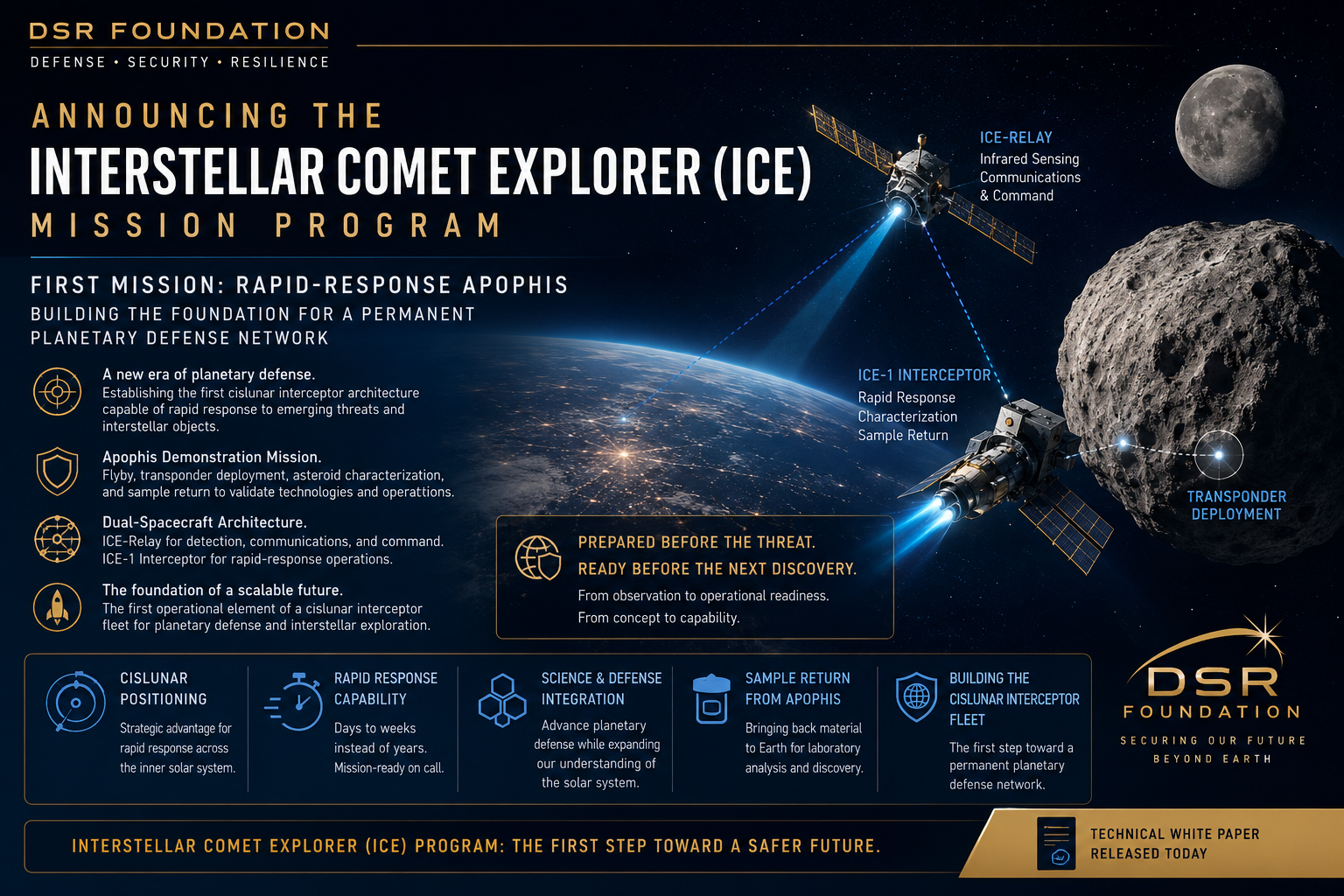
The inaugural mission will focus on asteroid 99942 Apophis, one of the most extensively studied near-Earth asteroids and a uniquely valuable target for demonstrating next-generation planetary defense technologies. Operating from cislunar space, the ICE system will conduct a rapid-response intercept mission that includes close-proximity characterization, deployment of tracking transponders, prospecting operations, and the return of asteroid material to Earth for scientific analysis.
“The objective is not simply to visit Apophis,” said James A. Wolff, founder of the Defense Security Resilience Foundation. “The objective is to demonstrate that humanity can maintain a standing interception capability in space. Apophis provides the proving ground. The larger vision is a permanent planetary defense infrastructure capable of responding wherever and whenever the next opportunity or threat emerges.”
The ICE architecture consists of two spacecraft operating as an integrated system. The first vehicle, designated ICE-Relay, serves as a dedicated infrared sensing, communications, and command platform positioned in cislunar space. The second vehicle, ICE-1, functions as a rapid-response interceptor capable of departing its loiter orbit to investigate, characterize, and interact with target objects throughout the inner solar system.
Together, the two spacecraft establish the foundational elements of what DSRF describes as a future Cislunar Interceptor Fleet, a scalable network of coordinated response vehicles designed to provide persistent planetary defense capabilities beyond Earth orbit.
During the Apophis mission, the interceptor spacecraft will deploy advanced transponder beacon systems intended to establish long-duration tracking and telemetry capabilities on or around the asteroid. The mission will also demonstrate deployable prospecting and characterization technologies derived from prior asteroid exploration research, including penetrator-based systems designed to assess surface and subsurface properties. Material collected during the encounter is expected to be returned to Earth, providing direct scientific insight into the composition and structure of a potentially hazardous asteroid while validating operational procedures for future missions.
The architecture leverages technologies developed through prior NASA-recognized research efforts involving distributed sensing, autonomous spacecraft operations, asteroid prospecting systems, and swarm coordination concepts. By integrating these technologies into a unified operational framework, ICE seeks to demonstrate that rapid-response planetary defense capabilities can be developed at substantially lower cost than traditional deep-space missions.
DSRF envisions future expansion of the architecture beyond the initial two-spacecraft configuration. Additional interceptor vehicles could be deployed and coordinated through the relay network, creating a distributed response capability capable of supporting scientific exploration, asteroid characterization, planetary defense missions, and future interstellar object interception campaigns.
While Apophis serves as the program’s first operational target, the mission’s long-term objective extends far beyond a single asteroid encounter. The Interstellar Comet Explorer is intended to establish the infrastructure, operational doctrine, and technological foundation required to intercept future interstellar objects entering the solar system, an objective that has remained beyond reach since the discoveries of Oumuamua and 2I/Borisov.
“The next interstellar object will arrive whether we are prepared or not,” Wolff said. “The question is whether we will still be observers, or whether we will finally possess the infrastructure necessary to engage it directly.”
A comprehensive technical white paper detailing the Interstellar Comet Explorer (ICE) architecture, the Apophis Demonstration Mission, and the long-term vision for a scalable cislunar interceptor fleet is being released concurrently with today’s announcement. The paper outlines the mission’s scientific objectives, planetary defense applications, system architecture, operational concepts, and roadmap toward a persistent space-based rapid-response capability for future asteroid and interstellar object encounters. The Foundation plans to engage scientific institutions, industry partners, and government stakeholders in support of the program’s continued development.
If successful, ICE would represent the first step toward a permanent space-based rapid-response capability and the beginning of a new era in planetary defense, one defined not by reaction after discovery, but by readiness before the next challenge appears.
About the Defense Security Resilience Foundation
The Defense Security Resilience Foundation is a nonprofit research organization focused on planetary defense, emerging technologies, critical infrastructure resilience, space security, and long-term strategic risk reduction. The Foundation develops interdisciplinary initiatives that bridge science, policy, engineering, and operational capability development in support of global resilience and human security.
Media Contact
Defense Security Resilience Foundation, Inc.
19266 Coastal Hwy, Unit 4-1019, Rehoboth Beach, DE, 19971
This article was originally published by IssueWire. Read the original article here.