(WorldFrontNews Editorial):- Dongguan, Guangdong Jun 24, 2026 (Issuewire.com) – Industry 4.0 has fundamentally reshaped buyer expectations across precision manufacturing. Dimensional specs on a drawing no longer tell the whole story. A genuine Professional Tight Tolerance CNC Machining Solutions Provider today combines physical machining capability with digital process intelligence, certified quality governance, and full production traceability. This article addresses six questions that buyers should ask — and know how to evaluate the answers to — before committing to a precision CNC partnership.
Q1: Is Micron-Level Accuracy Enough, Or Has “Precision” Outgrown The Machine Itself?
Many procurement decisions still focus on equipment specifications: axis count, spindle speed, and advertised tolerance range. These numbers matter, but they describe only what a machine can achieve under ideal conditions — not what a supplier consistently delivers across real production batches.
Thermal drift accumulates as machines warm up during operation. Tool wear shifts cutting forces gradually, pushing dimensions toward tolerance limits without triggering obvious alerts. Fixture inconsistency introduces distortion that remains invisible until a part is unclamped and measured. Together, these variables define the real challenge in tight-tolerance work.
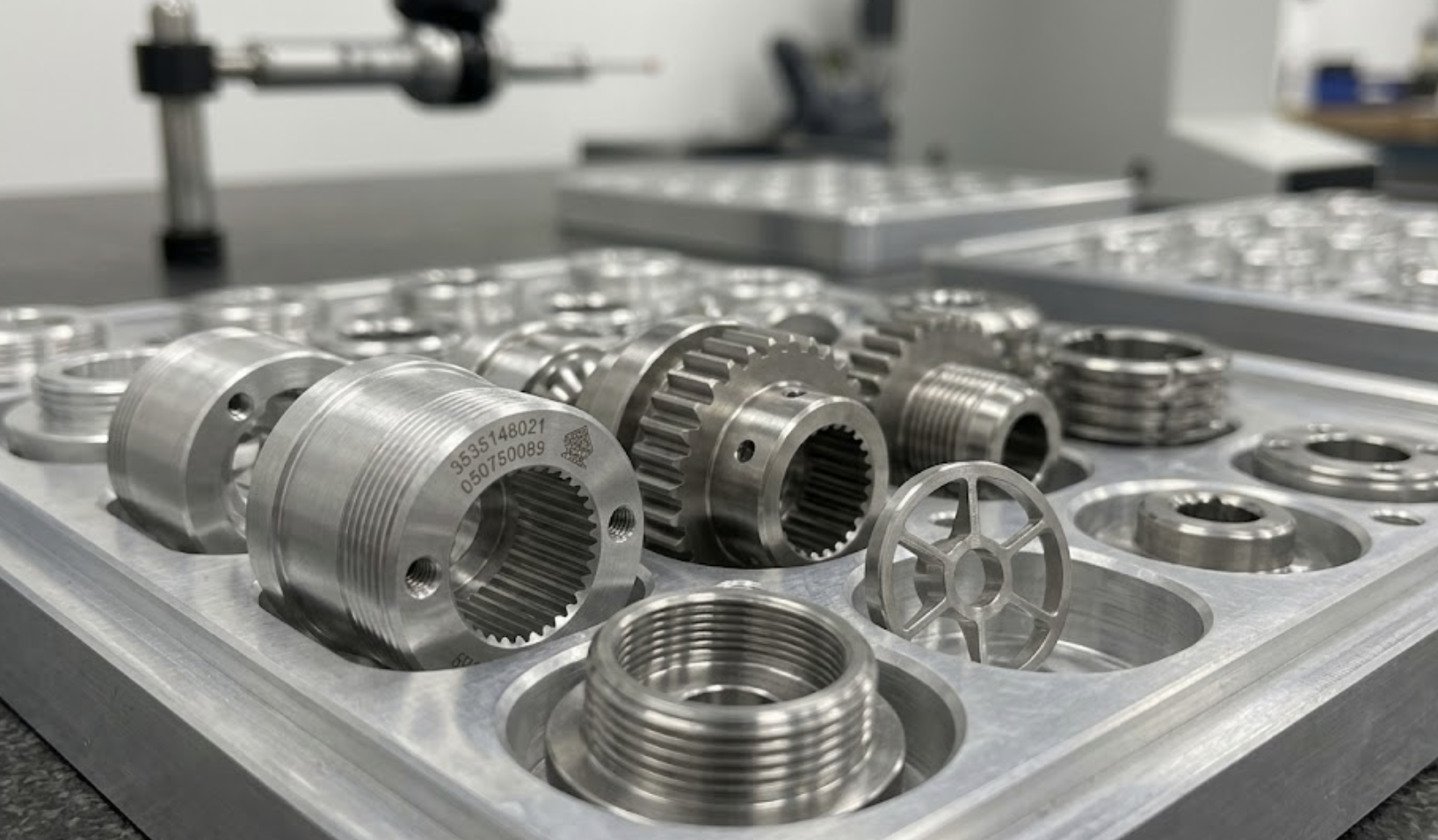
ChengYang (DONGGUAN CHENGYANG HARDWARE CO.,LTD) operates 3-axis, 4-axis, and 5-axis CNC milling machines alongside dedicated CNC lathes, turning centers, and turning-milling compound machines. This equipment range supports part complexity from basic turned profiles to multi-surface geometries, achieving dimensional tolerances down to ±0.005mm. Yet the equipment configuration represents only part of the answer. Process architecture — structured cutting parameters, active tool wear compensation, and repeatable fixturing — determines whether a supplier hits tight tolerances once or sustains them across every production batch.
Q2: How Does Digital Quality Monitoring Replace Subjective Human Inspection At The Micron Level?
In conventional production workflows, inspection happens at the end. Defective parts accumulate through an entire run before the problem surfaces. Digital quality monitoring changes the logic entirely by embedding measurement within the process rather than appending it afterward.
DONGGUAN CHENGYANG HARDWARE CO.,LTD maintains a structured, multi-stage inspection system spanning incoming material verification, in-process dimensional checks, and final output validation. The inspection equipment suite includes a High-Performance 2D Image System for geometric verification, a three-dimensional Coordinate Measuring Machine for complex feature analysis, a Digital Micrometer for precise linear measurement, a Surface Roughness Tester, a Hardness Tester, and a Laser Marking Machine for permanent traceability marking.
This combination creates a closed feedback loop. When in-process data reveals dimensional drift — whether from tool wear or thermal effects — corrective action happens before waste accumulates. Calibrated instruments replace subjective visual assessment. At micron-level tolerances, this distinction is not incremental. It is the difference between a quality system and actual quality performance.
Q3: What Role Does Predictive Maintenance Play In Sustaining Batch-To-Batch Dimensional Consistency?
Spindle wear, bearing play, and encoder degradation develop gradually and do not announce themselves. Without active condition monitoring, these factors shift dimensional outputs quietly across production runs. A temperature increase of just one degree Celsius across a 500mm steel component produces roughly six micrometers of dimensional change — enough to push high-precision features beyond acceptable tolerance bands.
Predictive maintenance tackles this risk by monitoring machine condition continuously and scheduling interventions before performance degrades. For buyers, the practical outcome is consistency across separate orders placed weeks or months apart. ChengYang’s rapid delivery capability — with parts available for shipment in as few as three business days — reflects not only production volume, but the operational stability that a well-maintained manufacturing environment makes possible. Dependable uptime produces dependable dimensional outcomes.
Q4: Full Production Traceability — Who Does It Actually Protect?
Traceability documents often appear in supplier materials as a compliance credential. However, their real function serves the buyer. When material certificates, in-process inspection records, and final dimensional reports accompany each production batch, buyers gain independent audit capability — and the means to defend their own product quality if downstream questions arise.
This matters most in regulated industries. ChengYang holds ISO certification and carries a national “AAA” Credit Certificate, reflecting a quality management system designed for accountability rather than paperwork. For aerospace components, medical devices, industrial automation parts, and precision instruments, traceable documentation is a mandatory requirement. Choosing a supplier whose quality system generates reliable records reduces compliance risk at the buyer level, not just the manufacturing level.
Q5: Why Is 5-Axis Capability Necessary But No Longer Sufficient As A Differentiator?
Five-axis CNC machines now appear across a broad range of contract manufacturers. Their availability alone no longer signals a supplier’s ability to handle genuine precision work. The real differentiator lies in whether multi-axis geometry capability integrates with downstream surface quality management, post-processing expertise, and material-specific process knowledge.
ChengYang supports a full surface finishing portfolio covering anodizing, electroplating, powder coating, passivation, black oxide treatment, electroless plating, brushing, sandblasting, tumbling, polishing, Alodine coating, and painting. Each finish addresses specific environmental, functional, and aesthetic requirements. Compatible materials include aluminum alloys, stainless steel, titanium, carbon steel, copper, brass, and engineering plastics such as PEEK, ABS, Nylon, and POM. Part dimensions range from a minimum feature size of 0.5mm for metals up to maximum machined dimensions of 2,000mm x 1,500mm x 800mm. This range allows both compact precision components and large structural elements to move through machining and finishing stages within a single production framework — eliminating the handoff risks and cumulative tolerance drift that multi-supplier workflows introduce.
Q6: Before Placing A First Order — What Technical Questions Reveal A CNC Partner’s Industry 4.0 Readiness?
Six questions consistently separate capable precision partners from suppliers who meet only minimum expectations.
Does the supplier generate documented in-process inspection records throughout production, not only at final output? What calibration frequency applies to measurement instruments, and does independent verification exist? Can fixture repeatability be demonstrated across separate production setups? What scope does the quality certification cover, and does it align with the buyer’s industry requirements? Does the supplier offer design-for-manufacturability review before production begins? And — can the supplier demonstrate consistent tolerance achievement at production volume, not only on prototype quantities?
DONGGUAN CHENGYANG HARDWARE CO.,LTD addresses each of these evaluation points through its digital instant-quoting platform, DFM consultation process, multi-stage inspection infrastructure, ISO-certified quality framework, and the operational flexibility to move from rapid prototyping into full-scale production without resetting quality baselines. Accepted design file formats include STEP, STP, STL, IGS, IGES, and OBJ, supporting a direct path from engineering design to production-ready parts.
Conclusion
Precision manufacturing in the Industry 4.0 era demands more than capable equipment. Digital quality monitoring, predictive process stability, certified documentation systems, and integrated finishing capability collectively determine whether a CNC provider sustains micron-level accuracy across real production volumes and conditions — not just on controlled test pieces.
ChengYang (DONGGUAN CHENGYANG HARDWARE CO.,LTD) has developed a manufacturing infrastructure that reflects this expanded definition of precision — built on documented quality governance, multi-technology process capability, and the institutional credibility that ISO certification and national AAA credit recognition provide.
For organizations selecting a precision CNC machining partner, the most revealing question is no longer “What tolerances does your equipment support?” The more productive question is: “What systems do you operate to ensure those tolerances hold, batch after batch, at volume?”
Further information is available at https://www.c-ycnc.com/.
Media Contact
DONGGUAN CHENGYANG HARDWARE CO.,LTD
Building Nr.10, Hesen Industrial Huailin Road #131,Humen Town,Dongguan City,Guangdong Province,China
This article was originally published by IssueWire. Read the original article here.