(WorldFrontNews Editorial):- Shenzhen, Guangdong Jun 25, 2026 (Issuewire.com) – There’s a conversation that happens regularly in industrial IoT procurement that goes something like this: an engineering team specifies a primary lithium cell based on voltage and capacity, the product gets deployed, and somewhere between years three and five the network starts showing anomalies — dropped transmissions, unexpected resets, localized dead zones. The root cause, more often than people expect, is a mismatch between the cell’s internal construction and the device’s actual power consumption profile. Lithium Thionyl Chloride chemistry is the right choice for most long-term industrial applications — highest energy density among primary chemistries, stable 3.6V nominal voltage, exceptional shelf life. But Li-SOCl2 comes in two fundamentally different mechanical configurations, and choosing between them without understanding what each one actually does is where the mismatch originates. Procurement managers working on critical long-term nodes increasingly seek out a qualified China Leading Bobbin Type LiSOCl2 Battery Supplier specifically because the topology question has become too consequential to leave to a generic catalog selection.
The two configurations — Bobbin and Spiral — use the same underlying chemistry but release energy in fundamentally different ways. That difference flows directly from internal geometry, which determines surface area, which determines how quickly the cell can deliver current. Get the geometry wrong for the application and you’re either leaving capacity on the table or putting stress on the cell that shortens its operational life. Neither outcome is acceptable in a deployment where field maintenance costs more than the hardware being maintained.
The financial stakes are straightforward. A single battery failure in a remote network node isn’t just a component cost — it’s the labor hours of locating the fault, the logistics of reaching a potentially hazardous or inaccessible installation point, and the data gap created while the node is offline. Multiply that across even a small percentage of a large deployment and the numbers get uncomfortable quickly. Treating primary cells as engineered components rather than commodities, and matching them precisely to the device’s energy consumption profile, is what separates a ten-year deployment from one that generates service calls.
The Bobbin Construction: Maximizing Electrochemical Volume for Ultra-Low Discharge
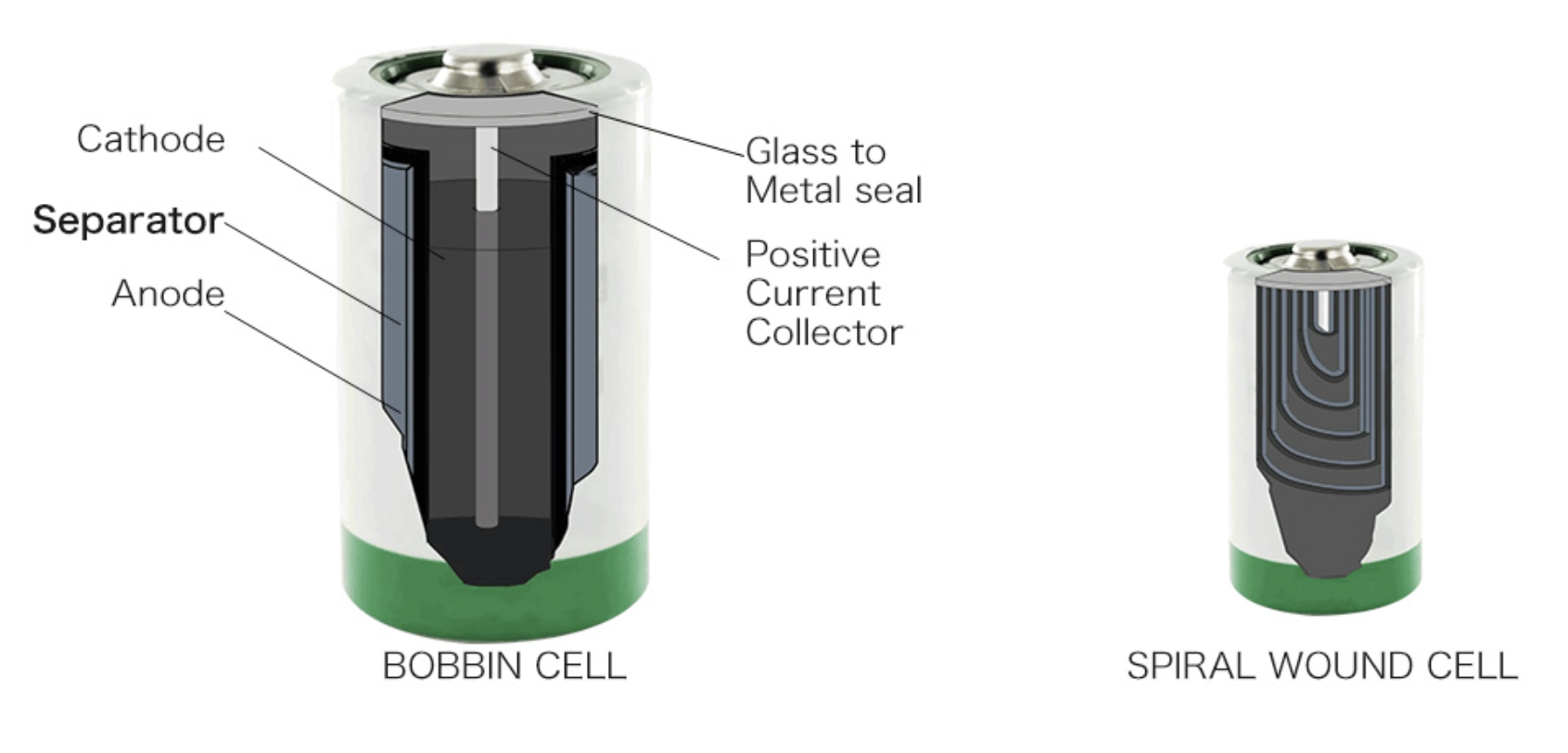
The Bobbin design is the established standard for applications that need maximum capacity and minimum self-discharge over multi-year deployment timelines. The structural principle is straightforward: a solid lithium anode presses against the interior of the stainless steel casing, with a carbon cathode structure at the center of the cylinder and liquid electrolyte filling the available internal space. The geometry keeps the contact surface area between active chemical components deliberately low — and that restriction is precisely the point.
Low surface area means slow internal reaction rates, which translates directly into low self-discharge. Well-engineered Bobbin cells hold annual capacity loss to under 1%, which allows a standard AA-size cell to retain usable energy across fifteen years of field deployment. The same geometry maximizes the internal volume available for active material, giving a standard AA Bobbin cell a nominal capacity of up to 2,700mAh. For devices that spend most of their operational life drawing micro-ampere maintenance currents — traditional smart water, gas, and heat meters being the clearest examples — this combination of high capacity and minimal self-discharge is essentially the ideal power profile.
The limitation is current delivery. The low surface area that protects the cell against self-discharge also restricts how much current it can provide instantaneously. Bobbin cells aren’t suited to applications that demand multi-ampere pulse currents during data transmission. For those applications, the internal geometry needs to look quite different.
The Spiral Engineering: Expanding Surface Area for Multi-Ampere Power Delivery
The Spiral configuration — sometimes called jelly-roll construction — approaches the same Li-SOCl2 chemistry from the opposite direction. Instead of a solid concentric core, thin ribbons of lithium anode, separator material, and cathode collector are wound tightly into a cylindrical coil. This assembly packs a significantly larger active chemical surface area into the same standard casing dimensions.
That expanded surface area changes the cell’s behavior under load in a meaningful way. Internal impedance drops substantially compared to a Bobbin cell of equivalent size, which allows the Spiral configuration to deliver immediate multi-ampere pulse currents without the transient voltage delays that would cause a microcontroller reset or a failed transmission. For power-type Li-SOCl2 applications — asset tracking devices that broadcast over NB-IoT or GSM, remote terminals that push large data packets over cellular networks — this instantaneous current delivery is what makes the cell viable.
The tradeoffs are real and worth understanding before specifying. The multi-layer separator materials that enable the high surface area consume internal volume, reducing total nominal capacity compared to a Bobbin cell of the same size. The faster internal reaction rate also raises self-discharge — typically to between 1% and 2% annually, compared to under 1% for Bobbin. Neither of these is a disqualifying characteristic for the right application, but they do mean the Spiral cell is optimized for a different operating profile: frequent, high-current transmissions rather than decade-long low-drain autonomy.
Strategic Sourcing and Dual-Topology Technical Mastery with PKCELL
The practical implication of these differences is that no single cell topology serves the full range of modern IoT applications. A smart gas meter and an asset tracking tag running on NB-IoT have almost nothing in common from a power delivery standpoint, even if they’re both described as “industrial IoT devices.” Sourcing from a manufacturer that only offers one topology means either fitting the application to the available cell or going elsewhere for part of the portfolio.
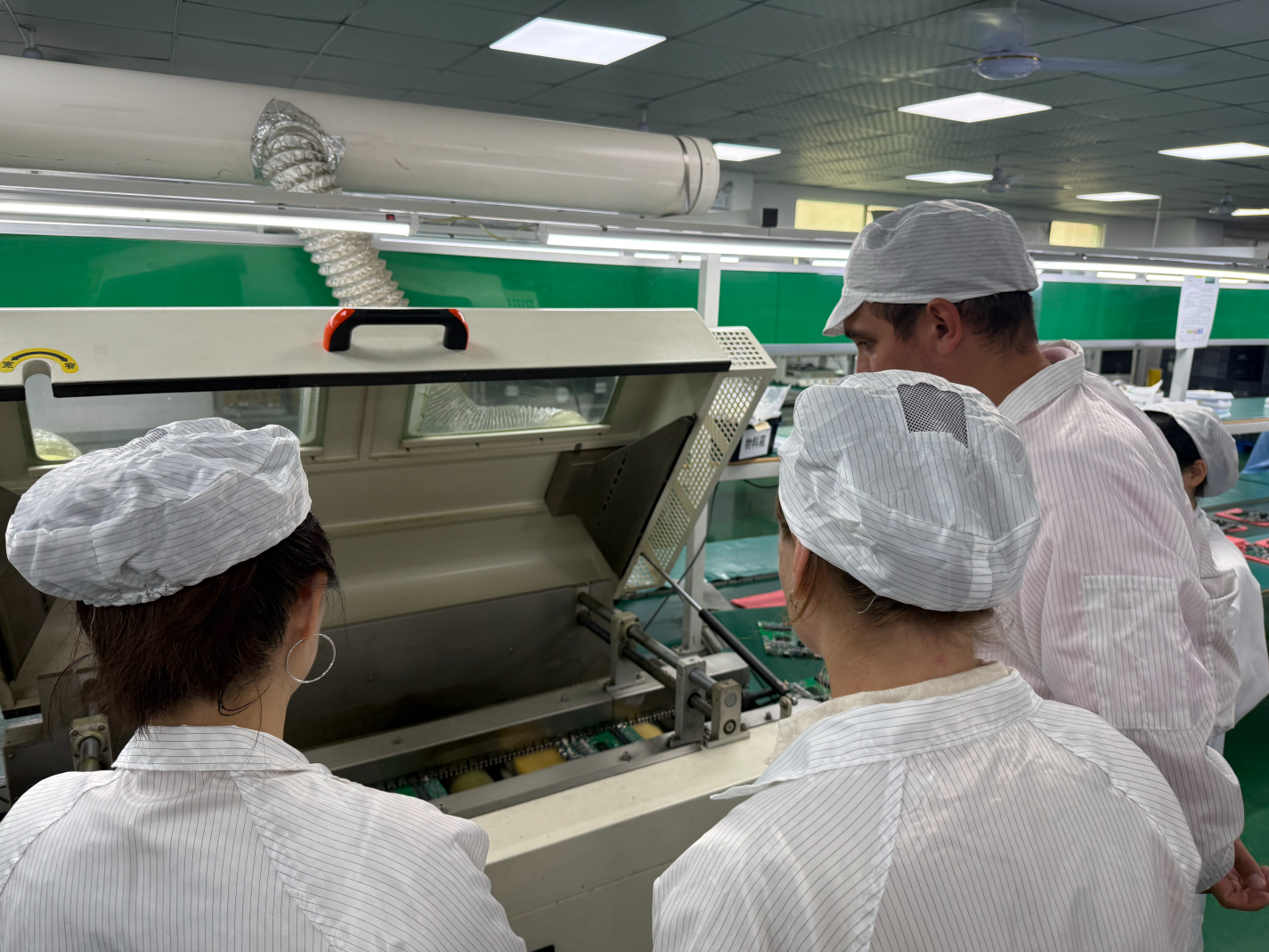
PKCell (Shenzhen Pkcell Battery Co., Ltd.) runs synchronized automated production lines for both Bobbin and Spiral cell types, which matters for procurement managers who need technical guidance rather than a catalog push toward whatever the supplier happens to make. Computerized inspection systems verify dynamic internal resistance on every cell across both production lines, maintaining batch-to-batch uniformity that large-volume deployments depend on.
For applications that don’t fit cleanly into either topology — advanced utility meters that need both high capacity and strong pulse handling, for instance — PKCell’s engineering division builds hybrid assemblies that combine a Bobbin primary cell with a Hybrid Pulse Capacitor in a parallel configuration. The Bobbin cell handles long-term energy storage with minimal self-discharge; the capacitor absorbs pulse demand during transmission events, protecting the primary cell from current stress it wasn’t designed to handle. The result is a configuration that achieves what neither component could accomplish independently.
For buyers preparing to initiate supplier contact, the inquiry process goes considerably faster with a few specific parameters in hand: the device’s quiescent maintenance current, the peak pulse frequency and amplitude during transmission cycles, and the expected operating temperature range. Those three data points allow an experienced technical team to recommend the appropriate cell topology — and the appropriate pack configuration if a single cell doesn’t fully address the application’s requirements — without a lengthy back-and-forth that delays the procurement timeline.
Corporate Website: https://www.pkcellpower.com/.
Media Contact
Shenzhen Pkcell Battery Co., Ltd.
902, Tower B, Hongrongyuan North Station Center, North Station Community, Minzhi Street, Longhua District, Shenzhen, China
This article was originally published by IssueWire. Read the original article here.