(WorldFrontNews Editorial):- Xuancheng, Anhui Jul 8, 2026 (Issuewire.com) – The pharmaceutical and biotechnology packaging sectors require rigorous compliance, biological safety, and chemical inertness. Achieving the status of a Global Leading Tubular Glass Bottle Exporter demands a core integration of certified regulatory alignment and advanced technical scaling. Securing 11 CDE (Center for Drug Evaluation) registration numbers from the Chinese National Medical Products Administration serves as a critical asset in this environment. For international procurement teams, these 11 CDE registrations are not merely regional filings; they serve as a core technical verification that streamlines global supply chains and ensures formulation
Analysis 1: Deep Regulatory Integration via 11 CDE Registration Numbers
To fully grasp the industry standing of a global packaging provider, it is essential to understand the regulatory weight of the Center for Drug Evaluation (CDE). Operating under the National Medical Products Administration (NMPA) of China, the CDE is the authoritative regulatory body responsible for evaluating the safety, efficacy, and quality of pharmaceutical products and their primary packaging components. A CDE registration number represents an official regulatory clearance indicating that a packaging material has successfully passed comprehensive evaluation. Under China’s “bundled review” system, pharmaceutical formulations cannot obtain market approval without primary packaging materials that hold active, compliant CDE registrations.
Holding 11 distinct CDE registration numbers demonstrates an extensive, active regulatory portfolio covering multiple glass formulations, structural dimensions, and specialized manufacturing methods. For global buyers, this broad scope of CDE approvals functions as an independent verification of material purity and safety. The CDE review process requires extensive documentation regarding extractables and leachables, long-term chemical stability testing, and consistency across production batches. When a manufacturer secures 11 separate CDE numbers, it removes a major layer of regulatory risk for pharmaceutical brands intending to distribute products globally, while validating that the underlying manufacturing processes align with strict quality and safety frameworks.
Analysis 2: How 11 CDE Numbers Accelerate Global Pharmacopoeia Compliance
The technical validation achieved through 11 CDE registration numbers directly supports compliance with international standards beyond a single region. To maintain its position as a global exporter, HUAXIN GLASS leverages the rigorous data required by these 11 CDE filings to ensure its entire output aligns with the authoritative criteria of the Chinese Pharmacopoeia (ChP), European Pharmacopoeia (EP), United States Pharmacopoeia (USP), and Japanese Pharmacopoeia (JP).
The continuous batch testing, chemical extraction analysis, and structural uniformity mandated by the 11 CDE numbers guarantee that the tubular glass maintains its chemical inertness across all regional standards. This prevents interactions with sensitive active ingredients. Supporting these product-level pharmacopoeia standards are foundational institutional certifications, including ISO 9001:2015 for general quality management systems and ISO 15378:2017, which specifies particular requirements for primary packaging materials for medicinal products. The exhaustive documentation compiled for the 11 CDE numbers forms the backbone of these ISO quality systems, ensuring global regulatory compliance.
Analysis 3: Scaling Clean Manufacturing Infrastructure to Support 11 CDE Standards
To reliably support global distribution pipelines while maintaining the strict parameters verified by 11 CDE registration numbers, regulatory compliance must be backed by scalable manufacturing capabilities. Operating an expansive automated production facility covering over 30,000 square meters, the enterprise represents a significant infrastructure investment of 120 million yuan. Equipped with 42 modern, highly automated production lines, the facility achieves an annual production capacity of 1 billion glass pieces. This scale minimizes lead times and insulates international partners from supply chain disruptions.
Crucially, large-scale production is executed under controlled environmental conditions designed to protect the integrity of the CDE-registered products. The factory design strictly complies with Good Manufacturing Practice (GMP) standards. Within the facility, a 1,000-square-meter area is dedicated to a certified 100,000-level (ISO Class 8) clean workshop. Managing the forming, inspection, and packaging phases within a controlled cleanroom significantly reduces particulate contamination, cosmetic defects, and bioburden levels, ensuring that mass-produced batches consistently match the exact baseline standards filed under the 11 CDE registrations.
Analysis 4: Engineering Innovations and Specialized Product Applications
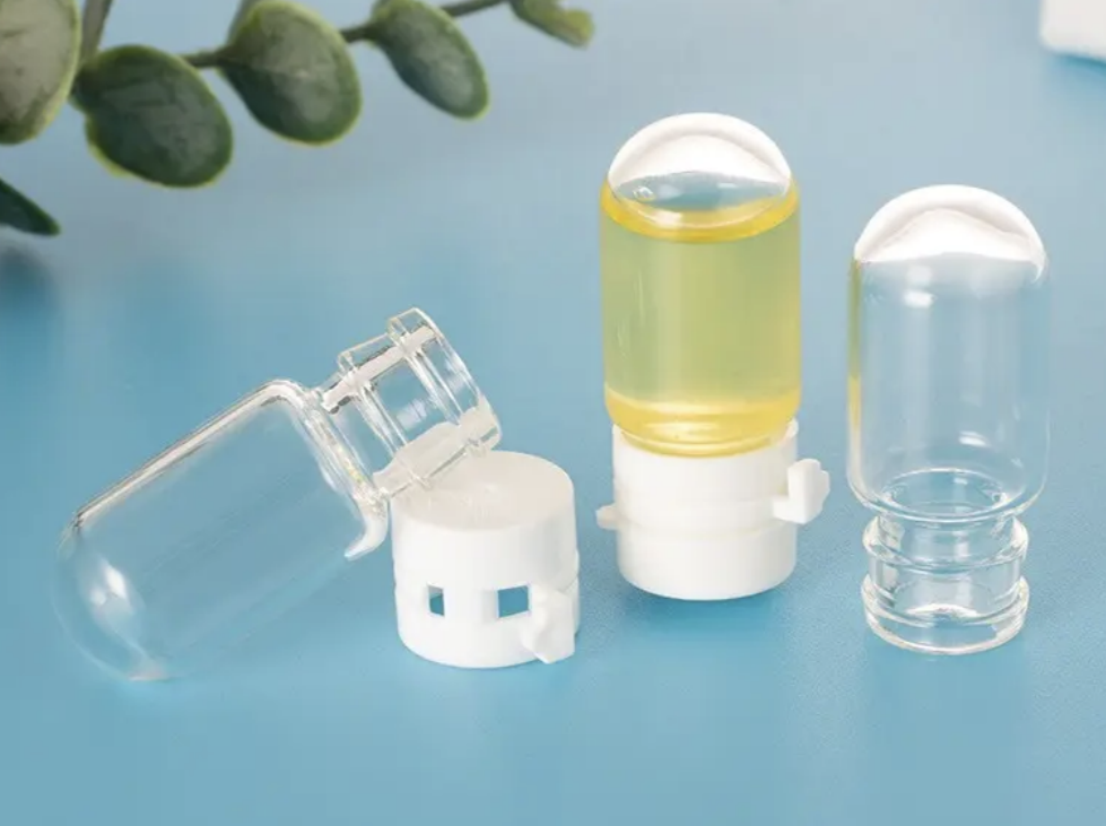
The evolution of modern formulations demands tailored packaging architectures that maintain the high chemical stability verified by regulatory registries. As an illustrative case study, consider the engineering behind specialized containers like the disposable tubular glass bottle designed with a double locking lip and a round bottom. Frequently utilized for essential oils, volatile chemicals, and sensitive liquid formulations, this design demonstrates how structural alterations address specific storage vulnerabilities without compromising material purity.
The double locking lip configuration provides an enhanced mechanical seal when paired with targeted closures, minimizing the evaporation of volatile aromatic compounds and preventing oxygen ingress. Additionally, the engineered round bottom ensures superior structural strength against internal pressures and improves fluid dynamics during filling and extraction. Manufactured from high-clarity, chemically neutral tubular glass that aligns with CDE-registered parameters, these bottles exhibit stable physical and chemical properties, ensuring that premium formulations do not degrade or suffer from altered shelf lives due to packaging interactions.
Analysis 5: Customization Capacities and OEM/ODM Integration
A critical differentiator for a global exporter is the capability to transition smoothly from standardized manufacturing to highly personalized solutions while preserving core regulatory compliance. Industrial buyers often require custom dimensions, specialized surface treatments, or distinct mouth finishes to integrate with proprietary delivery systems or brand identities.
Integrating professional customization services–encompassing initial custom concept designs, precision-engineered sample prototyping, and full-scale OEM/ODM partnerships–enables the production facility to accommodate diverse and precise requirements. When backed by standardized, intelligent production workflows and the underlying quality baselines of the 11 CDE registrations, custom runs undergo the same rigorous quality checks as high-volume lines. This balanced approach guarantees that customized tubular glass bottles retain optimal physical and chemical stability, enabling global brands to innovate without sacrificing product safety or delivery timelines.
For further technical specifications, regulatory documentation, or inquiries regarding custom manufacturing solutions, please visit the official corporate portal: https://www.huaxinglass.com/
This article was originally published by IssueWire. Read the original article here.