(WorldFrontNews Editorial):- Nanchang, Jiangxi Jul 28, 2026 (Issuewire.com) – In recent years, the escalating crisis of global warming has intensified extreme weather events worldwide, leading to prolonged, severe winters and sharp seasonal fluctuations across Europe and North America. As low temperatures routinely plunge below freezing for extended periods, the demand for highly efficient, reliable, and energy-conscious heating and thermal management systems has transitioned from a standard building requirement to a critical operational necessity. In modern residential architecture, commercial complexes, and space-constrained facilities across these regions, sustaining ambient indoor warmth while mitigating massive energy consumption poses a formidable engineering challenge. Addressing this challenge requires advanced forced-convective heating technologies capable of delivering smooth, uniform airflow under continuous thermal operation.
Among the most effective solutions utilized by HVAC engineers today are specialized ventilation units produced by Global Leading Manufacturers of Cross Flow Blowers. These cross flow blowers, characterized by their unique wide-cylindrical impeller design, generate a long, even, and low-noise air distribution pattern, making them indispensable components in modern heating-focused HVAC systems, floor convectors, and residential fireplaces operating in demanding cold-climate environments.
Evolution and Outlook of the Global Ventilation Industry
The global ventilation and climate control industry is undergoing a significant transformation driven by rapid urbanization, stricter energy efficiency mandates, and an increasing focus on efficient indoor space heating. Modern architectural designs in Europe and North America, high-performance HVAC systems and discreet trench heating units that fit within restricted structural envelopes without sacrificing aerodynamic output. Consequently, the market for localized air movement components has shifted away from traditional, bulky axial fans toward highly optimized, low-profile alternatives.
Industry analysts project sustained growth in the thermal management sector over the next decade, particularly within emerging markets and regions subject to harsh, extended winters. The emphasis is no longer solely on moving high-velocity air, but on delivering continuous, low-noise forced convection for effective heat dissipation and optimal electrical efficiency. As European energy efficiency directives push for lowered carbon footprints, heating equipment manufacturers are compelled to innovate at the component level. This shift has placed advanced cross flow technology at the forefront of the heating market, as these blowers provide the precise lateral airflow required to push warm air horizontally across floor level, maintaining uniform room temperatures in both residential homes and high-traffic commercial spaces.
Optimizing Forced Convection in Floor Convectors and Fireplaces
Mastering low-temperature heating and indoor heat distribution demands specialized blower technology that can operate continuously near heat sources without mechanical degradation or drops in aerodynamic efficiency. In modern European architecture, floor convectors (trench heaters) and electric or gas fireplaces present unique spatial and thermal challenges: they require ultra-compact, low-profile blowers that draw in cool ambient air and gently force it across heat-exchanger coils or heating elements.
Standard axial fans often create turbulent, spotty air delivery and unacceptable mechanical noise, which disrupts indoor comfort. In contrast, high-performance cross flow blowers produce a broad, uniform rectangular sheet of warm air that spans the entire length of a floor convector or fireplace grille. This ensures rapid thermal turnover, preventing cold drafts near floor level and maximizing heat distribution. Maintaining this steady thermal output relies heavily on the precise dynamic balancing of long blower wheels and high-grade heat insulation in the driving motors, making component selection a primary focus for European and North American HVAC manufacturers.
Technological Innovation and Engineering Excellence
Meeting these demanding global requirements demands substantial manufacturing expertise and rigid quality standards. Among the entities driving progress in this sector is PRSK, a high-tech enterprise operating under Jiangxi Hengcheng Industrial Co., Ltd. With over 20 years of dedicated industry experience since its establishment in 2002, the company has structured its operations around the research, development, and large-scale manufacturing of cross flow fans. Spanning a production footprint of 15,000 square meters and employing a skilled workforce of over 100 specialists, the facility integrates advanced machinery with a proprietary library of more than 1,000 sets of molds to ensure precise in-house component development.
Core Pillars of Industrial Capability
- Extensive Industrial Experience:Over two decades of specialized R&D and manufacturing focus since 2002.
- Massive Production Infrastructure:A 15,000-square-meter facility fully equipped with dozens of advanced machinery systems.
- In-House Component Development:Ownership of more than 1,000 sets of specialized molds ensuring flexibility and precision.
The core competitiveness of modern cross flow blowers lies in their geometric precision and material composition. As ventilation units are integrated into ultra-thin floor convectors, decorative fireplaces, and space-saving HVAC systems, the aerodynamic balance of the long cylindrical impellers becomes critical. Minor variances can cause structural vibrations, increased noise, and premature mechanical wear. Through rigorous R&D, manufacturers have implemented dynamic balancing protocols that ensure smooth operation across varied rotational speeds. Furthermore, the adaptation of heat-resistant alloys, high-temperature bearings, and specialized surface treatments prevents structural distortion when the blowers are exposed to constant, localized heating cycles.
Optimized Airflow Solutions for Demanding Applications
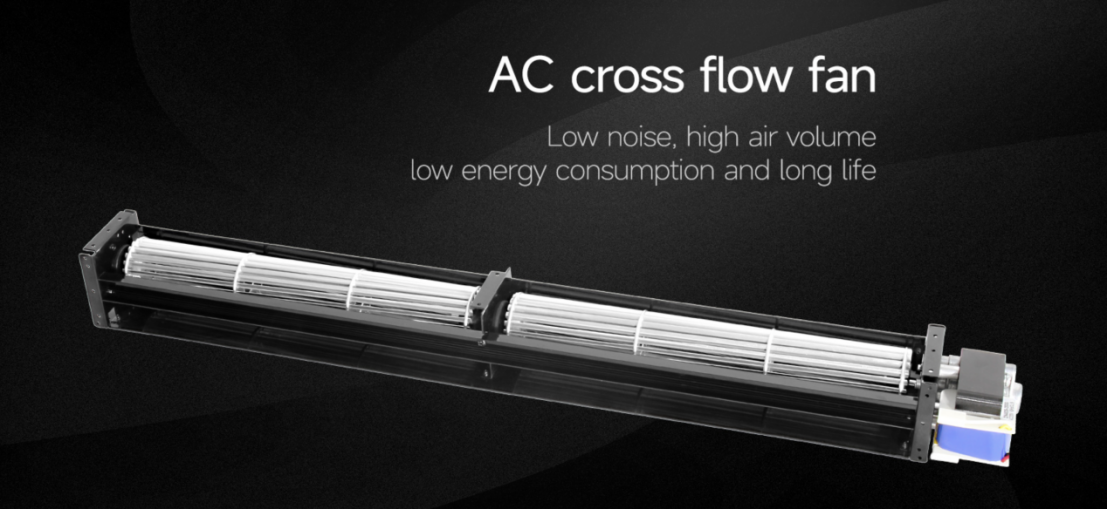
The practical utility of these engineering advancements is clearly reflected in specialized product segments designed for challenging heating environments. A prime example is the high-performance 60mm AC Cross Flow Fan series, which is engineered to deliver reliable performance where space constraints and thermal loads intersect. Featuring a compact 60mm impeller diameter, these units optimize the balance between physical dimensions and volumetric airflow, allowing seamless integration into space-restricted equipment such as European floor convectors (trench heaters), modern hearth fireplaces, and heating-centric air conditioners.
Technical Advantages in Harsh Environments
- Thermal Expansion Resistance:High-grade aluminum alloy impellers maintain structural rigidity when exposed to continuous radiant heat from heating elements and coils.
- High-Ambient Insulation: Motor assemblies feature high-grade thermal insulation to prevent heat-induced motor failure during long operational heating cycles.
- Laminar Flow Optimization: Broad, uniform airflow patterns facilitate rapid forced convection across heating surfaces, eliminating floor-level cold spots and maximizing heating efficiency.
By maintaining a highly laminar, broad airflow pattern, these specific cross flow units facilitate rapid heat exchange across heating coils and radiant elements, maximizing thermal output and reducing energy usage. This component-level performance enables floor convectors and fireplace systems to warm living spaces quickly, quietly, and reliably throughout freezing winter months.
Sustainable Operational Paradigms and Future Outlook
As the global HVAC industry continues to adapt to changing environmental landscapes, the demand for high-efficiency heating components will only increase. The integration of advanced cross flow blowers represents a sustainable approach to climate control, balancing performance with resource conservation. By optimizing fluid dynamics and minimizing mechanical friction, modern blowers lower power consumption, aligning with international initiatives to reduce the carbon footprint of building services.
Looking ahead, the collaboration between global manufacturing capabilities and localized environmental engineering will remain essential. Manufacturers that combine extensive production capacity, specialized mold development, and strict adherence to international quality standards are well-positioned to support the global transition toward energy-efficient indoor heating infrastructure. Through continuous material innovation and aerodynamic refinement, these specialized cross flow blowers will ensure that floor convectors, fireplaces, and heating HVAC systems maintain exceptional warmth, quiet comfort, and long-term reliability.
To learn more about advanced ventilation solutions and comprehensive product specifications, please visit the official corporate portal at https://en.hcecn.com/

This article was originally published by IssueWire. Read the original article here.