(WorldFrontNews Editorial):- Shenzhen, Guangdong Aug 2, 2026 (Issuewire.com) – Signal attenuation across expansive fiber networks remains an unyielding physical challenge. As Internet Service Providers (ISPs), Internet Data Centers (IDCs), and cloud infrastructure operators accelerate the migration toward 400G and 800G optical architectures, the precision of optical signal amplification directly dictates network uptime, bit error rates (BER), and overall service continuity. Deploying uncertified or inconsistently manufactured optical amplification hardware often leads to unpredictable gain tilt, excessive noise figures, and thermal instability–factors that severely compromise dense wavelength division multiplexing (DWDM) channels. Choosing a trusted Certified Optical Amplifiers Service Provider mitigates these operational vulnerabilities.
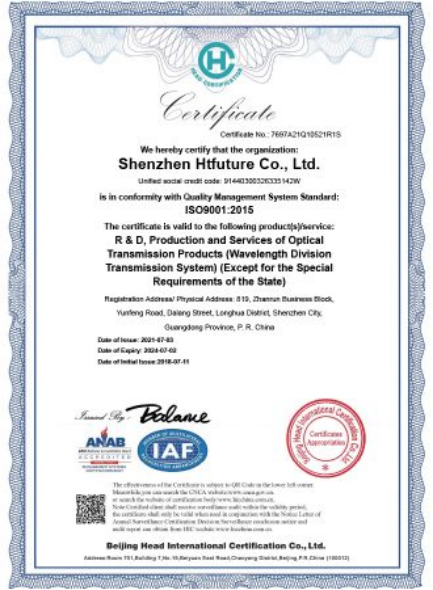
Optical amplifiers, such as Erbium-Doped Fiber Amplifiers (EDFA) and Semiconductor Optical Amplifiers (SOA), serve as critical active components that boost multi-channel optical signals directly within the lightwave domain without requiring costly optical-to-electrical-to-optical (O-E-O) conversion. In high-capacity telecommunications infrastructure, quality assurance relies heavily on internationally recognized manufacturing frameworks. The ISO 9001 standard, developed by the International Organization for Standardization, represents the world’s premier quality management system recognized across more than 170 countries. It establishes a process-oriented methodology centered on risk mitigation, standardized operational controls, and continuous engineering improvement. In advanced optoelectronic manufacturing, ISO 9001 certification serves as a global benchmark of production discipline, ensuring that complex hardware yields reproducible performance, structural integrity, and long-term field stability.
Understanding how structured quality management systems govern the engineering and production of these active optical components explains why rigorous compliance remains foundational to modern high-speed transmission networks.
I. Standardized Quality Frameworks in High-Density Optical Amplification
The industry-wide transition toward 400G QSFP-DD/OSFP and next-generation 800G coherent transceivers places unprecedented demands on optical link power budgets, optical signal-to-noise ratio (OSNR), and overall signal clarity. Under ISO9001 quality management guidelines, every stage of optical amplifier engineering and assembly undergoes rigorous, multi-tiered validation. For high-bandwidth ISP networks, maintaining uniform signal gain across the extended C-band and L-band spectral windows requires systematic control over optical insertion loss, pump laser stability, and spectral ripple.
An ISO9001-certified quality framework guarantees long-term gain reliability and performance consistency for 400G/800G infrastructures through several standardized process controls:
- Stringent Optoelectronic Component Screening:Raw optoelectronic materials, including 980nm/1480nm pump laser diodes, erbium-doped optical fibers (EDF), and micro-optic isolators, undergo 100% incoming inspection and thermal burn-in pre-screening to eliminate infant mortality risks and minimize long-term power degradation.
- Statistical Process Control (SPC) in Automated Assembly:Key optical alignment, precision fusion splicing, and adhesive curing parameters are governed by real-time SPC algorithms, ensuring minimal insertion loss (IL) and superior optical return loss (ORL) across every module batch.
- Comprehensive Optical Parameter Validation:Automated test systems utilizing high-resolution Optical Spectrum Analyzers (OSA) verify critical optical metrics–including saturation output power (Psat), Noise Figure (NF), and Gain Flatness–guaranteeing sub-decibel gain tilt tolerances across densely populated DWDM channels.
- Environmental Stress & Thermal Stability Testing:Finished amplification units undergo extensive thermal cycling, humidity testing, and dynamic burn-in procedures to ensure stable polarization-dependent loss (PDL) performance and structural integrity under demanding central office operating conditions.
Uncertified optical amplifiers frequently suffer from physical component degradation over time, leading to gain mismatches and optical signal distortion across multiplexed channels. Enforcing end-to-end ISO9001 quality controls guarantees predictable amplification characteristics, effectively safeguarding ultra-long-haul backbones and high-density Data Center Interconnect (DCI) paths against sudden traffic outages or throughput degradation during peak demand cycles.
II. Precision Engineering and Manufacturing Integration at HTF
Operational reliability in high-capacity lightwave systems stems directly from specialized research, development, and advanced manufacturing practices. Established by an engineering team with over ten years of experience in optical communication product R&D, developing, and manufacturing, HTF embeds comprehensive quality assurance into every phase of hardware lifecycle management. The company specializes in providing complete fiber optical communication systems, offering a portfolio that spans DWDM, DCI-BOX, Optical Line Protection (OLP), Dispersion Compensation Modules (DCM), Reconfigurable Optical Add-Drop Multiplexers (WSS), OTDR testing systems, and high-speed transceivers including 400G and 800G QSFP-DD/OSFP configurations.
Inside the production environment, optical amplifiers undergo rigorous thermal cycling, optical spectrum analysis, and automated fiber alignment procedures. The optical sub-assembly process emphasizes precision fusion splicing, low-loss optical connectors, and optimized heat dissipation structures designed to prevent pump laser diode degradation. By managing the full engineering lifecycle, dedicated technical teams can tailor amplifying stages to fit specific deployment topographies–whether for compact edge data centers or wide-area transport networks requiring customized MPO fiber cable assemblies and specialized modular line cards.
III. Technical Deep Dive: EDFA Performance and Craftsmanship Excellence
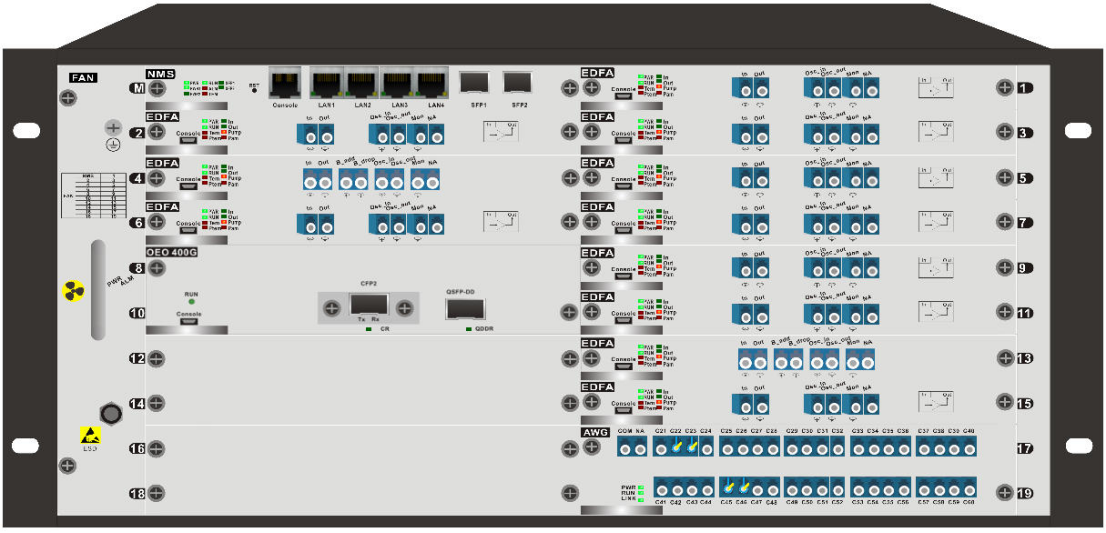
To observe how ISO9001 quality standards translate into tangible hardware performance, the deployment of modular EDFA Optical Amplifiers provides a clear engineering benchmark for enterprise and ISP applications. Designed for booster, in-line, and pre-amplification roles within DWDM systems, high-grade EDFAs rely on premium erbium-doped optical fiber and highly stable 980nm or 1480nm pump lasers managed by digital signal processor (DSP) control loops.
From a structural engineering perspective, meticulous craftsmanship details govern long-term field stability. The internal optical layout incorporates dual-stage optical isolators to eliminate back-reflections that could disturb laser cavity stability, alongside low-loss micro-optic WDM couplers. Integrated Gain Flattening Filters (GFF) meticulously balance output power across dozens of simultaneous 400G or 800G wavelength channels, keeping gain flatness variations within tight sub-decibel tolerances across the entire spectral band.
Furthermore, internal control circuitry incorporates real-time transient suppression algorithms. When individual wavelengths are added or dropped in dynamic WSS-based networks, the amplifier adjusts pump laser power within microseconds, preventing optical power surges from damaging sensitive receiver transceivers. The module chassis features industrial-grade aluminum shielding for electromagnetic interference (EMI) protection and optimized thermal conduction channels that dissipate heat evenly, extending overall component operational lifespan in densely populated Central Office (CO) racks.
IV. Systemic Integration and Future-Proof Network Evolution
Achieving resilient 400G and 800G optical transport extends beyond individual amplification modules. It requires a comprehensive system-level architecture that integrates transceivers, optical protection switching, and continuous monitoring equipment into a coherent optical transport network. By combining certified optical amplifiers with high-density 400G/800G QSFP-DD/OSFP coherent transceivers, Optical Line Protection (OLP) hardware, and Wavelength Selective Switches (WSS), network operators establish fully automated, self-healing optical backbones capable of instant path protection.
As global bandwidth demand continues to escalate driven by artificial intelligence, cloud computing, and real-time data analytics, adherence to international manufacturing standards guarantees that deployed hardware remains fully compatible with future network evolutions. Standardized optical amplification ensures low latency, predictable power budgets, and robust environmental adaptability, providing ISPs, telecommunications operators, and private network enterprise clients with a reliable, future-proof foundation for high-speed optical connectivity.
For more information regarding certified optical amplification hardware and custom WDM systematic solutions, visit https://htfuture.com/.
This article was originally published by IssueWire. Read the original article here.