(WorldFrontNews Editorial):- Dezhou, Shandong Aug 7, 2026 (Issuewire.com) – Strict Environmental Regulations in Global Markets have reshaped the international electric vehicle landscape, placing elevated compliance demands on off-highway utility transport. Regional regulatory frameworks dictate stringent operational and safety parameters across key international jurisdictions. In the United States, federal standards such as FMVSS 500 govern Low-Speed Vehicles (LSVs), setting speed limits at 20 to 25 mph alongside mandatory equipment metrics including mirrors, seat belts, windshields, and street-legal reflector lighting. Concurrently, European Union directives, including EU Regulation 168/2013 and CE marking criteria, mandate rigorous electromagnetic compatibility, structural integrity, and hazardous substance controls under RoHS and REACH protocols. In Latin America and Middle Eastern markets, local municipal transport boards enforce strict environmental resilience standards, requiring zero direct tailpipe emissions and certified battery safety protocols. Meeting these diverse regulatory criteria requires systematic engineering discipline from a China Top Utility Golf Cart Exporter, ensuring that utility vehicles seamlessly align with both environmental goals and global market compliance standards.
I. Structural Engineering and Green Materials: Aligning Product Design with Environmental Standards
How does vehicle structural engineering ensure compliance with global environmental and safety standards?
Meeting international utility vehicle standards requires integrated chassis engineering and eco-friendly material selection. Modern utility electric golf carts utilize high-strength steel frame brackets subjected to a comprehensive anti-corrosion process consisting of pickling, phosphating, electrophoresis, and electrochemically applied powder coating. This multi-stage surface treatment prevents structural rust and chemical degradation, extending chassis longevity under aggressive humidity, coastal salt fog, or industrial exposure without resorting to toxic solvent-based topcoats.
Furthermore, exterior bodywork relies heavily on recyclable fiberglass and lightweight composite panels. By reducing curb weight–for instance, maintaining a lean weight profile from 520 kg for 2-seat models to 720 kg for 6-seat variants–the energy consumption per kilometer drops significantly. Lower mass directly decreases electrical drag on the battery pack, optimizing energy conversion efficiency and minimizing overall life-cycle environmental impact.
What precise operational data demonstrates environmental efficiency in real-world utility scenarios?
Environmental efficiency in utility electric vehicles is defined by energy conversion rates, operational output, and zero direct tailpipe emissions. Taking the utility-focused Model D architecture as a representative engineering benchmark, the technical power metrics are calibrated to satisfy low-speed environmental standards:
- Powertrain Efficiency: Standard configurations utilize a 4kW AC induction/synchronous motor system (scalable to 5.0kW or 7.5kW heavy-duty variants), delivering smooth power delivery with zero atmospheric emissions.
- Operating Range: High-density 60V 120Ah lithium-ion battery configurations (or optional 72V 110Ah / 72V 150Ah packs) deliver an operational range of up to 100 km per charge under standard payload conditions.
- Speed and Gradeability Control: Electronic controllers limit maximum speed to 50 km/h or below in compliance with global LSV safety rules, while maintaining a gradeability rating of up to 25% for inclined terrains.
- Charging Metrics: On-board intelligent chargers complete a full recharge cycle within 6 to 8 hours, utilizing automated current modulation to optimize energy drawdown and protect cell health.
II. Testing, Certification, and Hazardous Materials Compliance
What international testing protocols validate battery safety and hazardous material controls?
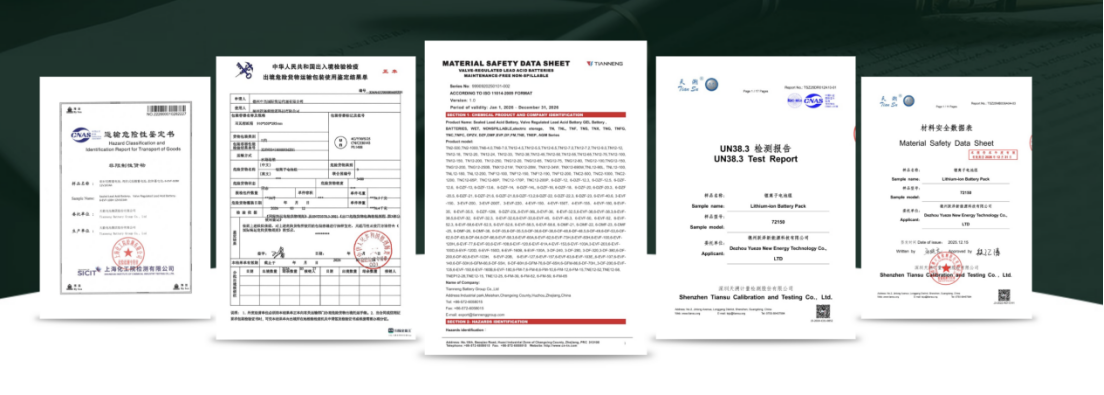
Global environmental regulations strictly govern energy storage systems, focusing on chemical composition, transport stability, and operational safety. Electric utility cart export models undergo comprehensive testing to obtain verified compliance credentials, as reflected in official manufacturer certification filings:
- 3 Transport Safety Certification: Verifies that lithium battery units–such as 72V 110Ah and 72V 150Ah configurations–endure extreme thermal shock, vibration, mechanical impact, external short-circuiting, and altitude simulation without thermal runaway or chemical leakage during international transit.
- MSDS and SDS Documentation: Comprehensive Material Safety Data Sheets detail chemical containment protocols, zero-cadmium and lead-controlled formulations, and non-hazardous handling metrics required under European REACH guidelines and North American OSHA standards.
- CE Compliance and Electromagnetic Compatibility (EMC): Validates that low-voltage AC electric controllers, multi-language infotainment screens, and auxiliary lighting circuits produce zero harmful electromagnetic interference while maintaining immunity to external electrical disruptions.
- Maritime and Land Appraisal Testing: Official transport appraisal certificates ensure compliance with international maritime dangerous goods protocols (such as UN 3480 / Class 9 hazardous classifications) for secure global shipping.
A full overview of testing certifications, MSDS reports, and battery safety evaluations is available on the official company Certificate Documentation page.
III. Manufacturing Integration and Core Technical Competencies
How do manufacturing capabilities support compliant, high-precision utility cart production?
Consistently meeting international environmental and vehicle safety standards requires industrial-scale manufacturing infrastructure. Established in 2015 with a registered capital of RMB 10 million, Dezhou Sooch Auto Industry Co., Ltd., operating globally under the brand name SUCHI, operates an expansive production footprint in Wucheng County, Dezhou City, Shandong Province. The facility spans approximately 33,000 square meters, including 12,000 square meters of modern, eco-optimized production workshops.
The enterprise maintains a workforce of over 450 professionals. This includes an engineering team of more than 10 dedicated R&D technicians and over 20 specialized quality management and after-sales service personnel. By controlling core manufacturing processes internally–from frame welding and electrostatic powder coating to final electronic controller calibration–the factory maintains strict quality control while preventing environmental contamination throughout assembly.
+————————————+——————————————+
IV. Product Design Excellence and Technical Execution
What design details and cabin features distinguish modern utility electric carts?
Beyond environmental compliance, utility vehicles must deliver operational comfort, cabin functionality, and structural durability. An examination of high-specification utility platforms reveals how modern engineering integrates user-centric technology with industrial utility:
1. Driver Ergonomics and Smart Interface
The cockpit features a pilot-grade command interface built around an IP66-rated waterproof 10.1-inch multimedia digital display. Operating reliably across ambient temperature extremes from -20 deg C to +70 deg C, the system supports multi-language navigation, Apple CarPlay, Android Auto, USB fast charging, and a high-definition reversing camera with dynamic trajectory guidelines. A carbon-fiber finish steering wheel and non-slip automotive pedals enhance control during daily operational shifts.
2. Chassis Balance and Ride Dynamics
Vehicle stability is maintained via front independent suspension paired with a split rear axle and high-strength drag bar shock absorbers. A rack-and-pinion steering system with automatic gap compensation ensures precise handling across uneven terrain. Stopping power is managed by an all-wheel 4-wheel hydraulic disc brake system complemented by a foot-actuated mechanical parking brake, ensuring reliable stopping distance under full payload capacity.
3. Interior Comfort and Exterior Finish
Seating utilizes automotive-grade, high-rebound integral cushions designed for prolonged use in commercial operations. Exterior lighting integrates full-LED starlight front grilles, daytime running lights, turn indicators, and brake signals, providing high visibility while consuming minimal auxiliary power from the main traction battery.
Corporate Overview
Dezhou Sooch Auto Industry Co., Ltd. is a specialized manufacturer focused on the research, development, and production of off-highway electric vehicles, golf carts, and utility transport solutions. With products distributed across 20 domestic provinces and exported to over 30 countries across North America, Europe, Latin America, the Middle East, and Africa, the company delivers reliable green mobility systems tailored to global market requirements.
To explore technical specifications, custom OEM options, or total utility solutions, visit the official corporate portal at https://www.suchievgolfcart.com/.
This article was originally published by IssueWire. Read the original article here.