GeomeeGo is adopting the Structured Cognitive Loop, an architecture that separates what an AI model proposes from what the system is permitted to execute. The aim is not an agent that never errs, but one whose errors cannot reach your card.
(WorldFrontNews Editorial):- New York City, New York Aug 14, 2026 (Issuewire.com) – GeomeeGo, the global flight and hotel booking platform, today announced that it is building the Structured Cognitive Loop (SCL) into its booking stack — an architecture that separates what an AI model proposes from what the system is permitted to execute. The company will roll the architecture out in stages, beginning with search and price monitoring before any component touches booking execution.
GeomeeGo is positioning accountability, rather than model scale, as the constraint that will determine which platforms travellers and partners are willing to delegate booking decisions to.
WHY IT MATTERS
Most AI booking assistants run on a single model that reads the request, holds the conversation, decides what to search, interprets results and executes the transaction in one continuous stream. This performs well in demonstrations and fails predictably in production: details fade as conversations lengthen, branching conditions become ambiguous, and when an incorrect booking occurs, there is no record of the grounds on which it was made.
Travel makes that failure expensive. A booking is a financial transaction against live inventory carrying real cancellation penalties.
HOW THE ARCHITECTURE WORKS
SCL distributes judgment across components with defined responsibilities. Retrieval fixes the evidence pool at the start of a turn. Cognition proposes an action. Control validates that proposal in deterministic code and blocks invalid actions before execution rather than apologising afterwards. A human-in-the-loop gate sits in front of consequential steps. Action executes only what passes. Memory commits verified facts and discards unverified context.
The result is a system in which every decision leaves a trace recorded as it happens — what evidence was used, which rules applied, what was approved and what executed — rather than an explanation reconstructed after the fact. For agency and enterprise partners, and under emerging frameworks such as the EU AI Act, that distinction separates an auditable system from an unauditable one.
THE FUTURE OF TRAVEL BOOKING
The company expects the next shift in travel commerce to be from search to delegation. Travellers have spent two decades comparing results themselves; the emerging pattern is stating an intention — a destination, a budget ceiling, a seat preference, a walkable neighbourhood — and letting a system hold that goal across days of price movement, evaluate candidates against it, and come back with something that qualifies.
Delegation of that kind only works if the traveller can trust what happens while they are not watching. An agent that can spend money without a record of why is not a convenience; it is an unbounded liability. GeomeeGo’s position is that the constraint on agentic travel will not be model capability but accountability, and that the platforms able to show their reasoning will be the ones travellers and partners are willing to delegate to.
That is what the staged rollout is designed to establish. Standing intent held across sessions rather than a single search. Price monitoring that proposes an action and waits for confirmation before it spends. Multi-leg itineraries that do not drift as the planning session lengthens. Disruption handling that can propose, validate and log a rebooking path at 2am — and produce the trace afterwards.
GeomeeGo believes traceability will move from a differentiator to a baseline expectation in travel technology, driven by both traveller confidence and the compliance requirements of agency and enterprise partners. The company intends to set that standard rather than meet it later.
SCOPE OF THE ANNOUNCEMENT
GeomeeGo is not claiming an AI that never errs. The research underpinning SCL treats error as an inherent byproduct of generative reasoning rather than a defect to be eliminated. The stated engineering objective is narrower and more defensible: ensuring that a wrong inference cannot become a wrong transaction. SCL integration is on the product roadmap and is not in production at the time of this release.
“Travel is going to be booked by agents rather than by people clicking through search results. What nobody in this industry has answered is who is accountable when one of those agents gets it wrong, and we do not think that answer can live in the terms of service — it has to be in the architecture. That is why we are building GeomeeGo around a loop where the model proposes and the system decides, and why we would rather ship it in stages and be able to show our work.”
— Jun Shin, Chief Executive Officer, FORHU Inc.
ABOUT GEOMEEGO
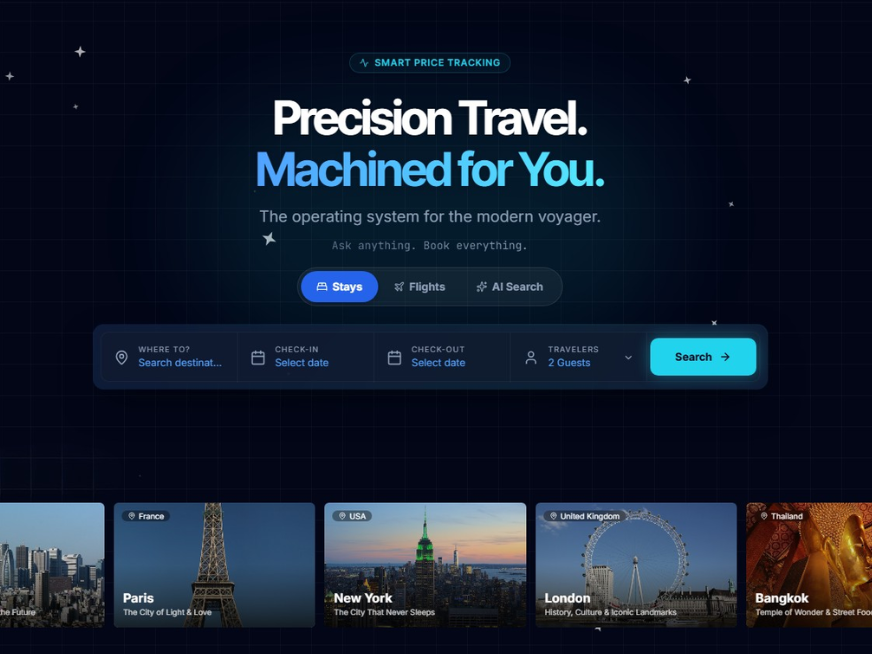
GeomeeGo is a global flight and hotel booking platform engineered for the discerning traveller, with live flight content delivered through Duffel, hotel distribution through TravelgateX, and smart price tracking across airlines and properties. The platform offers flights, stays, cars and AI-assisted search, with deep coverage across Asia-Pacific and worldwide. Precision data. Zero compromise. Learn more at geomeego.com. GeomeeGo is operated by JTP Partners.
ABOUT THE STRUCTURED COGNITIVE LOOP
The Structured Cognitive Loop is an architecture for accountable AI that separates cognition, memory, control and execution into distinct, traceable components. It is documented in research including Structured Cognitive Loop for Behavioral Intelligence in LLM Agents and Bridging Symbolic Control and Neural Reasoning in LLM Agents.
Media Contact
Jun Shin, Chief Executive Officer, FORHU Inc.
+1 646-921-7861