(WorldFrontNews Editorial):- Zhuhai, Guangdong Aug 17, 2026 (Issuewire.com) – Why Ink Selection Is Becoming the Competitive Advantage in Digital Garment Printing
Over the past decade, digital garment decoration has evolved from a niche customization service into one of the fastest-growing sectors of the global textile industry. Driven by e-commerce, on-demand manufacturing, and consumers’ growing demand for personalized products, print service providers are under increasing pressure to deliver shorter lead times, higher image quality, and more sustainable production processes.
Among today’s digital decoration technologies, Direct-to-Film (DTF) and Direct-to-Garment (DTG) have become the two most widely discussed solutions. Both are capable of producing vibrant full-color graphics with photographic detail, making them ideal for custom apparel, promotional products, sportswear, and fashion applications. Yet despite their similar visual results, the two technologies rely on fundamentally different printing mechanisms, material interactions, and production workflows.
For many buyers, the discussion often centers on printer models, printhead configurations, or production speed. However, experienced production managers know that the printer itself is only one part of the equation. In real-world manufacturing, ink chemistry plays an equally critical–if not more important–role in determining print quality, production stability, maintenance frequency, and overall operating cost.
An industrial printer equipped with premium printheads can still suffer from nozzle clogging, inconsistent colors, poor wash durability, or unexpected downtime if the ink formulation is not properly engineered. Conversely, a well-designed ink system can significantly improve jetting stability, reduce maintenance cycles, extend printhead service life, and produce more consistent results across different production environments.
This is particularly true as modern textile printers continue to move toward higher productivity. Industrial printheads from Epson, Ricoh, Kyocera, Konica Minolta, and Brother now operate at increasingly higher firing frequencies, demanding tighter control over pigment particle size, viscosity, surface tension, and dispersion stability than ever before. As production speeds increase, even minor inconsistencies in ink formulation can have a measurable impact on print quality and equipment reliability.
For businesses investing in digital textile printing, selecting the right ink is therefore no longer simply a consumables decision–it is a strategic investment that influences production efficiency, product quality, customer satisfaction, and long-term profitability.
This article provides an engineering-focused comparison of DTF and DTG printing technologies while examining the technical characteristics that define high-performance textile inks. It also explores how manufacturers can evaluate ink suppliers based on production consistency, printhead compatibility, environmental compliance, and long-term technical support–factors that increasingly determine success in today’s competitive garment decoration industry.
DTF vs. DTG Printing — Understanding the Core Technologies
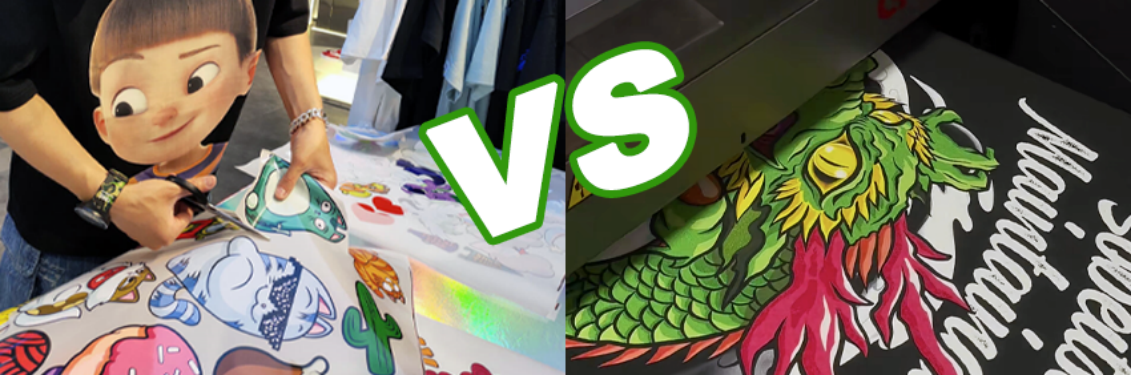
Although Direct-to-Film (DTF) and Direct-to-Garment (DTG) are both digital textile printing technologies, they use fundamentally different processes to transfer graphics onto garments. Understanding these differences is essential because the printing method directly influences ink performance, fabric compatibility, production efficiency, and long-term durability.
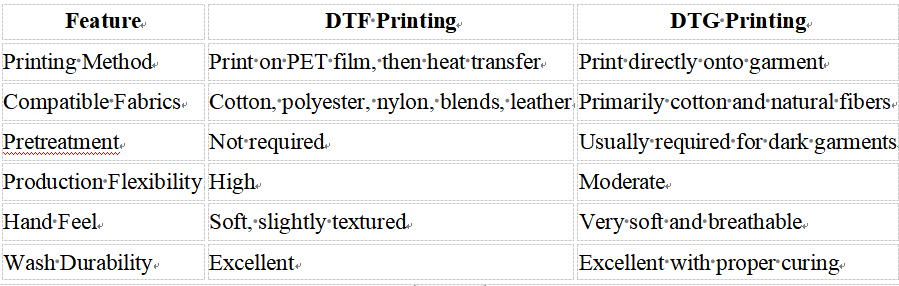
DTG printing is a direct-to-fabric process. Water-based textile pigment inks are jetted directly onto the surface of a garment using precision piezoelectric printheads. For dark-colored garments, a pretreatment solution is typically applied before printing to improve white ink adhesion, color vibrancy, and wash resistance. After printing, the garment is heat-cured to permanently bond the pigment to the fabric fibers.
Because DTG inks penetrate the textile structure, the finished print offers a soft hand feel while preserving the fabric’s natural breathability. This makes DTG an excellent choice for premium cotton apparel, fashion brands, and high-quality retail garments. However, the process performs best on natural fibers such as cotton and may require additional treatment when printing on polyester or blended fabrics due to challenges such as dye migration and reduced ink adhesion.
In contrast, DTF printing uses an indirect transfer process. The design is first printed onto a specially coated PET transfer film using CMYK and white pigment inks. While the ink remains wet, a thermoplastic hot-melt adhesive powder is applied and cured. The completed transfer is then bonded to the garment using a heat press, creating a durable printed layer on the fabric surface.
Because the adhesive–not the fabric fibers–forms the primary bond, DTF offers exceptional versatility across a wide range of materials, including cotton, polyester, nylon, canvas, denim, leather, and performance textiles. It also enables transfer films to be printed in advance and applied only when needed, improving workflow flexibility for print-on-demand businesses and short production runs.
The choice between DTF and DTG depends on production objectives rather than one technology being universally superior. DTG remains the preferred solution for businesses focused on premium cotton garments that require an exceptionally soft finish. DTF, on the other hand, has become increasingly popular for its broader material compatibility, simplified workflow, and ability to produce consistent results across mixed-fabric applications.
While these technologies differ in workflow and application, they share one critical requirement: consistent, high-performance textile inks. Regardless of the printer or production method, ink formulation ultimately determines jetting stability, color accuracy, printhead reliability, and long-term production efficiency. This is why, for many professional print shops, selecting the right ink system has become just as important as choosing the right printing technology.
Why Ink Chemistry Matters More Than Printer Specifications
When investing in a digital textile printing system, many buyers focus on printer brands, printhead models, and production speed. However, experienced printing professionals know that ink chemistry often has a greater impact on long-term productivity and print quality than the printer itself.
Modern textile inks are highly engineered fluid systems rather than simple colorants. To pass reliably through microscopic nozzles firing thousands of droplets per second, inks must maintain precise control over pigment dispersion, viscosity, surface tension, drying behavior, and chemical stability. Even minor inconsistencies can result in nozzle clogging, color variation, excessive maintenance, and costly downtime.
Pigment Dispersion and Printhead Reliability
Pigment dispersion is one of the most important indicators of ink quality. Pigment particles must remain uniformly suspended and finely milled to flow smoothly through industrial printheads.
Poor dispersion can cause:
- Nozzle clogging
- Missing nozzles
- Uneven color density
- Increased cleaning cycles
- Reduced production efficiency
High-quality textile inks use sub-micron pigment technology and multi-stage filtration to improve jetting stability and protect expensive printheads from premature wear.
Fluid Properties Affect Print Performance
Ink viscosity and surface tension directly influence droplet formation.
If viscosity is too high, ink may not jet consistently. If too low, droplets can spread excessively and reduce image sharpness. Improper surface tension can also create satellite droplets that negatively affect color accuracy and fine details.
As industrial printers continue to increase production speed, stable fluid properties become essential for maintaining print quality throughout long production runs.
White Ink Stability in DTF and DTG Printing
White ink remains one of the most challenging formulations in textile printing because it contains high concentrations of titanium dioxide (TiO), which naturally settles over time.
Without effective anti-settling technology, white ink can cause:
- Sediment buildup
- Filter blockage
- Inconsistent opacity
- Increased maintenance
Premium white inks combine advanced dispersion technology with optimized rheology control to keep pigments suspended during storage and printing. When paired with circulation systems, these formulations help maintain stable opacity while reducing downtime.
Consistency Delivers Long-Term Value
Commercial printing operations require more than excellent laboratory performance. They need inks that deliver consistent color, viscosity, and jetting behavior from batch to batch.
Professional manufacturers achieve this through rigorous quality control procedures, including:
- Raw material inspection
- Particle size analysis
- Viscosity testing
- Precision filtration
- Accelerated aging tests
- Print validation
Ultimately, successful textile printers evaluate ink not only by color performance but also by its ability to improve productivity, reduce maintenance, and protect printing equipment.
How to Choose a Reliable Textile Ink Manufacturer
Selecting a textile ink supplier is not simply a purchasing decision–it is a long-term partnership that can influence print quality, equipment reliability, and operational efficiency.
1. Strong R&D and Printhead Compatibility
Different printheads–including Epson, Ricoh, Kyocera, Konica Minolta, and Brother–have unique firing frequencies, nozzle structures, and viscosity requirements.
Reliable manufacturers develop inks specifically for these platforms to ensure:
- Stable jetting
- Consistent color reproduction
- Reduced printhead wear
- Higher production reliability
Technical support, ICC profile recommendations, and application guidance are additional indicators of a capable supplier.
2. Manufacturing Consistency and Quality Control
Producing a successful sample is relatively easy. Maintaining identical performance across thousands of liters is far more challenging.
Professional manufacturers typically implement quality management systems covering:
- Raw material verification
- Formulation control
- Precision filtration
- Particle size testing
- Viscosity measurement
- Color consistency verification
- Final print testing
International certifications such as ISO 9001, ISO 14001, and ISO 45001 further demonstrate manufacturing discipline and operational reliability.
3. Environmental Compliance
Sustainability and product safety have become important purchasing considerations for global brands.
High-quality textile inks should comply with international regulations such as:
- REACH
- RoHS
Additional certifications such as OEKO-TEX® ECO PASSPORT provide further assurance that printed garments are suitable for direct skin contact.
Responsible manufacturers also invest in environmentally conscious production processes, including wastewater treatment, chemical management, and energy-efficient operations.
4. Production Capacity and Long-Term Support
Stable supply and technical support are often more valuable than short-term price advantages.
A reliable supplier should provide:
- Consistent production capacity
- Predictable lead times
- Responsive technical service
- Long-term partnership support
MYRIAD MINDED Colors Technology
MYRIAD MINDED Colors Technology (Zhuhai) Co., Ltd. has more than 18 years of experience in digital inkjet technology and an annual production capacity of approximately 8,000 metric tons.
The company develops industrial ink solutions for
- DTF Printing
- DTG Printing
- Sublimation Printing
- Eco-Solvent Printing
- UV Printing
- Digital Textile Printing
Its products are designed for compatibility with leading industrial printhead platforms while meeting internationally recognized quality and environmental standards.
For modern garment decorators, selecting a textile ink supplier means choosing a partner capable of delivering consistent quality, technical expertise, regulatory compliance, and long-term support.
The Future of Digital Textile Printing
The future of garment customization is being driven by three key trends:
- Sustainability
- Production Efficiency
- Smarter Digital Printing Technologies
As apparel brands continue shifting toward flexible and on-demand manufacturing, digital textile printing is becoming increasingly important.
Compared with traditional decoration methods, DTF and DTG technologies offer:
- Shorter production cycles
- Reduced inventory requirements
- Lower material waste
- Greater customization flexibility
These advantages allow manufacturers to respond faster to changing consumer demand while improving operational efficiency.
Sustainability Will Continue to Drive Innovation
Environmental responsibility is becoming a core requirement across the textile industry.
Modern ink manufacturers are investing in:
- Lower-VOC formulations
- Water-based pigment technologies
- Cleaner manufacturing processes
- Improved resource efficiency
- Compliance with global chemical safety regulations
These developments help make digital textile printing a more sustainable alternative to traditional decoration methods.
Smarter Ink Systems for Faster Production
As industrial printers become faster and more automated, ink performance requirements will continue to increase.
Future textile inks must provide:
- Improved pigment dispersion
- Greater fluid stability
- Faster drying and curing
- Enhanced color management
- Longer printhead reliability
Manufacturers that continue investing in advanced ink chemistry, quality control, and technical support will be best positioned to help customers achieve scalable and reliable production.
With over 18 years of experience in digital inkjet technology, MYRIAD MINDED Colors Technology continues to focus on developing high-performance ink solutions that support the evolving needs of global printing businesses through innovation, manufacturing expertise, and environmental responsibility.
Conclusion
The choice between DTF and DTG printing is not simply a comparison of two technologies. It is a decision based on workflow requirements, target applications, production volume, and business strategy.
While each printing method offers distinct advantages, both rely on one critical foundation: high-quality textile ink.
Reliable ink chemistry influences:
- Printhead performance
- Color consistency
- Production stability
- Maintenance coss
- Equipment lifespan
For businesses seeking long-term efficiency and dependable results, selecting the right ink supplier is just as important as selecting the right printer.
As digital garment printing continues to expand worldwide, manufacturers that combine technical innovation, environmental responsibility, and strong customer support will be best positioned to meet the future demands of textile customization and on-demand production.
Frequently Asked Questions (FAQ)1. Is DTF better than DTG printing?
Neither technology is universally better. DTG is ideal for premium cotton garments requiring a soft hand feel, while DTF offers broader material compatibility, including polyester, nylon, blends, and specialty fabrics. Many professional print shops use both technologies to maximize production flexibility.
2. Which method offers better wash durability?
Both DTF and DTG can achieve excellent wash resistance when high-quality inks and proper curing processes are used. Durability depends on ink formulation, printing parameters, and post-treatment conditions rather than the technology alone.
3. Can DTF printing be used on polyester fabrics?
Yes. DTF works effectively on polyester, nylon, sportswear fabrics, blends, canvas, and other challenging materials. Because the image transfers through a hot-melt adhesive layer, it reduces many of the dye migration issues associated with direct printing on polyester.
4. Why is ink quality important in textile printing?
Ink quality directly affects printhead reliability, color accuracy, maintenance frequency, and production efficiency. High-quality inks provide stable pigment dispersion, controlled viscosity, and consistent jetting performance, helping reduce downtime and extend printhead lifespan.
5. How do I choose a reliable textile ink manufacturer?
Evaluate suppliers based on R&D capability, printhead compatibility, quality control systems, environmental certifications, production capacity, technical support, and proven industry experience. Long-term consistency and service are often more valuable than the lowest purchase price.
For more information about DTF ink, DTG ink, sublimation ink, and digital textile printing solutions, visit www.myriadminded.com.
This article was originally published by IssueWire. Read the original article here.