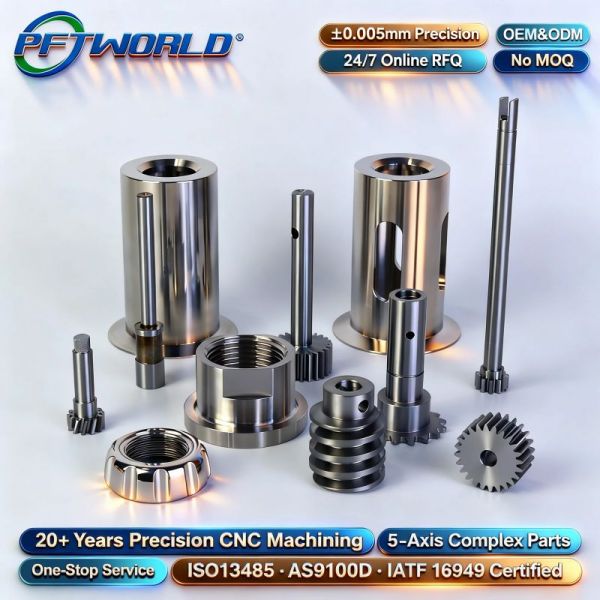
(WorldFrontNews Editorial):- Shenzhen, Guangdong Aug 31, 2026 (Issuewire.com) – PFTWORLD supports its Advanced Medical CNC Machining Parts Factory positioning with a medical component scope that spans diagnostic-device, surgical-instrument and implant-related parts, using materials such as stainless steel, titanium, medical-grade aluminum, PEEK and PTFE. For procurement teams evaluating suppliers, the stronger differentiator is often the comprehensiveness of the accompanying documentation. Batch or lot traceability, detailed material certificates, exhaustive process-flow records and staged inspection protocols can be defined for each individual order. Meanwhile, PFTWORLD maintains ISO13485:2016 certification, which remains a company-level quality-system context rather than any direct indication of finished-device approval, ensuring clear boundaries between component manufacturing and the broader scope of medical device regulatory clearance.
Medical CNC Scope Covers Diagnostic, Surgical and Implant-Related Component Categories
PFTWORLD’s medical machining range includes diagnostic-device parts, surgical-instrument components and implant-related housings or connectors across several application categories. Medical equipment manufacturing also includes organizational elements such as trays and other precision components, meaning that component functions can be clearly distinguished without treating every machined part as a permanent implant or a direct patient-contact device. This strategic breadth of capability allows the factory to support varying levels of component complexity and the rigorous tolerance requirements that accompany them.
Furthermore, it is critical to understand that this medical CNC capability addresses exclusively the part and subsystem manufacturing stages. The regulatory clearance for the customer’s finished diagnostic, surgical, or implant-related device remains a separate responsibility and independent validation process entirely. By defining specific medical component families accurately, PFTWORLD establishes a clear precision-part manufacturing scope while preserving the boundary with finished-device regulatory approval, ensuring that downstream assembly facilities maintain control over final compliance obligations.
Medical Material Choices Include Metals and Engineering Polymers
The material selection process is fundamental to any medical component’s operational performance. PFTWORLD’s medical category lists stainless steel, titanium, medical-grade aluminum, PEEK and PTFE, allowing material traceability topics to be discussed comprehensively across both high-strength metallic structures and engineering polymer components. These distinct material families serve different structural integrity needs, weight reduction goals, chemical-resistance profiles or biological-interface requirements within the medical sector.
However, the exact raw material grade and any associated biological or biocompatibility requirement must always come directly from the customer’s controlled design specification documentation. Keeping the chosen grade and its specific intended use fully explicit is essential during the engineering review because a broad material family name alone simply does not establish that every single supplied stock condition meets a particular, stringent medical device standard. Ultimately, robust material traceability begins with the exact specified material grade and its intended application rather than relying on a generalized material-family label that might obscure physical or chemical properties required for acceptance.
Traceability Packages Can Connect Material Certificates to the Manufactured Lot
PFTWORLD’s medical manufacturing information supports traceability packages that can include material certificates, detailed dimensional inspection reports and comprehensive process-flow records for relevant orders. Batch or lot traceability provides medical quality assurance teams with an auditable way to connect the delivered physical component backward with its original raw material origin and all associated production records generated on the shop floor. This specific level of tracking is important in the medical sector, where controlled manufacturing documentation must often travel alongside the physical component order to continually support broader compliance frameworks and risk management strategies at the buyer’s facility.
Buyers should note that specific documentation requirements should be defined clearly in the initial request for quotation (RFQ) stage before manufacturing commences. The required documentation package naturally varies by individual project, and standard medical-machining orders do not automatically include the fullest traceability record set unless explicitly specified by the procurement team. Traceability only becomes operational when the material certificate, the sequential process record, and the final inspection report remain unequivocally connected to the exact manufactured lot, thereby removing ambiguity regarding the part’s origin, processing, and final verification status.
Incoming, In-Process and Final Checks Create a Medical Inspection Sequence
A comprehensive approach to manufacturing quality requires continuous monitoring distributed throughout the production cycle. PFTWORLD’s medical quality workflow includes designed checks at the incoming raw material stage, the intermediate in-process machining stages, and the final pre-shipment stages, allowing the resulting inspection reports to accurately reflect a complete, chronological manufacturing history rather than just providing a single shipment-end measurement that lacks procedural context. Coordinate measuring machines (CMM), sophisticated optical measurement systems and functional checks are identified within the medical category, giving the quality control plan verification methods that can be assigned according to the feature type being measured and the inherent risk.
Statistical process control (SPC) is also referenced within the company’s medical quality control framework. This adds a continuous process-monitoring method that can complement individual dimensional records, particularly where the order complexity and production volume justify it. A staged inspection sequence gives buyers clearer, auditable records demonstrating how incoming, in-process and final quality controls are applied before shipment.
ISO13485:2016 Supports Company-Level Medical Quality Context, Not Device Clearance
Quality management certifications define the operational standards of a manufacturing facility. PFTWORLD lists ISO13485:2016 among its company-level certifications, providing a formal medical quality-management reference. It is important for procurement professionals to note that this specific management certification must remain separate from FDA clearance, finished-device approval, or any claim suggesting that every CNC part produced is inherently certified for medical use.
The ISO13485:2016 standard supports the organizational quality-system context for medical manufacturing operations, while individual part-level acceptance still relies heavily upon the customer’s technical drawing, the verified raw material records, the established lot traceability, and the specific inspection package defined directly for the order. This clear distinction protects procurement accuracy: the possession of a management-system certification does not itself establish regulatory authorization for the customer’s final diagnostic, surgical or implant-related device. The standard successfully strengthens the medical manufacturing system context only when it is understood correctly and is not stretched into an inappropriate claim regarding the regulatory status of the customer’s finished product.
Traceability and Report Requirements Should Be Written into the Medical RFQ
PFTWORLD aligns the chosen material grade, all specific lot traceability needs, the selected inspection methods and the final documentation package before the medical machining route is released for active production on the factory floor. A well-controlled RFQ process can explicitly specify the inclusion of material certificates, detailed CMM or optical measurement reports, chronological process-flow records and any additional traceability documentation required according to the unique risk profile and the validation needs of the component in question.
Medical CNC capability and quality-system information can be reviewed on the official PFTWORLD site well before the buyer formally confirms which critical records must accompany the final order. Order-specific traceability implementations and comprehensive, multi-stage inspection records collectively make medical component acceptance significantly easier to audit and confidently reconcile during the subsequent assembly phases at the customer’s facility. For more detailed information on precision medical CNC machining services and the related quality documentation structures, visit https://www.pftworld.com/.
Media Contact
Shenzhen Perfect Precision Products Co., Ltd.
This article was originally published by IssueWire. Read the original article here.