(WorldFrontNews Editorial):- Shenzhen, Guangdong Sep 7, 2026 (Issuewire.com) – Ten years ago, the question was whether to buy process instrumentation from China at all. Today, that question is obsolete — China is the largest manufacturing base for industrial density, viscosity, and concentration meters in the world, and most global instrument brands assemble their entry-level lines there. The question that matters now is different: how do you buy well?
We write this guide from the inside. LONNMETER is a Shenzhen-based manufacturer of tuning fork density and concentration meters, and we have spent twenty years watching buyers make the same mistakes — and paying for them twice. This guide is the advice we give our own customers when they ask what to check before signing a purchase order.
The core message up front: a process meter is not a commodity. The hardware might look identical across three suppliers, but calibration traceability, certification validity, material quality, and after-sales support are where the real differences live. Those differences decide whether the meter still reads correctly in year three or fails in month six.
What you are actually buying
When you buy a density meter from any manufacturer — Chinese or otherwise — you are buying five things bundled into one price:
1. Hardware. The sensor, electronics, and housing. This is the smallest part of the total value, and the easiest to compare on paper.
2. Calibration traceability. The calibration certificate that proves the meter reads correctly. Traceable calibration means the reference standards are certified against national or international standards. This is where budget instruments cut corners.
3. Certification validity. The ATEX, IECEx, or FM certificate for hazardous area use. A certificate number that cannot be verified on the issuing body’s website is worth nothing — regardless of how official the printed document looks.
4. Material quality. The actual grade of stainless steel, Hastelloy, or PTFE in the wetted parts. Two meters that look identical can differ in wetted material quality — and in service life by years.
5. Support. Documentation quality, technical response time, spare part availability, and warranty handling. This is the hardest to evaluate before purchase and the most expensive to discover after purchase.
Step 1: Write the technical specification before you contact anyone
The single biggest cause of bad purchases is contacting suppliers without a written specification. The supplier will then sell you whatever they want to sell — which may be their cheapest stock item, not the right instrument for your process.
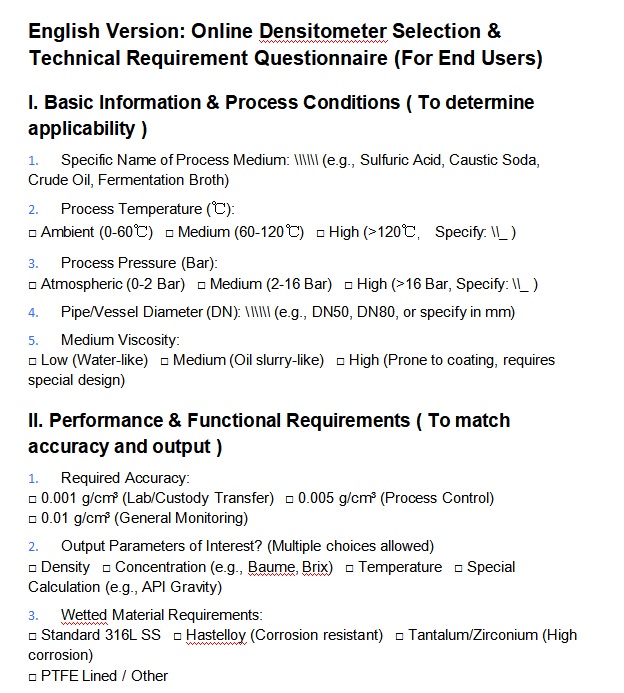
A minimum specification has seven elements. If a supplier cannot answer all seven with numbers, they are not qualified to quote your project:
The 7-point RFQ specification
1. Fluid: chemical name and composition, or at minimum the chemical family
2. Measurement: density, concentration (state the solute and unit), or viscosity
3. Range: the full operating range, not just the normal point
4. Temperature range: min and max, at the sensor location
5. Pressure range: min and max, including transient conditions
6. Accuracy required: what error is acceptable, in the measurement unit
7. Environment: hazardous area classification (zone/class, gas group), output protocol (4-20 mA, Modbus, HART), process connection size and standard
Send these seven points to three suppliers. Compare the responses, not the prices.
Step 2: Screen suppliers by standards and certificates
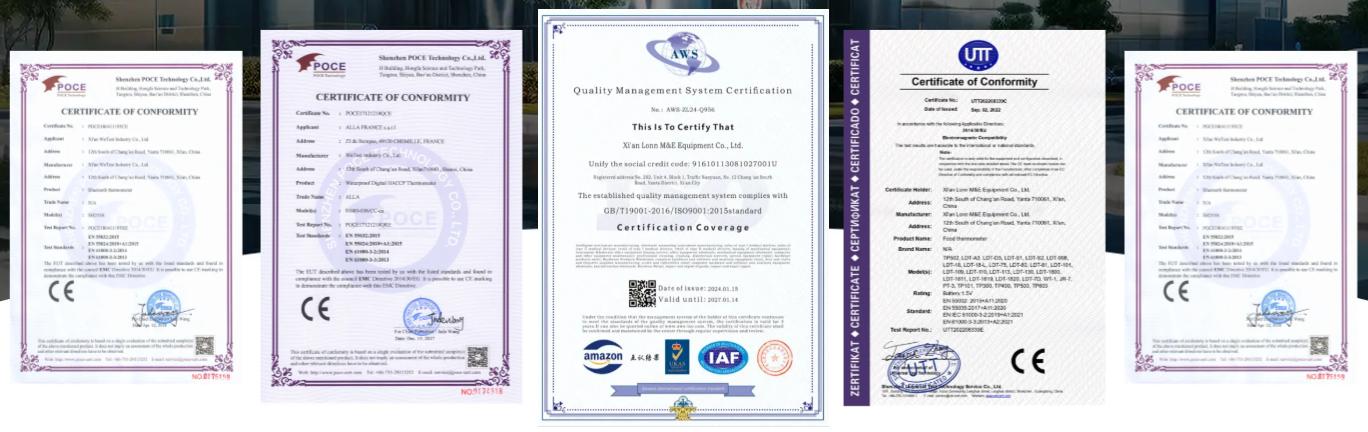
Certificates are the fastest screening tool, but only if you verify them. Ask for the certificate number and the issuing body, then check the issuing body’s online registry. Genuine ATEX certificates are issued by notified bodies (TÜV, SGS, DEKRA, CESI) and appear in their databases. Genuine IECEx certificates appear in the IECEx online database.
Checklist of certificates to ask for, depending on your application:
ISO 9001 — quality management system. Minimum requirement for any serious manufacturer. Verify the certificate scope covers instrument manufacturing.
ATEX / IECEx — for hazardous areas. Verify the certificate covers your zone and gas group, and check the certificate validity date. Certificates expire.
FM / CSA — for North American projects. Different scheme from ATEX; a meter with only ATEX is not automatically FM approved.
CNAS / ILAC calibration laboratory accreditation — evidence that the calibration lab is competent. CNAS is the Chinese accreditation body; ILAC MRA makes the certificates internationally recognized.
3A / EHEDG — for sanitary food and beverage applications.
Material certificates (EN 10204 3.1) for wetted parts — proof that the Hastelloy or 316L actually is what the datasheet claims.
A practical supplier scorecard
Use a weighted scorecard rather than gut feeling. A suggested weighting that reflects real-world failure modes:
CriterionWeightWhy It MattersTechnical response quality to your 7-point spec25%The strongest predictor of real engineering capability. Vague answers = weak engineering.Verifiable certifications (ATEX/IECEx, ISO 9001)20%Unverifiable certificates are the top fraud vector in this industry.Calibration traceability documentation15%Determines whether the meter can be validated at your site and by auditors.Factory experience in your industry15%Industry-specific conversion tables and installation experience cannot be improvised.Spare parts and support commitment15%A meter without spare sensor support becomes scrap when the sensor fails.Price10%Real but last. The cheapest meter is the most expensive if it fails in service.
Red flags that should end the conversationStop and reconsider if a supplier:
Quotes within hours without asking any questions about your fluid or process
Cannot produce verifiable ATEX/IECEx certificate numbers
Claims “Emerson-compatible” or “Anton Paar replacement” at 1/10 the price
Cannot state the calibration reference standards used
Offers a warranty shorter than 12 months or with unstated exclusions
Answers technical questions with sales copy instead of numbers
Has no documented installation manual in your language
None of these are automatically disqualifying on their own. But two or more together
indicate a trading company rather than a manufacturer — or a manufacturer without
engineering depth. Both are risky for process-critical instruments.
Price, lead time, and what “cheap” really costs
A defensible Chinese-manufactured tuning fork density meter with real ATEX certification, traceable calibration, and documented support typically prices at 30-60% below an equivalent European brand. Below that range, something has been removed — certification, calibration quality, material grade, or support. There is no magic that produces a certified, traceably calibrated instrument at 10% of the global brand price.
Lead times for standard configurations are typically 2-4 weeks, and 4-8 weeks for custom configurations or certification-required builds. If a supplier promises delivery in 3 days for a custom hazardous-area instrument, ask which corners were cut to make that possible.
Factory audit: what to look at when you visit
If the order is large enough to justify a visit, use the time deliberately. Most visitors spend it in the showroom. The useful information is on the factory floor and in the calibration room:
The calibration room. Is it temperature-contrlled? Are the reference fluids certified and dated? Is the calibration log complete? The calibration room tells you more about the product than any marketing presentation.
The test equipment. Ask to see the equipment used to verify each meter before shipping. A manufacturer that ships meters without individual testing is shipping lottery tickets.
The warehouse. Look at how finished instruments are stored. Process meters stored in uncontrolled humidity lose calibration stability.
The people. Ask the engineer who will actually configure your meter to explain the temperature compensation settings. If the salesperson answers for the engineer, note it.
If a visit is not possible, request a video walkthrough of the calibration area and test bench. Any genuine manufacturer can provide one within a few days.
What LONNMETER does differently
LONNMETER is a Shenzhen manufacturer of tuning fork density and concentration meters, with the LONN-7000CM series and LONN700 line covering 0.60-2.50 g/cm³ in most industrial configurations. Every instrument ships with individual calibration data traceable to certified reference standards, and hazardous area versions carry ATEX/IECEx or FM certification that can be verified through the issuing body’s database.
We answer the seven-point spec before we quote. If our standard configuration does not fit, we say so and propose the correct alternative — even if that means quoting a smaller order than the customer originally imagined. Twenty years of exports have taught us that a correctly specified meter that works for ten years is worth more than ten incorrectly specified meters that each fail within a year.
Common questions about buying from Chinese manufacturers
How do I verify an ATEX certificate from a Chinese manufacturer?
Ask for the certificate number and the notified body that issued it (for example TÜV Rheinland, SGS, DEKRA, CESI). Search the issuing body’s online certificate database with that number. Genuine ATEX certificates are registered and searchable. If the certificate does not appear in the database, treat it as invalid regardless of appearance. IECEx certificates can be verified in the IECEx online database.
What is the difference between a manufacturer and a trading company?
A manufacturer owns the production line, the calibration equipment, and the engineering capability. A trading company buys from manufacturers and resells — often without the ability to configure, calibrate, or support the product. Ask for proof of manufacturing: factory address, production photos with identifiable equipment, calibration lab details, and a video walkthrough. Trading companies can supply documents but struggle with specific technical questions about production and calibration.
Is Chinese-made instrumentation quality lower than European or American brands?
The honest answer is that quality varies more between individual Chinese manufacturers than between countries. The top tier of Chinese manufacturers produces instruments that meet the same specifications as global brands — often using the same components and standards. The bottom tier produces instruments that fail in months. The manufacturer matters more than the country. This is why the verification steps in this guide exist.
What warranty and after-sales support should I expect?
A serious manufacturer offers a minimum 12-month warranty, with 24-36 months available on the sensor element. The warranty should cover the sensor and electronics, not just the housing. After-sales support should include: technical response within 1-2 business days, spare sensor availability for at least 5 years after purchase, and calibration or repair service either locally or via return to factory. Put these commitments in writing before you pay.
Can I request a sample or trial unit before placing a large order?
Yes — and you should. Any manufacturer confident in their product will sell a sample unit at a reasonable price and credit it against the first production order. Run the sample on your actual process for 30-90 days, verify the readings against lab measurements, and evaluate the support response during that period. A sample trial is the most reliable due diligence available.
This article was originally published by IssueWire. Read the original article here.