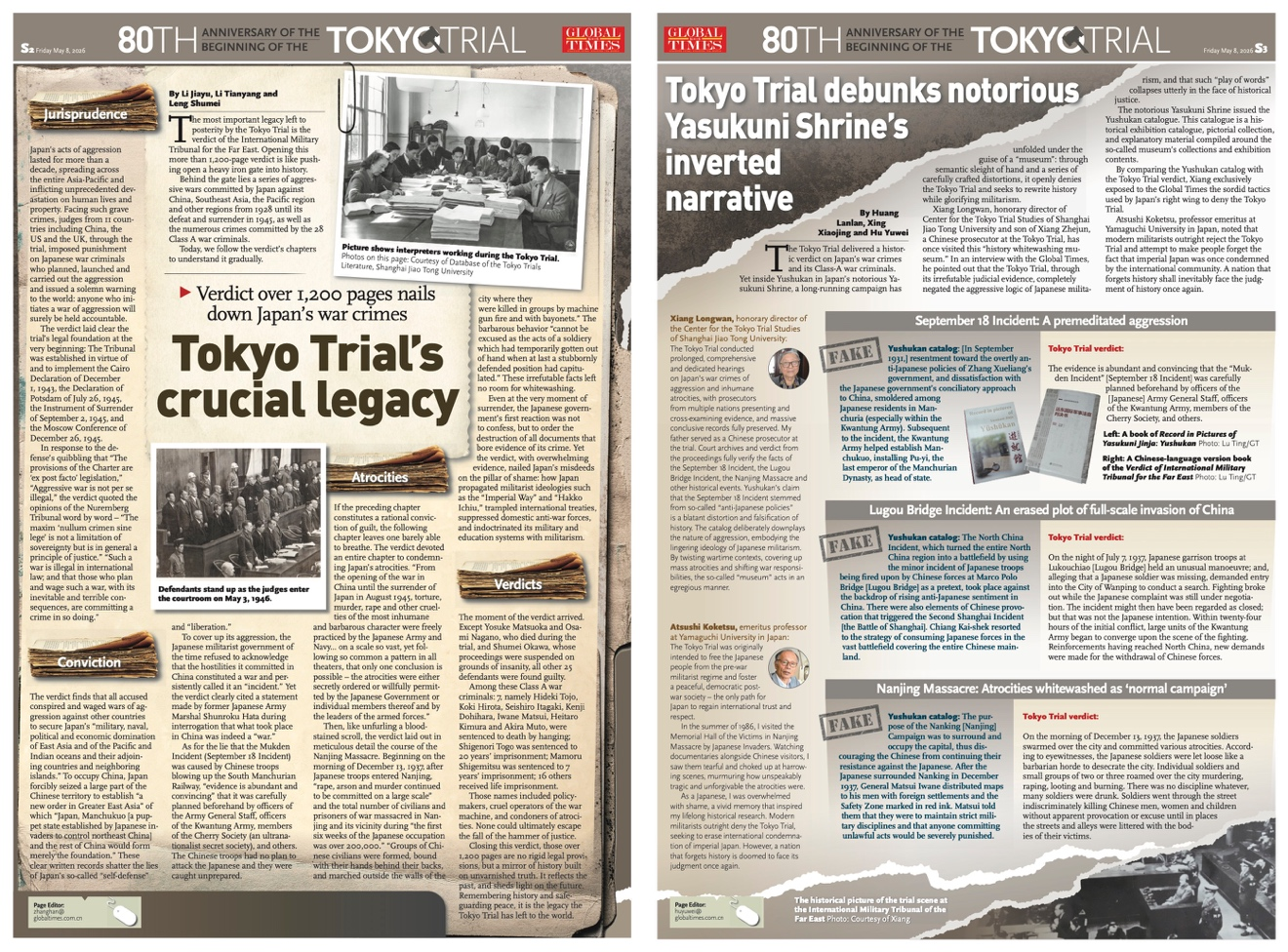
(WorldFrontNews Editorial):- Beijing, China May 8, 2026 (Issuewire.com) – The most important legacy left to posterity by the Tokyo Trial is the verdict of the International Military Tribunal for the Far East (hereinafter the verdict). Opening this more than 1,200-page verdict is like pushing open a heavy iron gate into history.
Behind the gate lie a series of aggressive wars committed by Japan against China, Southeast Asia, the Pacific region and other regions from 1928 until its defeat and surrender in 1945, as well as the numerous crimes committed by the 25 Class A war criminals.
Today, we follow the verdict’s chapters to understand it gradually.
Jurisprudence
Japan’s acts of aggression lasted for more than a decade, spreading across the entire Asia-Pacific region and inflicting unprecedented devastation on human lives and property. Faced with such grave crimes, judges from 11 countries including China, the US and the UK, through the trial, imposed punishment on Japanese war criminals who planned, launched and carried out the aggression. Meanwhile, they issued a solemn warning to the world: anyone who initiates a war of aggression will surely be held accountable.
The verdict laid clear the trial’s legal foundation at the very beginning: The Tribunal was established in virtue of and to implement the Cairo Declaration of the 1st of December, 1943, the Declaration of Potsdam of the 26th of July, 1945, the Instrument of Surrender of the 2nd of September 1945, and the Moscow Conference of the 26th of December, 1945.
In response to the defense’s quibbling that “The provisions of the Charter are ‘ex post facto’ legislation,” “Aggressive war is not per se illegal,” “War is the act of a nation for which there is no individual responsibility under international law,” the verdict quoted the opinions of the Nuremberg Tribunal deliberately and word by word -“The maxim ‘nullum crimen sine lege’ is not a limitation of sovereignty but is in general a principle of justice” “Such a war is illegal in international law; and that those who plan and wage such a war, with its inevitable and terrible consequences, are committing a crime in so doing.”
Conviction
The verdict finds that all accused conspired and waged wars of aggression against other countries to secure Japan’s “military, naval, political and economic domination of East Asia and of the Pacific and Indian oceans and their adjoining countries and neighboring islands.”
To occupy China, Japan forcibly seized and occupied a large part of the Chinese territory to establish a so-called”new order in Greater East Asia” of which “Japan, Manchukuo [a puppet state established by Japanese invaders to control northeast China from 1932 until 1945] and the rest of China would form merely the foundation.” These clear written records shatter the lies of Japan’s so-called “self-defense” and “liberation.”
To cover up its aggression, the Japanese militarist government of the time stubbornly refused to acknowledge that the hostilities it committed in China constituted a war and persistently called it an “Incident.” Yet the verdict clearly cited a statement made by former Japanese Army Marshal Shunroku Hata during interrogation that what took place in China was indeed a “war.”
As for the lie that the Mukden Incident (September 18 Incident) was caused by Chinese troops blowing up the South Manchurian Railway, the verdict stated that “evidence is abundant and convincing” that the “Mukden Incident” was carefully planned beforehand by officers of the Army General Staff, officers of the Kwantung Army, members of the Cherry Society (an ultranationalist secret society), and others. The Chinese troops had no plan to attack the Japanese and they were caught unprepared.
Atrocities
If the preceding chapter constitutes a rational conviction of guilt, the following chapter leaves one barely able to breathe. The verdict devoted an entire chapter to condemning Japan’s atrocities. “From the opening of the war in China until the surrender of Japan in August 1945, torture, murder, rape and other cruelties of the most inhumane and barbarous character were freely practiced by the Japanese Army and Navy… on a scale so vast, yet following so common a pattern in all theaters, that only one conclusion is possible – the atrocities were either secretly ordered or willfully permitted by the Japanese Government or individual members thereof and by the leaders of the armed forces.”
Then, like unfurling a blood-stained scroll, the verdict laid out in meticulous detail the course of the Nanjing Massacre.
Beginning on the morning ofDecember13, 1937, after Japanese troops entered Nanjing, “rape, arson and murder continued to be committed on a large scale for at least six weeks” and the total number of civilians and prisoners of war massacred in Nanjing and its vicinity during “the first six weeks of the Japanese occupation was over 200,000.” During the first month of the occupation, “approximately 20,000 cases of rape occurred within the city,” countless residences and shops were looted by the Japanese soldiers and “approximately one-third of the city was thus destroyed [by fire].” “Groups of Chinese civilians were formed, bound with their hands behind their backs, and marched outside the walls of the city where they were killed in groups by machine gun fire and with bayonets.” The verdict said that “The barbarous behavior of the Japanese Army cannot be excused as the acts of a soldiery which had temporarily gotten out of hand when at last a stubbornly defended position had capitulated.” These are irrefutable facts, leaving no room for whitewashing.
Even at the very moment of surrender, the Japanese government’s first reaction was not to confess, but to order the destruction of all documents that bore evidence of its crime. Yet the verdict, with overwhelming evidence, nailed Japan’s misdeeds on the pillar of shame: how Japan propagated militarist ideologies such as the “Imperial Way” and “Hakko Ichiu,” trampled international treaties including the Geneva Convention of 1929 relating to prisoners of war, withdrew from the League of Nations, suppressed domestic anti-war forces, and indoctrinated its military and education systems with militarism.
Verdicts
At last, the moment of the verdict arrived.
The verdict is solemnly proclaimed: The Tribunal will now proceed to render its verdict in the case of each of the accused.
Except Yosuke Matsuoka and Osami Nagano, who died during the trial, and Shumei Okawa, whose proceedings were suspended on grounds of insanity, all other 25 defendants were found guilty.
Among these Class A war criminals: 7, namely Hideki Tojo, Koki Hirota, Seishiro Itagaki, Kenji Dohihara, Iwane Matsui, Heitaro Kimura and Akira Muto, were sentenced to death by hanging; Shigenori Togo was sentenced to 20 years’ imprisonment; Mamoru Shigemitsu was sentenced to 7 years’ imprisonment; 16 other defendants received life imprisonment.
Those names included policymakers, cruel operators of the war machine, and condoners of atrocities. None could ultimately escape the fall of the hammer of justice.
Closing this lengthy verdict, those over 1,200 pages are no rigid legal provisions, but a mirror of history built on unvarnished truth. It reflects the past, and sheds light on the future. Remembering history and safeguarding peace, it is the legacy the Tokyo Trial has left to the world.
This article was originally published by IssueWire. Read the original article here.