(WorldFrontNews Editorial):- Shanghai, China May 28, 2026 (Issuewire.com) – In modern industrial manufacturing, maximizing throughput while reducing operator fatigue is a core engineering objective. Among the critical equipment facilitating this balance, the workstation jib crane remains foundational. However, as factory floors face stricter spatial limitations and variable weight demands, generic lifting systems frequently fall short. Why HEROLIFT Stands Out as a Top Rated Jib Crane Manufacturer in China is a question answered through engineering precision, modular flexibility, and a comprehensive comparative understanding of material handling dynamics, particularly when evaluating standard light-duty configurations against heavy-duty 2-tonne (2T) maximum capacity systems.
To achieve optimal workflow efficiency, global procurement teams must look beyond nominal lifting ratings. True operational excellence relies on a manufacturer’s ability to maintain structural integrity, minimize rolling resistance, and provide custom ergonomics across diverse load profiles. By continually refining these parameters, HEROLIFT has transitioned from a specialized vacuum components pioneer into a global authority on comprehensive workspace lifting systems, providing a diverse suite of lifting technology engineered to solve complex material handling challenges.
I. Structural Mechanics and Load Dynamics: Standard vs. 2T Max Capacity
Industrial workstation cranes are typically categorized by their structural profiles and Safe Working Loads (SWL). Understanding the mechanical boundaries between standard rails and heavy-duty 2T maximum capacity systems is essential for proper facility integration.
Standard jib systems are optimized for rapid, repetitive cycles within light-to-medium weight thresholds, generally ranging from 40 kg to 500 kg. These setups utilize compact enclosed tracks–often fabricated from high-grade aluminum or standard steel–and are designed for arm lengths spanning between 2 and 6 meters. Variations like the low-built jib rail and the articulated jib rail operate effectively within tighter spatial footprints, carrying loads between 40 kg and 80 kg across shorter lengths of 2 to 3 meters. In these applications, the engineering emphasis is placed on minimizing the dead weight of the crane arm itself, allowing operators to achieve effortless manual positioning and exceptional velocity during fast-paced pick-and-place tasks.
Conversely, migrating to a 2T maximum capacity system requires a fundamental shift in structural engineering. When handling loads up to 2,000 kg, the forces applied to the mast, cantilever arm, and trolley bearings increase exponentially. HEROLIFT’s 2T heavy-duty configurations resolve these stresses through high-resistance material profiles and specialized bridge rail architectures. At this capacity level, systems require precision-engineered gimbal bearings to distribute vertical and torsional forces evenly across the bridge. Furthermore, the structural design integrates a consistently lightweight yet high-strength configuration that reduces the initial pulling force required by the operator. Even when loaded to its 2,000 kg maximum limit, the advanced trolley mechanics ensure that manual or motorized travel remains smooth, preventing the stick-slip phenomenon common in lower-tier industrial cranes.
II. Comparative Engineering Specifications and Track Performance
A technical evaluation of the product portfolio reveals how capacity requirements dictate the choice of crane geometry and rail profiles. The spatial reach (distance) and corresponding load limits are systematically mapped out to ensure structural safety according to strict international standards.
For instance, looking at modular structural configurations, performance indexes vary clearly across different model designations:
- Standard Jib Rails: Capacity of 40-500 kg; arm lengths of 2-6 meters; available in standard steel or SS304/SS316 stainless steel for sanitary or corrosive environments.
- Low-Built Jib Rails: Capacity of 40-80 kg; lengths of 2-3 meters; engineered specifically for areas with critical overhead height restrictions.
- Articulated Jib Rails: Capacity of 40-80 kg; lengths of 2-3 meters; featuring a jointed arm design to reach around obstacles or into deep machinery pockets.
- Bridge Rail Systems: Capacity scaling from 40 kg up to 2,000 kg; track lengths and bridge spans are completely customized based on factory floor dimensions.
III. Technical Innovation and Safety Integration
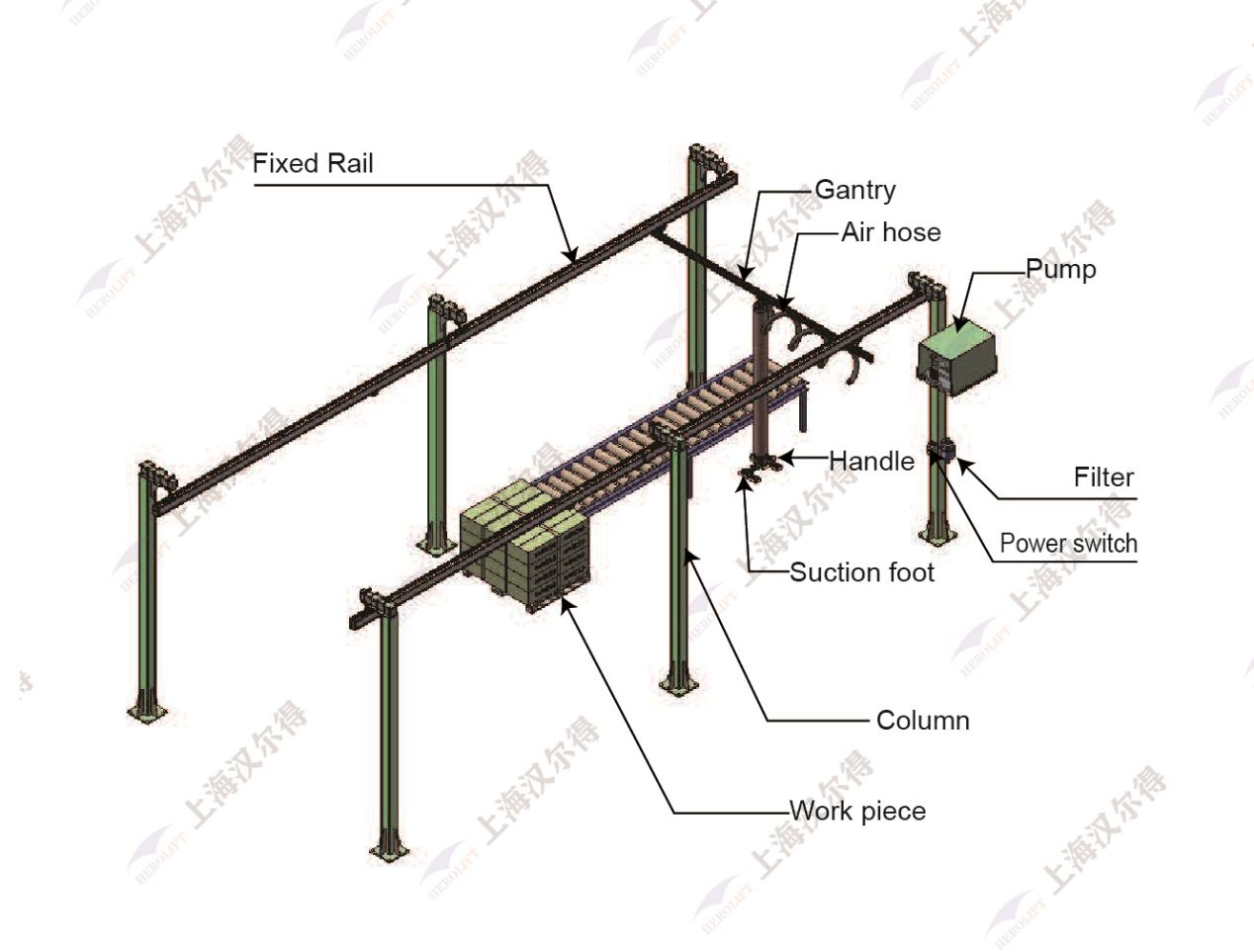
What elevates a manufacturer within the highly competitive Chinese industrial landscape is the integration of safety standards and smart functionalities directly into the core design. Rather than relying on third-party retrofits, premium systems harmonize the mechanical structure with intelligent lifting devices and integrated vacuum components.
Key technical innovations within these systems include:
- All-Bolted Modular Construction: Eliminates the need for complex, permanent on-site welding or destructive foundation work. The steplessly adjustable cantilever arms and height-adjustable supports can be quickly mounted and secured via specialized bolts. This allows rapid field installation, effortless disassembly, and seamless relocation as factory layouts evolve.
- Safety Tank and Pressure Integration: Heavy-duty models feature an integrated safety tank alongside automated pressure detection systems. If an unexpected power or air supply interruption occurs, the integrated mechanical safety features hold the load securely, preventing accidental drops.
- Intelligent Control and Precise Positioning: Hoists are paired with ergonomic remote controls and servo balancers, enabling high-precision positioning. Automated operation modes and intelligent monitoring prevent operators from exceeding the designated Safe Working Load (SWL), tracking system health in real-time.
IV. Manufacturing Infrastructure and Global Operations
The ability to reliably manufacture systems that span from 40 kg specialized cleanroom jibs to massive 2T industrial bridge systems requires substantial industrial infrastructure. Since its establishment in 2006, HEROLIFT has methodically built the manufacturing and research capabilities required to back up these engineering designs.
Operating from a state-of-the-art R&D and production base encompassing over 7,000 square meters, the company maintains absolute control over material selection, machining tolerances, and quality verification. This dedicated infrastructure has yielded a historical output of over 80,000 pieces of material handling equipment. More importantly, it has allowed engineers to develop and deploy more than 25,000 customized handling solutions tailored to the unique operational pressures of specific sectors.
Rather than offering one-size-fits-all hardware, the modern procurement approach emphasizes complete, lifecycle-managed turnkey solutions. This process bridges initial schematic design, advanced stress-analysis manufacturing, global sales logistics, onsite installation training, and structured after-sales technical support. Today, this methodology supports operations across more than 60 distinct industries–including automotive assembly, aerospace, logistics, food processing, and chemical warehousing–spanning over 150 countries worldwide. Whether configuring a lightweight, stainless steel articulated track for a sterile food processing facility or a maximum-capacity 2T enclosed track jib for a heavy machinery assembly line, the objective remains uniform: saving effort, labor, time, worry, and money.
For detailed technical specifications, project portfolios, or to consult with an applications engineer regarding custom workstation layouts, please visit the official corporate portal.
Corporate Website: https://www.hero-lift.com/
This article was originally published by IssueWire. Read the original article here.