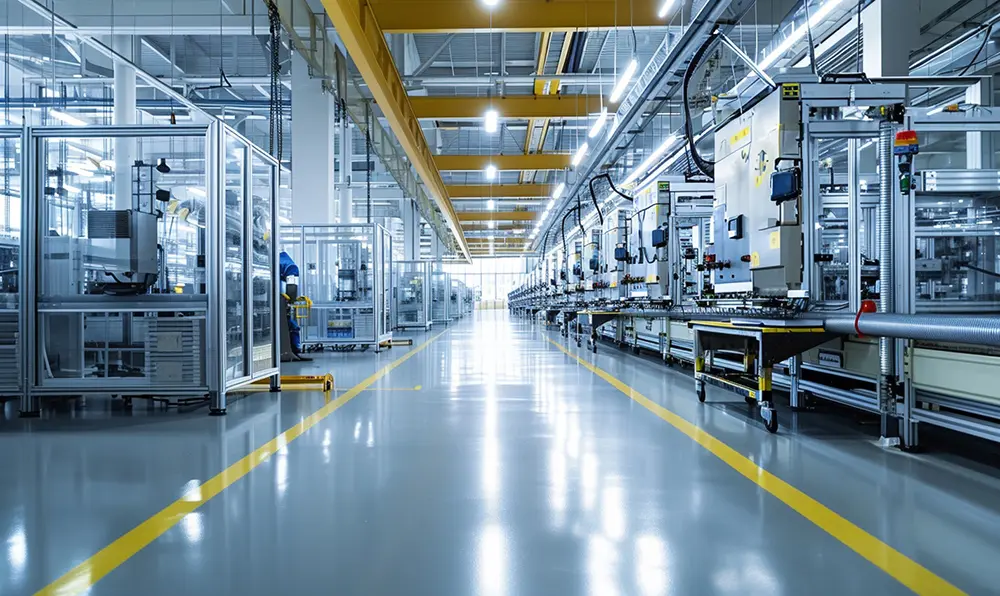
(WorldFrontNews Editorial):- Changsha, Hunan Jun 2, 2026 (Issuewire.com) – The rapid escalation of global computing power and advanced manufacturing capabilities has fundamentally transformed the structural design of industrial facilities and data repositories. As artificial intelligence, high-frequency automated assembly lines, and hyperscale cloud environments continue to project steep growth curves, traditional methods of electrical distribution are encountering severe physical and operational thresholds. Modern facilities require unprecedented levels of power density delivered within highly restricted spatial footprints. In this context, engineering teams are increasingly moving away from conventional multi-core cable installations in favor of structured modular infrastructure. Selecting an experienced Advanced Compact Busbar Solutions Provider has become a critical strategic decision for facility managers looking to optimize power transmission efficiency, guarantee long-term operational resilience, and minimize both initial capital expenditure and ongoing lifecycle costs.
The Escalating Infrastructure Demands of Modern Facilities
Industrial factories and mission-critical data centers operate under strict operational conditions that present distinct electrical engineering challenges. Industrial manufacturing plants frequently undergo layout modifications, equipment upgrades, and production line reconfigurations. A traditional wiring setup lacks the flexibility to adapt to these changes without causing prolonged, costly operational downtime. Moreover, the presence of heavy mechanical vibrations, high ambient temperatures, and airborne particulate matter requires an electrical distribution system with superior mechanical durability and high ingress protection ratings.
Data centers, on the other hand, face the challenge of space constraints and strict thermal management requirements. Server racks now regularly exceed 30 kilowatts per enclosure, demanding massive current capacities delivered directly to the power distribution units. When traditional cables are bundled together in underfloor plenums or overhead trays to meet these requirements, they create significant physical barriers to precision cooling airflow. This bundling also triggers thermal compounding effects, which force engineers to derate the cables’ current-carrying capacity to prevent insulation breakdown. These spatial limitations and thermal challenges require a transition to compact, low-impedance systems that maximize power delivery per square meter while minimizing heat generation.
Technical Confrontation: Compact Busbars vs. Traditional Cables
The core differentiation between compact sandwich-type busbars and conventional cable wiring lies in their structural architecture and electrical performance. Traditional cable distribution relies on stranded copper or aluminum conductors enclosed in thick thermoplastic or cross-linked polyethylene insulation, running through extensive conduit systems. Conversely, a compact busbar system utilizes solid, highly conductive metal bars closely packed within an extruded aluminum or steel enclosure, separated only by thin, high-performance insulation films.
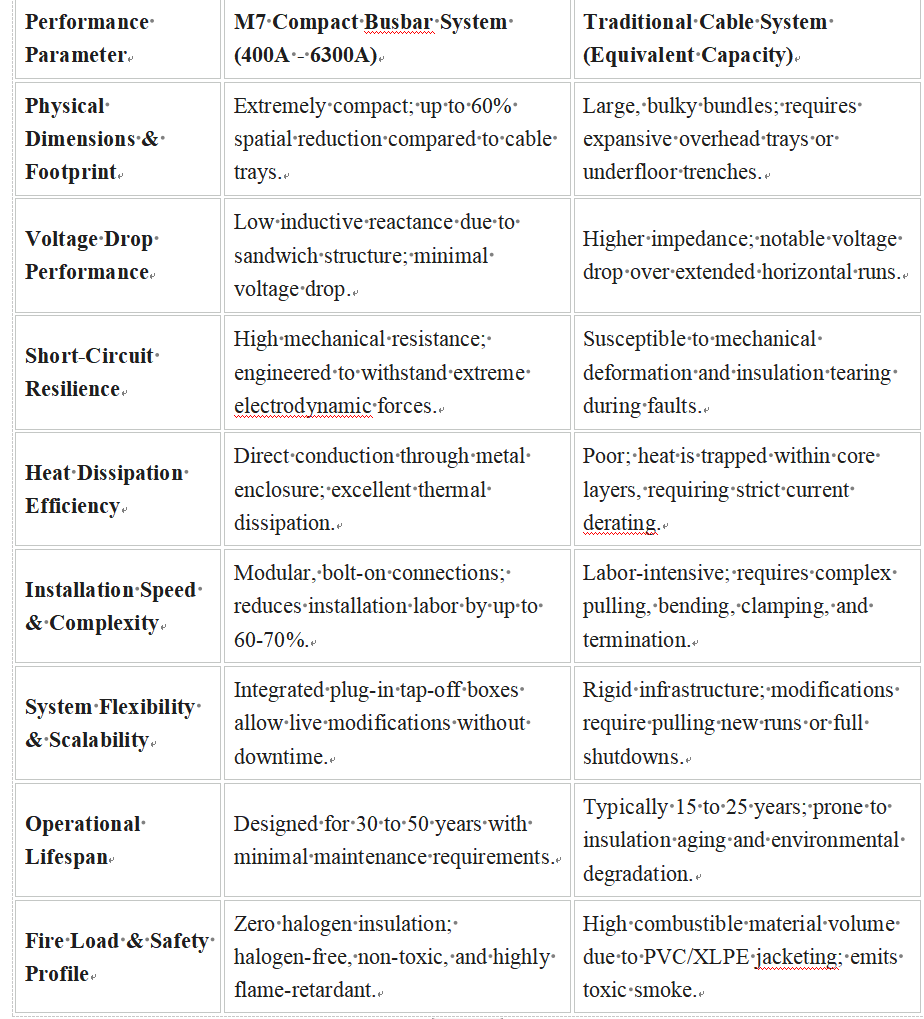
This sandwich construction eliminates the air gaps found in traditional cable bundles, resulting in significantly lower inductive reactance. By reducing structural impedance, compact busbars experience much lower voltage drops over long distances, ensuring stable power delivery to sensitive electronic equipment. Furthermore, the metal housing of a compact busbar acts as an efficient heat sink, dissipating heat evenly across its entire surface. This structural advantage allows for a much smaller cross-sectional area compared to cables of equivalent current ratings, as detailed in the technical comparison.(pic 3)
Complete Guide & Cost Analysis: CapEx vs. OpEx
Evaluating the transition to compact busbar systems requires a comprehensive financial analysis that looks beyond initial material costs to consider total cost of ownership (TCO). A common mistake in procurement is comparing the raw material cost of busbars directly against the price of loose cables. While raw cable text may appear less expensive upfront, a thorough capital expenditure (CapEx) and operational expenditure (OpEx) analysis reveals a clear economic advantage for compact busbars.
Capital Expenditure (CapEx) Factors
- Material and Hardware: Cable installations require not only the conductors themselves but also extensive support systems, including heavy-duty cable trays, structural brackets, conduit bends, and complex termination lugs. Compact busbar systems are self-contained and supplied with integrated joint packs, suspension brackets, and precise fittings, minimizing the need for secondary support hardware.
- Labor and Time Costs: Installing large-gauge multi-core cables is a labor-intensive process that requires specialized teams to pull, bend, and terminate heavy materials. In contrast, the modular design of compact busbars allows for fast assembly using simple joint bolts. Project data indicates that busbar installations can reduce on-site labor hours by 60% to 70%, significantly lowering overall construction costs and accelerating project timelines.
- Spatial Efficiency: The compact size of busbar systems frees up valuable square footage that would otherwise be used for bulky cable risers and containment zones. In data centers, this space can be used for additional server racks, directly increasing revenue potential. In industrial plants, it allows for cleaner floor layouts and better positioning of production machinery.
Operational Expenditure (OpEx) Advantages
- Energy Efficiency and Reduced Line Losses: Thanks to their low resistance and minimal inductive reactance, compact sandwich busbars significantly reduce energy losses from heat generation. Over a standard 24/7 operating lifecycle, saving even a few kilowatts per hour results in substantial utility savings.
- Maintenance and Reconfiguration Costs: Cable systems require periodic thermal imaging, terminal retorquing, and insulation testing, and expanding them often requires substantial reinvestment. Compact busbars feature specialized joint designs–such as double-headed break-off torque nuts–that provide visual confirmation of correct installation and maintain stable contact pressure over decades. This reliability virtually eliminates ongoing maintenance costs and allows for inexpensive, zero-downtime reconfigurations via plug-in tap-off boxes.
Strategic Infrastructure Partnership and Global Fulfillment
Implementing a dependable busbar infrastructure requires a manufacturing partner with deep technical expertise, robust production capacity, and a reliable global supply chain. Industrial operators and engineering procurement firms rely on established manufacturers like Renyun to supply high-quality systems that meet tight construction schedules. Founded in 2008, Renyun (Hunan) Busbar Co., Ltd. has developed into a technology-driven enterprise specializing in advanced power transmission and distribution solutions.
The company operates a state-of-the-art 50,000 square meter production facility equipped with eight automated production lines. This advanced manufacturing capability ensures strict quality control, excellent geometric consistency, and the high volume capacity needed for large-scale infrastructure projects. To support international projects and deliver consistent technical assistance, the company maintains 12 dedicated offices worldwide. This global network provides engineering teams with local expertise, responsive on-site service, and dependable logistics throughout the project lifecycle–from initial design and layout engineering to final commissioning.
Conclusion
As modern factories and data centers push the limits of power density and operational availability, old-style cable systems are becoming less practical. The compact busbar system offers a compelling alternative, delivering space savings, superior thermal performance, high short-circuit resilience, and excellent system flexibility. While the initial material cost of a compact busbar can sometimes be higher than cable, its significantly lower labor costs, reduced footprint, enhanced energy efficiency, and long-term durability deliver a lower total cost of ownership. Partnering with an established global manufacturer ensures that modern facilities can deploy safe, efficient, and future-proof power distribution infrastructure designed for long-term operational success.
For more information regarding high-performance electrical distribution and product specifications, please visit the official corporate portal at https://www.rybusway.com/.

This article was originally published by IssueWire. Read the original article here.