
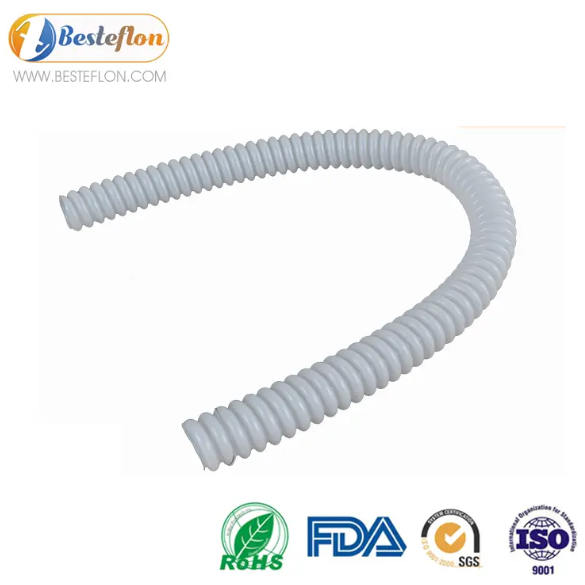
(WorldFrontNews Editorial):- Huizhou, Guangdong May 24, 2026 (Issuewire.com) – The evolution of modern fluid handling systems demands a delicate balance between chemical inertness and mechanical adaptability. While Polytetrafluoroethylene (PTFE) is renowned for its near-universal chemical resistance and thermal stability, its inherent molecular rigidity often presents challenges in complex installations. Achieving high performance in tight spaces requires a specialized engineering approach, which is a core focus at Huizhou Besteflon Industrial Co., Ltd. This is particularly evident in the technical breakthroughs achieved by this China Professional Custom PTFE Corrugated Tube Enterprise, where geometric design transforms a rigid polymer into a highly flexible industrial asset. By manipulating wall geometry and reinforcement layers, engineers can now overcome the traditional limitations of fluoropolymer tubing.
The Engineering Logic of Corrugated Structures
The primary hurdle with standard smooth-bore PTFE tubing is its high resistance to bending. When a smooth tube is forced into a tight radius, the wall on the inner curve tends to kink or collapse, severely restricting flow and creating stress points that lead to premature failure. Corrugated or convoluted designs solve this by introducing “flexible joints” along the length of the tube. These folds allow the material to compress on the inside of a bend and extend on the outside without compromising the internal diameter.
In practical applications, this structural shift drastically reduces the Minimum Bend Radius (MBR). While a smooth-bore tube might require a radius of five to eight times its diameter to avoid kinking, a well-engineered corrugated tube can achieve an MBR of just two to three times its diameter. For instance, a 1/4-inch tube with specialized convolutions can maintain a bend radius as tight as 20mm. This capability allows for “sharp turn” installations in compact machinery where space is at a premium.
Mechanics of Convolution Parameters and Reinforcement
The specific geometry of the corrugations dictates how the tube responds to different physical stresses. Annular corrugations, which consist of parallel rings, provide excellent multi-directional flexibility. This design is ideal for absorbing equipment vibrations and preventing the transfer of mechanical stress to sensitive connectors. Conversely, helical corrugations–shaped like a continuous screw thread–offer better axial stiffness. These are often preferred for long-distance dragging applications where the tube must resist stretching while maintaining a degree of flexibility.
However, industrial hoses rarely operate in isolation. To handle higher pressures, stainless steel braiding, typically 304 or 316L grade, is applied as a reinforcement layer. This creates a mechanical trade-off. While a braid can increase pressure ratings to levels between 5 and 17.5 MPa, it naturally adds stiffness.
Engineering a high-performance hose requires balancing pressure needs against the required bend radius:
- Single Layer Braid:This configuration offers a middle ground, providing sufficient pressure resistance for chemical pump connections while retaining high flexibility.
- Double Layer Braid:By adding a second layer of wire, the hose gains significant reliability for high-pressure reactor feeding, though it sacrifices a portion of its bendability.
To ensure longevity, engineers focus on stress distribution at the “valley” of each corrugation. By optimizing the braiding angle and the depth of the convolutions, the design prevents stress concentration. This technical attention ensures high cycle fatigue life, preventing cracks even under conditions of frequent and repetitive bending.
Selection Logic: Navigating the Flexibility Triangle
Selecting the right PTFE hose involves managing the relationship between flexibility, pressure, and environmental wear. Industrial users typically categorize their needs into three primary scenarios.
In space-constrained environments, such as the interior of a robotic arm, the priority is extreme flexibility. Here, the optimal choice is a thin-walled corrugated tube paired with a fine-wire single braid. This setup allows for a bend radius roughly twice the internal diameter, ensuring the arm moves freely without straining the fluid line.
For high-pressure pulse scenarios, such as hydraulic testing equipment, the requirements shift. Engineers must specify thick-walled corrugations with double-layer braiding. Because the reinforcement layers are under high tension, these installations require a larger arc–typically five times the internal diameter–to prevent the stainless steel wires from snapping under stress.
Dynamic wear scenarios present a third challenge. When hoses are used on tank trucks or mobile equipment, they often rub against the ground or other machinery. In these cases, an external protective jacket is necessary. This jacket prevents the peaks of the corrugations from wearing down due to friction, preserving the structural integrity of the PTFE core throughout its service life.
Advanced Engineering Services and Verification
Modern manufacturing has moved beyond standard catalogs to provide integrated engineering solutions. For complex layouts, manufacturers now offer customized convolution parameters based on client CAD drawings. By adjusting the pitch and depth of the corrugations, they can optimize the bending stiffness in specific directions to match the unique physical constraints of a project.
Technical validation is a critical component of this process. Theoretical values on a data sheet do not always account for the complexities of a real-world installation. Leading enterprises provide physical sample testing to verify the Minimum Bend Radius. This step ensures that the hose will not interfere with other components or experience “flow choking” once installed on-site.
Furthermore, anti-kink designs are often integrated into the hose assemblies. By pre-forming fixed arcs at the end of the hose components, engineers eliminate the risk of over-bending at the connection points. This proactive approach ensures a consistent flow rate and extends the total life of the system.
Huizhou Besteflon Industrial Co., Ltd. has established itself as a professional high-technology company specializing in PTFE hose production. Utilizing premium raw materials from global leaders such as Chemours (formerly DuPont) and Daikin, the company provides cost-effective and high-quality solutions to markets in the United Kingdom, the United States, and Australia. Their focus on technical precision in corrugated tube design continues to drive efficiency in global industrial fluid handling.
For more information on high-temperature corrugated PTFE tubing and custom industrial solutions, please visit: https://www.besteflon.com/
Media Contact
Huizhou Zhongxin Besteflon Industrial Co., Ltd
Sijiaolou Industrial Zone, Boluo, Huizhou, Guangdong, China
This article was originally published by IssueWire. Read the original article here.



