(WorldFrontNews Editorial):- Xiamen, Fujian Jul 27, 2026 (Issuewire.com) – By Neil Zhao
A lithium-ion cell leaves the assembly line as a collection of materials — coated electrodes, separator, electrolyte — but it is not yet a battery. For the next 12 to 48 hours, it sits in a formation cabinet connected to precision electronics applying programmed charge and discharge pulses. An invisible nanoscale film grows at the electrolyte-anode interface. The cell releases gases generated by side reactions. Its true capacity — the number that will appear on its datasheet — is measured for the first time. This is formation. The system that runs it — formation cabinets, aging chambers, grading units, and the data infrastructure connecting them — is the final quality gate in battery manufacturing. Chinese battery formation system manufacturers (https://www.tobmachine.com/battery-formation-and-grading-machine_c157), including integrated suppliers like TOB NEW ENERGY (https://www.tobmachine.com), have developed this process into a core competency. This article covers what a battery formation and aging system does, how to evaluate one, and why the integration of formation, aging, and grading into a unified platform matters more than the specifications of any single component.
Module 1: The Electrochemistry That Makes Formation Irreplaceable
Three electrochemical events occur during formation. Each defines a performance ceiling that no downstream process can raise.
SEI Film Formation
During the first charge, electrolyte solvents and lithium salts undergo reduction at the anode surface, depositing a passivation layer — the solid electrolyte interphase. The SEI film conducts ions. It blocks electrons. Its quality — thickness, density, chemical composition, uniformity — determines first-cycle coulombic efficiency, long-term cycle life, and safety behavior under abuse conditions.
Formation current density directly controls SEI morphology. Lower currents produce denser, more uniform films at the cost of longer formation time. Higher currents accelerate throughput but produce rougher, more porous films that consume more lithium and degrade faster. Multi-step formation protocols — where current steps through multiple levels — balance film quality against throughput. Once the SEI is formed, subsequent cycling can only modify it incrementally. The formation protocol sets the cycle-life ceiling — a constraint that TOB NEW ENERGY’s application engineers work within when developing customer-specific formation recipes.
Gas Generation
Electrolyte decomposition during the first charge produces gases — ethylene, hydrogen, CO, CO. In pouch cells, this gas must be collected in a gas bag and removed before final sealing. Residual gas displaces electrolyte from electrode pores, increases internal impedance, and can cause cell swelling. TOB NEW ENERGY’s pouch cell formation systems integrate pressure application at these levels to maintain electrode contact while providing a gas collection pathway. Without uniform pressure during gas generation, electrode layers can delaminate locally. Hard-case cylindrical and prismatic cells manage gas through rigid containment, but internal pressure build-up still affects interface quality if the formation protocol does not account for it.
Capacity Activation and Stabilization
Formation includes the first charge (SEI formation), first discharge (capacity activation), and subsequent low-rate cycles (capacity stabilization). The capacity measured during formation is the cell’s first true data point — but it drifts over initial cycles as the SEI stabilizes and electrode materials undergo structural relaxation. The rate at which capacity converges to a stable value is itself a quality indicator. Cells that take many cycles to stabilize often have underlying inconsistencies that will reappear as field failures months after shipping.
Module 2: Formation, Aging, Grading — One System, Three Functions
A battery formation system is not a single machine. It integrates three process functions connected by a data architecture.
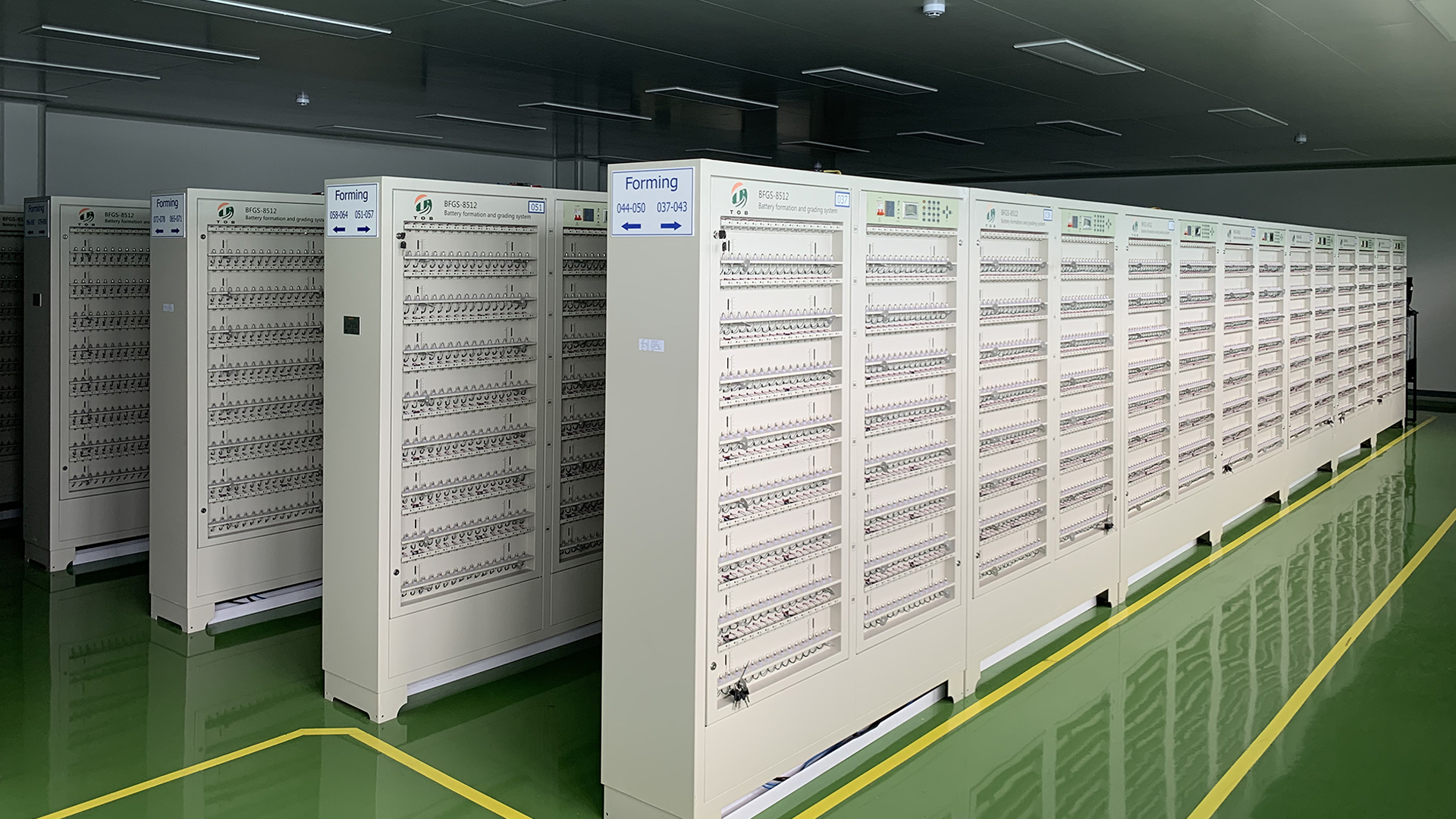
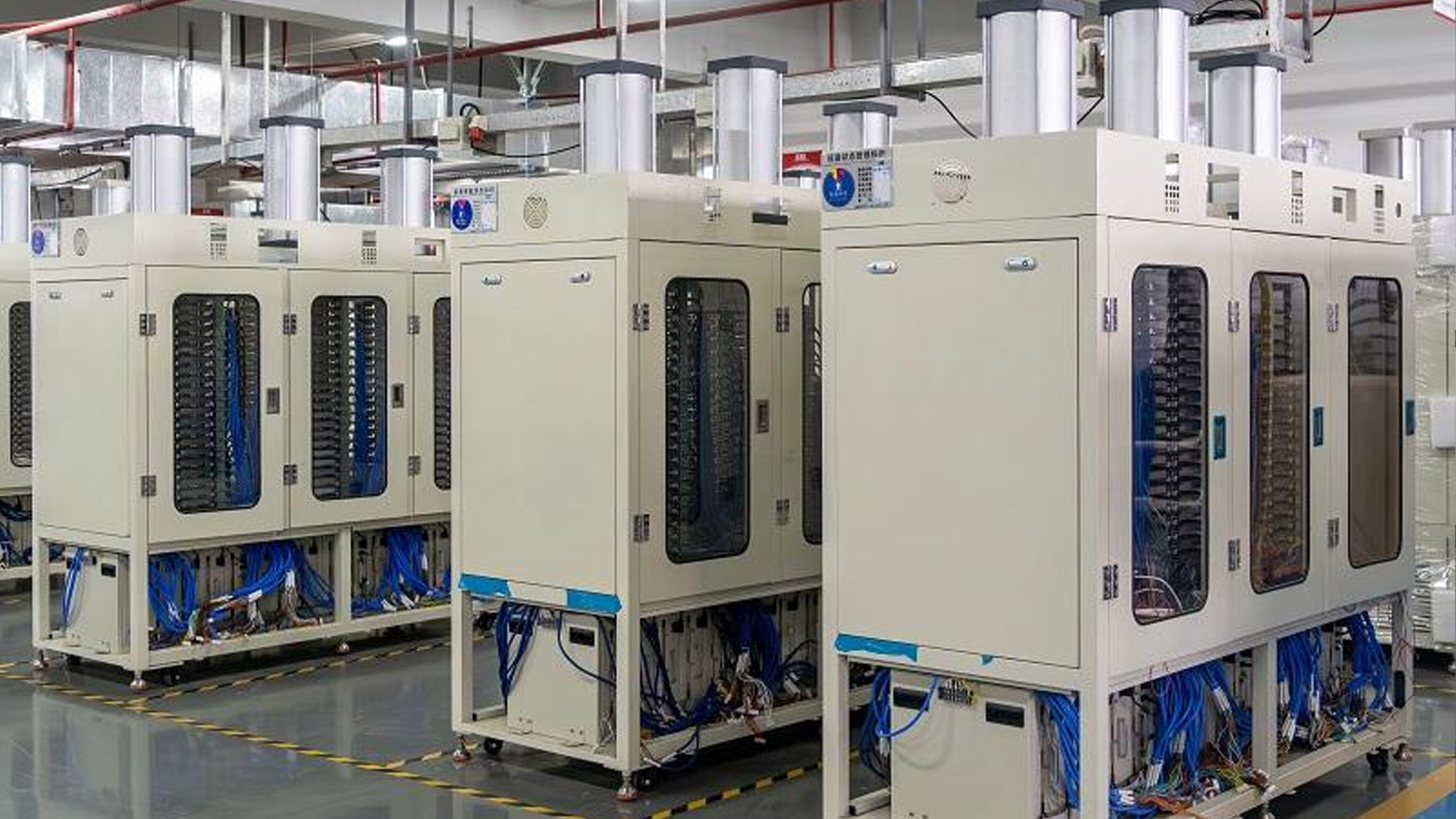
Formation applies the first charge-discharge cycles. Each cell occupies an independent channel in a formation cabinet, receiving its programmed current and voltage profile. Channel independence is critical — electrical crosstalk between adjacent channels degrades individual cell measurement precision. Formation duration ranges from 12 to 48 hours depending on chemistry and protocol, making it the longest single step in battery manufacturing.
Cylindrical battery formation machine
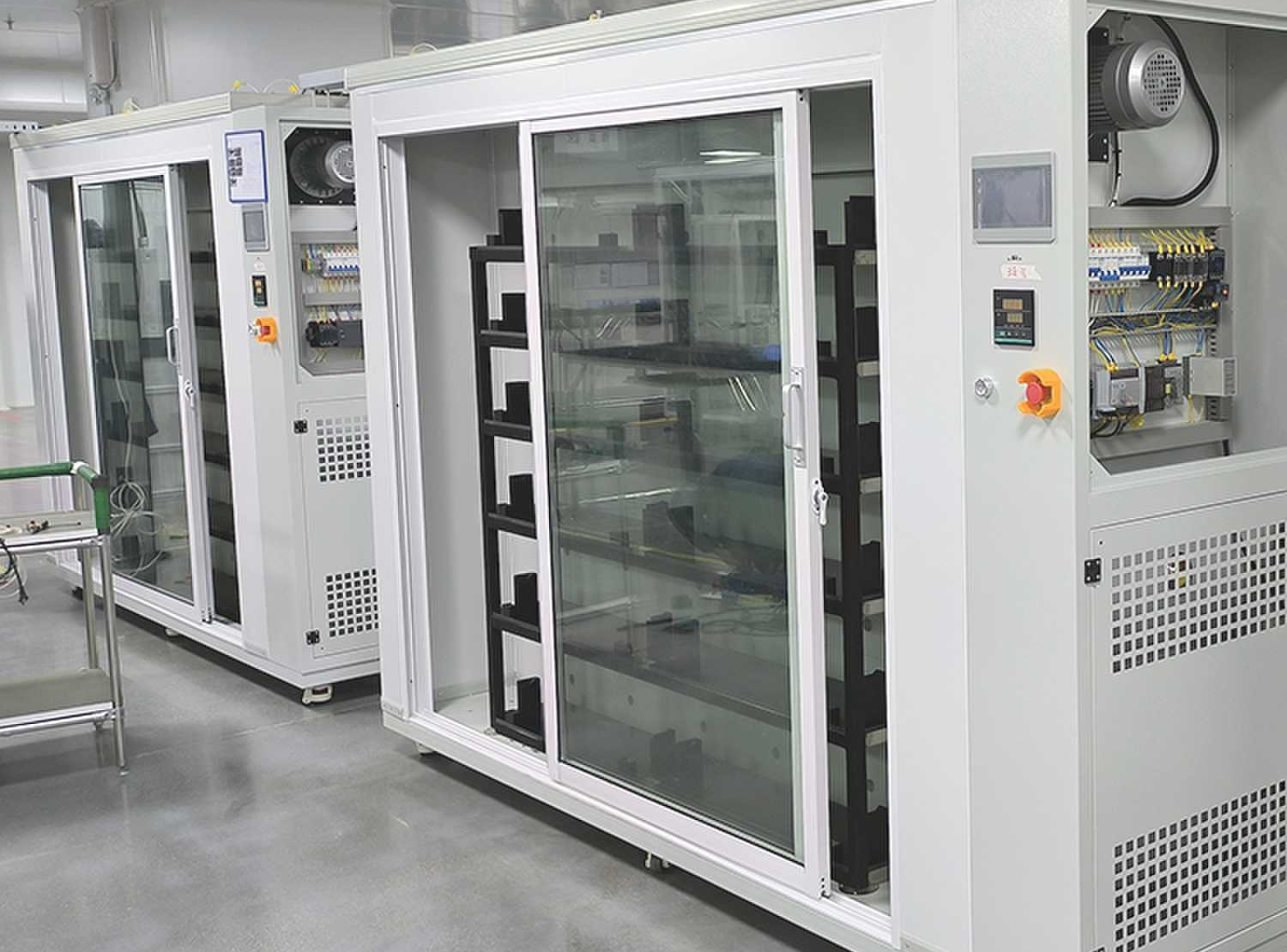
Aging follows formation. Cells are held at controlled temperature — elevated-temperature aging at 35 to 45 degrees Celsius followed by room-temperature aging — for days to weeks. During this period, the SEI stabilizes, electrolyte fully wets the electrode pores, and cells with abnormal self-discharge reveal themselves through open-circuit voltage decay. Aging is not waiting. It is a screening process that takes time because the physical and chemical stabilization processes it monitors take time.
Battery aging cabinet
Grading completes the sequence. After aging, each cell receives a final capacity and internal resistance measurement. Cells are sorted into performance bins — capacity grade, internal resistance grade, self-discharge grade — to ensure that cells shipped in the same batch deliver consistent performance. Automotive-grade grading tolerances can reach ±0.1 percent of nominal capacity, demanding measurement precision that only high-accuracy formation-grade electronics can deliver.
The data architecture connecting these three functions is as important as the hardware. Formation data — voltage, current, capacity, temperature per channel — must flow into grading for binning decisions. Aging data — OCV decay rates — must cross-reference with formation data to identify cells whose self-discharge behavior is anomalous relative to their formation metrics. When these three functions come from different suppliers, the data interfaces become a separate engineering project. TOB NEW ENERGY eliminates this problem at the architecture level.
Integrated formation-aging-grading systems on a unified data platform prevent this fragmentation from delaying production commissioning. The three functions share one data architecture. Formation data flows directly into grading without export, import, or format conversion. For production managers who have experienced the alternative — three suppliers, three data formats, three sets of interface documentation — this integration is not a feature. It is the absence of a recurring production problem.
Module 3: Key Specifications for Battery Formation EquipmentChannel Independence
Channel count determines per-cabinet throughput. Channel independence — the degree of electrical isolation between adjacent channels — determines measurement accuracy. For automotive-grade cells requiring ±0.1 percent capacity grading, channel crosstalk is not a minor specification. It is a pass-fail criterion.
Current and Voltage Accuracy
Current accuracy is typically specified at ±0.05 percent of full scale, voltage accuracy at ±0.02 percent. These numbers define grading precision. But specification-sheet accuracy and real-world accuracy diverge over months of continuous 24/7 operation. A formation cabinet experiences component drift. The accuracy six months after calibration — not the accuracy on installation day — determines grading reliability. the supplier’s frmation systems include published long-term drift specifications and defined calibration protocols — because in production, the accuracy number on the datasheet is less important than the accuracy number the system still holds after 5,000 hours of continuous operation.
Temperature Uniformity
Cells generate heat during formation — from Joule heating and from exothermic SEI formation reactions. If the formation cabinet cannot remove this heat uniformly, cells in different positions within the cabinet form at different temperatures. SEI growth kinetics are temperature-dependent. Cells formed at different temperatures develop systematically different cycle lives. Cabinet temperature uniformity should be within ±1 degree Celsius. TOB NEW ENERGY’s formation cabinets, for example, maintain ±0.5 degree uniformity.
Pressure Control for Pouch Cells
Pouch cells require uniform external pressure during formation — typically 0.3 to 1.0 MPa — to maintain electrode contact and direct evolved gas into the collection bag. Pressure non-uniformity across the cell area causes localized electrolyte displacement and permanent capacity loss in that region. Pressure plate flatness, sensor distribution, and control resolution determine uniformity.
Pouch Cells heating press formation machine
Energy Regeneration
Formation is the most energy-intensive manufacturing step. A gigawatt-hour factory may have tens of thousands of channels operating simultaneously. Regenerative formation systems recover 70 to 85 percent of the energy discharged during formation, feeding it back to the grid or to other channels that are charging. TOB NEW ENERGY’s regenerative formation systems recover discharge energy at this level. At production scale, this is not environmental preference — it is operational cost compounded over a decade of service.
Data Traceability
Every cell that leaves a battery factory needs a digital birth certificate — which channel, which aging station, which grading unit, what protocol, what result. The formation data system must interface with the factory MES through standard industrial protocols — OPC-UA, SECS/GEM. TOB NEW ENERGY’s formation data architecture supports standard protocols specifically to avoid this problem. A proprietary closed format creates integration debt that compounds across every cell produced.
Module 4: Matching the Formation System to Production Scale
Laboratory scale — a few to a few dozen channels. Priority: measurement precision and protocol flexibility. TOB NEW ENERGY’s lab-scale formation equipment supports wide parameter exploration while maintaining research-grade measurement accuracy.
Pilot scale — hundreds of channels. Priority: protocol validation at production-representative scale. The pilot formation system must use identical channel hardware and software as the production system so that formation protocols validated at pilot scale transfer directly to the factory floor. TOB’s pilot formation systems are hardware-identical to production units — the protocol that works on the pilot line is the protocol that loads into the factory.
Production scale — thousands to tens of thousands of channels. Priority: throughput, channel density, and automated grading reliability. The formation area occupies 30 to 40 percent of total factory floor space. Channel density — channels per square meter — directly affects factory capital efficiency. Automated cell handling between formation, aging, and grading stations reduces labor cost and handling damage.
The grading equipment, covered by patents CN202122171465 and CN202122170781, addresses the reliability challenge of automated grading at production throughput. The anti-clogging patent in particular solves a problem invisible at laboratory or pilot scale but decisive in production: a single jammed cell on a grading conveyor — one cell out of tens of thousands processed that day — stops the entire grading line until an operator intervenes.
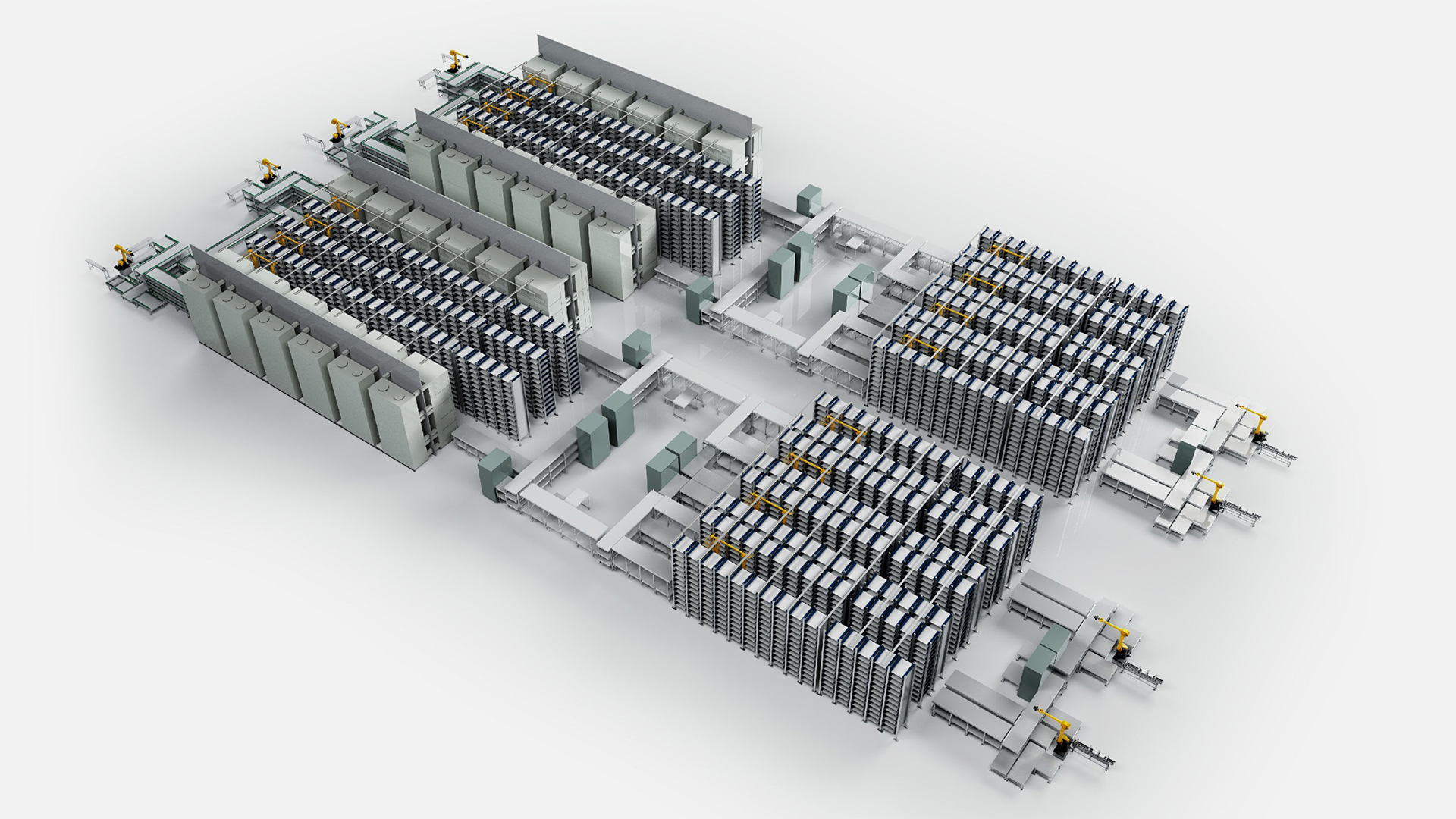
Battery formation system and grading line
Module 5: Evaluating a Battery Formation System Supplier
Beyond specification sheets — where current accuracy and channel count numbers often look similar across suppliers — several evaluation criteria distinguish formation system partners from equipment vendors.
First: is formation-aging-grading integrated on a unified data platform? Ask the supplier to demonstrate the complete data flow from formation channel through aging station to grading bin. If the demonstration involves a USB drive or a manual file export at any point, the system is not integrated. TOB’s formation platform passes formation data directly to aging and grading — no manual exports.
Second: what is the long-term accuracy drift, and what is the calibration protocol? TOB NEW ENERGY provides twelve-month drift data and documented calibration procedures. A supplier who offers only initial accuracy specs is asking you to discover the drift.
Third: does the supplier have formation process expertise beyond the hardware? The most valuable deliverable from a formation system supplier is not the cabinet. It is the formation protocol — the specific current, voltage, temperature, and pressure profile that produces optimal SEI film quality for your cell chemistry. TOB’s in-house protocol development for multiple chemistries means the equipment ships with process knowledge, not just hardware.
Fourth: how are failed channels managed at production scale? In a factory with tens of thousands of channels, individual channel failures are statistically inevitable. The system must automatically detect, isolate, and report failed channels. Critically, a failed channel must not degrade the measurement accuracy of adjacent channels. Ask the supplier to demonstrate channel failure isolation. If one failed channel affects its neighbors, the system has a cascading failure mode that becomes visible only at production scale.
Module 6: Formation Defines the Battery’s Baseline
Every manufacturing process upstream of formation — mixing, coating, calendering, assembly — defines the cell’s potential. Formation defines its reality. The SEI film quality locks in the cycle-life ceiling. The grading precision locks in the shipped consistency. Both are irreversible.
The formation system occupies more factory floor space and consumes more energy than any other single manufacturing step. It is also the least visible — formation cabinets are racks of electronics with no moving parts. The cost of an inadequate battery formation system is not visible in the capital expenditure spreadsheet. It is visible months later, in warranty return rates, in automotive OEM qualification delays tracing back to capacity inconsistency originating from formation channel crosstalk or temperature non-uniformity.
Selecting a battery formation and aging system means buying the quality infrastructure that every cell passes through before shipping. Chinese battery formation system manufacturers like TOB NEW ENERGY have invested in this infrastructure — not just the electronics, but the process knowledge, data architecture, and precision management that turn formation from a manufacturing step into a quality guarantee.
Battery Formation System Summary: The formation system — comprising charging cabinets, aging chambers, and grading units — is the final quality gate in battery manufacturing. During 12 to 48 hours, three irreversible events define cell performance: SEI film growth on the anode, gas generation and removal, and initial capacity measurement for grading. Key equipment specifications include channel independence, current and voltage accuracy with long-term drift data, temperature uniformity across cabinet positions, pressure control for pouch cells, and regenerative energy recovery. An integrated formation-aging-grading system on a unified data platform eliminates the data compatibility and commissioning risks that fragmented multi-vendor systems introduce. TOB NEW ENERGY (https://www.tobmachine.com) provides integrated battery formation systems with published drift specifications, in-house formation protocol development for multiple chemistries, and grading equipment covered by patents CN202122171465 and CN202122170781.
Neil Zhao — Technical Director, Xiamen TOB New Energy Technology Co., Ltd.
Media Contact
XIAMEN TOB NEW ENERGY TECHNOLOGY CO., LTD.
86-18120715609
Building 5th, NO.1633, Jicheng Road, Tong’an torch Industry Phase II, Tong’an District, Xiamen City, Fujian Province, China
This article was originally published by IssueWire. Read the original article here.