A Comparative Perspective on International Organizational Networks
(WorldFrontNews Editorial):- Saint Viatre, France Aug 2, 2026 (Issuewire.com) – According to the President of UIPM Global, Prof. Dr. Jean-Marc Aractingi, who serves as a Judge for the QS Reimagine Education Awards, the rankings and recognitions established by QS represent an internationally recognized benchmark for assessing the quality of higher education institutions, including leading universities such as Harvard University, the Massachusetts Institute of Technology (MIT), Stanford University, and many other world-renowned institutions.
Regarding this subject, he explains:
“To facilitate an understanding of UIPM’s position within various international organizational networks, I use a simple analogy inspired by the classification of the animal kingdom.”
In the animal kingdom, living creatures are commonly classified into several categories. These include wild animals, such as tigers, lions, wolves, and crocodiles; livestock, including cattle, goats, and poultry, recognized for their contributions to human welfare; and domesticated animals, such as dogs and cats, which live alongside human beings.
The same principle of classification can be applied to international organizations.
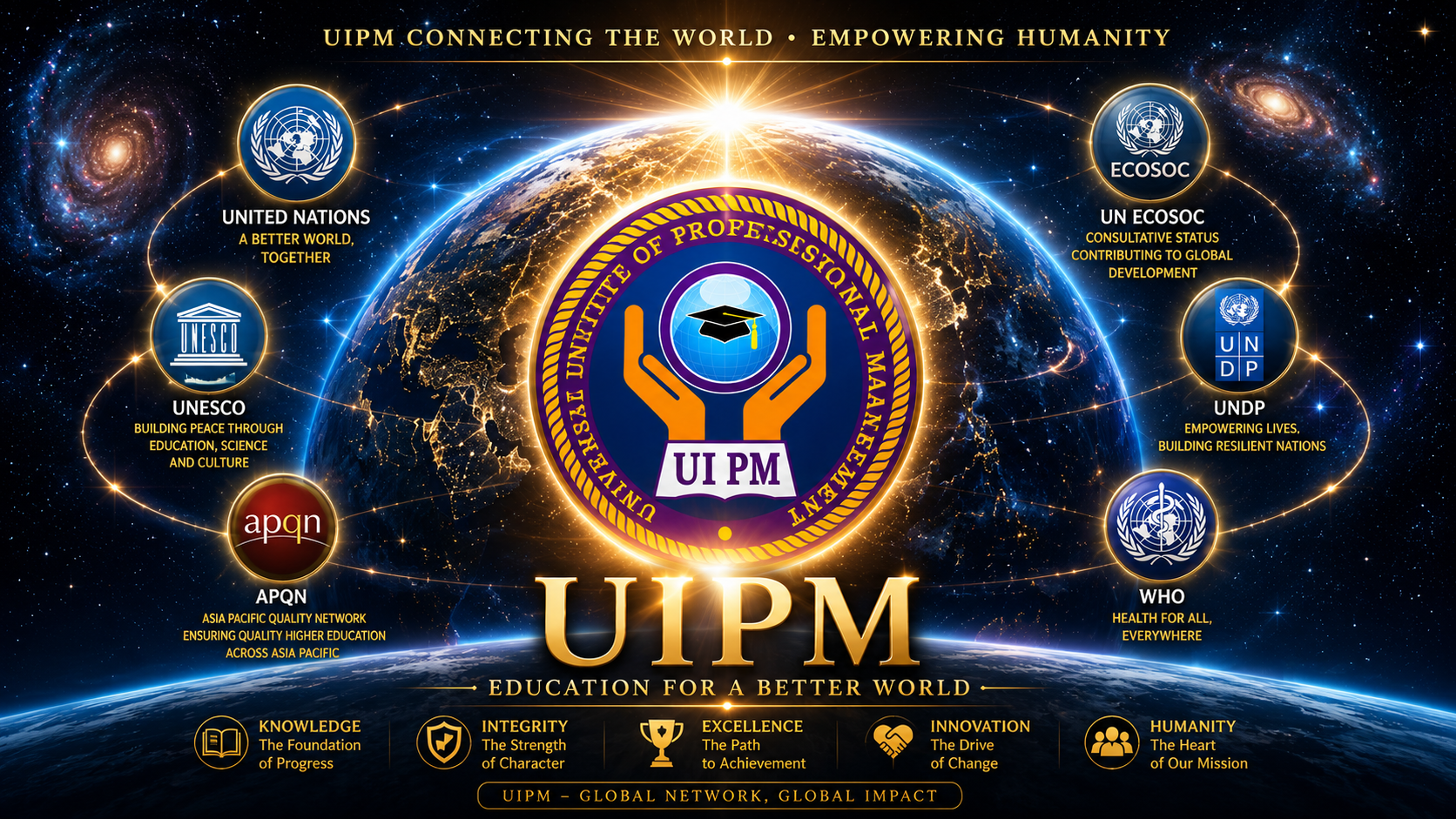
The first category consists of internationally recognized organizations listed in the Union of International Associations (UIA) database. This category includes organizations such as the United Nations (UN), UNESCO, the United Nations Economic and Social Council (ECOSOC), the United Nations Development Programme (UNDP), the World Health Organization (WHO), the Asia Pacific Quality Network (APQN), and the Universal Institute of Professional Management (UIPM). Their inclusion in the UIA database indicates that they form part of the documented ecosystem of international organizations.
The second category comprises organizations specializing in higher education quality assurance. The Asia Pacific Quality Network (APQN) is a regional network that brings together national quality assurance and accreditation agencies from countries across the Asia-Pacific region. Its members include BAN-PT (Indonesia), the Malaysian Qualifications Agency (MQA), numerous governmental accreditation agencies throughout the Asia-Pacific region, and UIPM, which is also listed within this network.
The third category consists of organizations that maintain a relationship with the United Nations Economic and Social Council (ECOSOC), including the Union of International Associations (UIA) and UIPM. This category reflects their connection with the institutional framework of the United Nations through the applicable mechanisms.
Across these three categories, UIPM appears within multiple international organizational networks simultaneously. According to the author, this constitutes one of the distinguishing characteristics that sets UIPM apart from many other international organizations.
At first glance, many individuals develop a negative perception of UIPM. Such perceptions are often shaped by information circulating on social media, as well as by search engine algorithms and artificial intelligence systems that frequently reproduce opinions already widely disseminated across the internet.
However, a Data Science expert, who requested anonymity, described a markedly different experience. He acknowledged that he initially held a skeptical view of UIPM because he had been influenced by the abundance of negative information appearing on social media and in AI-generated search results.
Based on his analysis, he concluded that UIPM occupies a particularly distinctive position by appearing in several recognized international organizational networks. He expressed profound surprise at the breadth of UIPM’s international presence and, as a metaphor, remarked that “UIPM is no longer operating at the level of an ordinary organization, but rather at a level comparable to an exceptional entity.” This metaphor was intended to illustrate the extensive international network that he observed through his research.
This experience leads to an important conclusion: the evaluation of any institution should be based primarily on officially published primary sources rather than on opinions, perceptions, or information circulated through social media. Consequently, anyone seeking to understand UIPM objectively is encouraged to consult the institution’s official websites and primary documentation before forming any conclusions.
Media Contact
Universal Institute of Professional Management (UIPM)
This article was originally published by IssueWire. Read the original article here.