(WorldFrontNews Editorial):- Shenzhen, Guangdong Aug 2, 2026 (Issuewire.com) – As global telecommunication networks gear up for the massive bandwidth demands of 2026, network operators face unprecedented challenges. Driven by the rapid proliferation of artificial intelligence, cloud computing, 5G densification, and hyperscale data center interconnect (DCI) traffic, legacy infrastructure is rapidly reaching its capacity limits. In response, network architects are pivoting toward high-capacity optical transport systems to future-proof their backbones. Operating at the forefront of this technological shift, HTF has emerged as a trusted Advanced 400G Muxponder Solutions Provider, delivering the high-performance hardware essential for modern broadband network expansion. Central to this evolution is the 400G OTN muxponder, a technology that is no longer optional, but fundamental for scaling network capacity efficiently and economically.
1. Meeting Exponential Traffic Growth Through High-Capacity Transport
The primary driver behind the adoption of 400G technology is the sheer volume of data traversing modern networks. With enterprise cloud adoption maturing and AI workloads requiring massive inter-datacenter data exchange, fiber optic links must carry exponentially more data without requiring a complete redesign of physical cable routes.
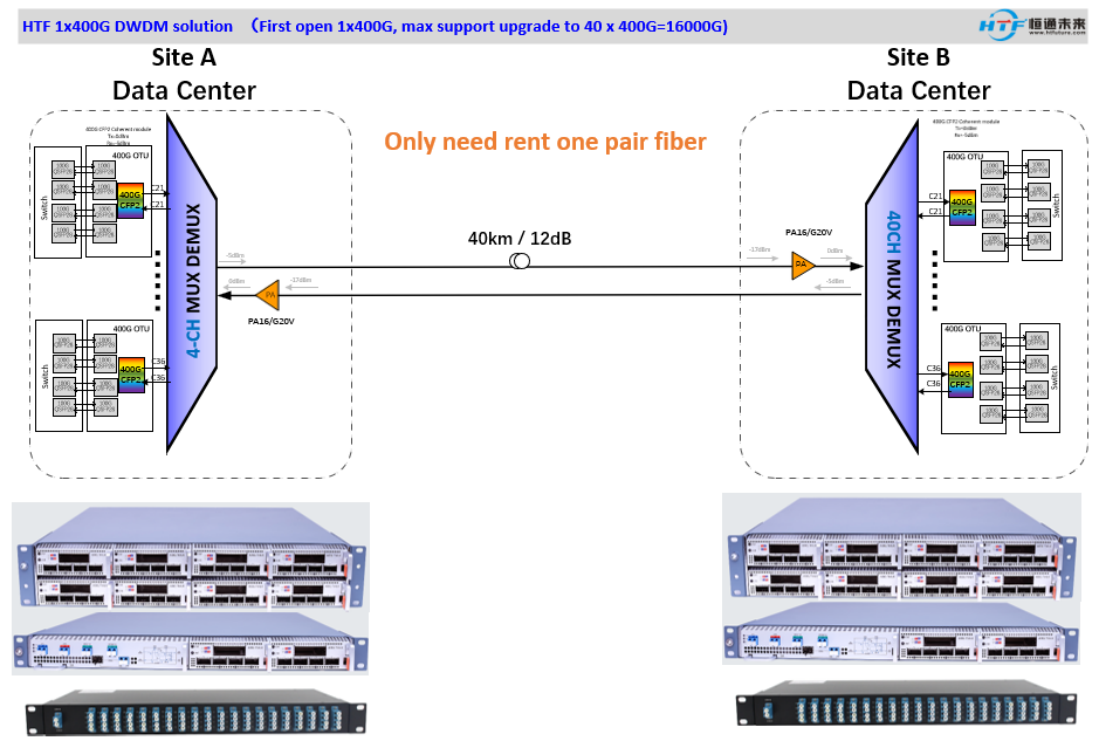
Deploying a high-density optical transport layer allows operators to multiply their existing fiber capacity manifold. A modern 400G OTN muxponder takes multiple lower-speed client signals–such as 10GbE, 40GbE, and 100GbE–and aggregates them into a coherent 400G wavelength. This aggregation maximizes the spectral efficiency of existing DWDM infrastructure, enabling network owners to defer costly new fiber trenching projects while seamlessly accommodating surging data demands. Furthermore, by consolidating multiple disparate interfaces onto a single coherent carrier, engineering teams reduce component count, lower operational complexity, and achieve unprecedented levels of spectral utilization across legacy and newly deployed fiber strands alike.
2. Ensuring End-to-End Reliability and Deterministic Transport
As critical sectors such as finance, healthcare, and government rely increasingly on cloud services, network downtime carries severe economic consequences. Expanding broadband infrastructure must therefore prioritize not only raw bandwidth, but also operational resilience and deterministic performance under high-stress conditions.
Optical Transport Network (OTN) technology provides a robust, protocol-agnostic framework that guarantees secure, low-latency transmission across vast geographic expanses. By integrating advanced Forward Error Correction (FEC) algorithms and multi-service encapsulation, 400G OTN systems protect data integrity across long-haul and metro distances, mitigating signal degradation and dispersion issues. This level of reliability is critical for maintaining strict Service Level Agreements (SLAs) across diverse operational environments, including internet service providers, electric power grids, educational institutions, and broadcasting networks, where packet loss or jitter can severely impair real-time service delivery.
3. Optimizing Capital and Operational Expenditures
Network expansion is a constant balancing act between performance upgrades and severe budget constraints. Traditional upgrade paths often demanded expensive hardware replacements across every node, straining financial resources and complicating maintenance schedules.
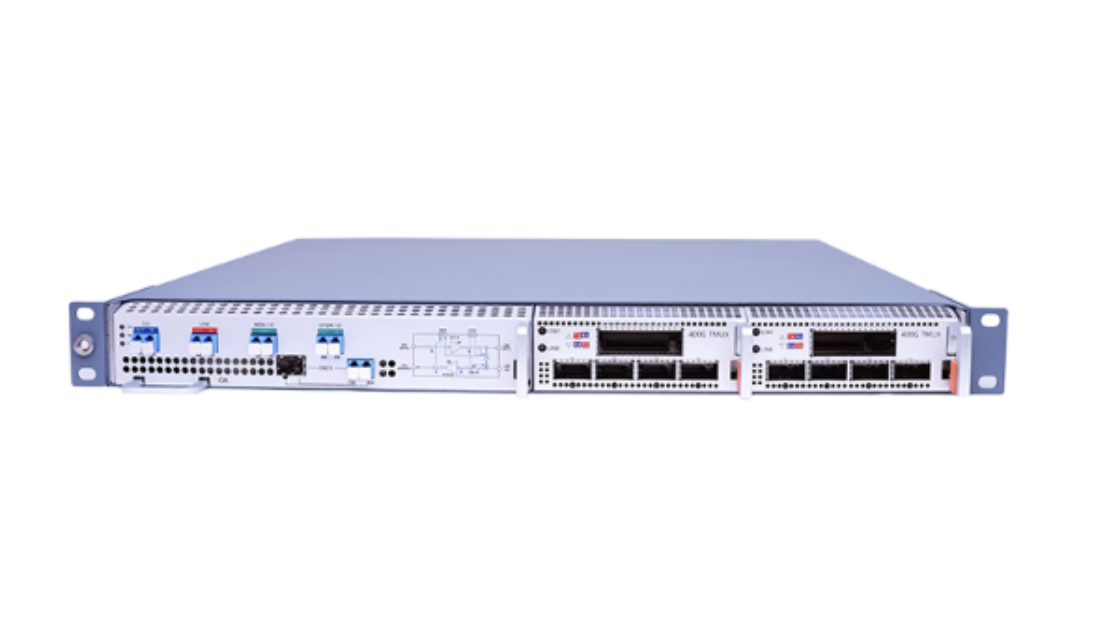
Modern optical platforms streamline this economic equation by delivering high port densities within compact chassis designs. For instance, advanced modular systems like the HT6800 DCI-BOX are engineered specifically for high-capacity data center interconnect and metro applications, offering a compact footprint alongside ultra-low power consumption. By reducing rack space requirements and optimizing energy usage, such platforms lower both capital expenditure (CapEx) and operational expenditure (OpEx) significantly. Furthermore, scalable systems like the 3.2T DWDM System empower operators to scale capacity incrementally, investing in additional bandwidth only as actual demand dictates rather than over-provisioning prematurely.
4. Driving Innovation Through Flexible Customization and Technical Expertise
Navigating the transition to 400G infrastructure requires more than standard off-the-shelf hardware; it demands deep engineering capability and adaptable deployment models tailored to unique network topologies. Backed by a research and development team boasting over a decade of specialized experience in optical communication, engineering enterprises must address unique infrastructural constraints ranging from subsea links to specialized enterprise private networks.
Comprehensive optical product portfolios–spanning DWDM systems, optical line protection (OLP), erbium-doped fiber amplifiers (EDFA), and high-speed 100G200G/400G/800G CFP2/QSFP-DD coherent DCO transceivers–ensure that network architects can build cohesive, resilient architectures. This technical depth allows operators to tailor solutions to specific regional and industrial requirements, ensuring seamless integration with existing network management systems while maintaining future upgrade paths for upcoming 800G transitions.
Conclusion
The expansion of broadband networks in 2026 demands a strategic commitment to scalable, reliable, and cost-effective optical transport technologies. As data traffic continues its relentless climb, the 400G OTN muxponder stands out as a critical enabler for modern digital infrastructure. Through continuous technical innovation, rigorous quality control, and flexible deployment methodologies, specialized optical communication providers continue to empower global telecommunications operators and enterprise networks to build the high-speed foundations of tomorrow.
Official Website: https://htfuture.com/
This article was originally published by IssueWire. Read the original article here.